Best No-KYC Crypto Exchanges in 2026 (Trade Anonymously & Safely)
Best No-KYC Crypto Exchanges in 2026 (Trade Anonymously & Safely)
KYC (Know Your Customer) is there to protect users, but it also limits a lot of traders. Not everyone has access to the same platforms, especially if you live in a restricted country or value your privacy.
And when you do find no-KYC options, they’re often unclear, not always legal in every region, or they change their policies without warning. That makes it hard to rely on them long term.
In this guide, we go through the best no-KYC crypto trading options available right now, so you can find what actually works for your situation.
Key Takeaways
- You can trade crypto without KYC on both CEXs and DEXs
- Most no-KYC platforms have withdrawal limits
- CEX = easier to use, DEX = more privacy and control
- The best choice depends on your goal (Liquidity, features, trading pairs)
Quick answer (Best No-KYC Exchanges Right Now)
Based on our testing of no-KYC policies, withdrawal limits, fees, and usability, these are the best options right now:
Our main takeaway: if you are comfortable using a decentralized exchange, Apex Omni is our top pick overall because you keep control over your own funds and avoid many of the risks that come with centralized no-KYC exchanges.
However, if you want the easiest setup and a platform that feels like a normal exchange, BTCC is the best beginner-friendly option.
Quick Picks
- Choose Apex Omni if you want the best long-term no-KYC exchange.
- Choose BTCC if you want the easiest no-KYC exchange to start with.
- Choose AsterDEX if you mainly care about low fees.
- Choose Hyperliquid if you want advanced trading tools and deep liquidity.
- Choose BloFin if you want higher no-KYC withdrawal limits and high leverage.
Short Platform Summary
|
Exchange |
Short Description |
Action |
|
Apex Omni |
Best overall no-KYC DEX for traders who want self-custody, smooth UX, bots, vaults, and real-world asset markets. |
|
|
BTCC |
Best no-KYC CEX for beginners who want a simple platform, longer track record, and access to crypto + traditional markets. |
|
|
AsterDEX |
Best low-fee DEX with 400+ pairs, strong privacy, and a wide range of spot and futures markets. |
|
|
Hyperliquid |
Best advanced DEX for active traders who want deep liquidity, fast execution, vaults, and pro-level tools. |
|
|
BloFin |
Best high-leverage no-KYC CEX with strong futures trading, copy trading, and higher daily withdrawal limits. |
Quick heads up: always check your local laws before using any no-KYC platform. This guide is based on our research and testing, but it is not legal advice.
Who Should Use No-KYC Exchanges?
No-KYC exchanges exist because not every platform is available everywhere. Some countries block certain exchanges, while others don’t. At the same time, platforms themselves differ; some require full verification, while others let you trade with little or no KYC, at least up to a limit.
So it’s not that simple.
That’s why people use no-KYC options. If major exchanges don’t work in your country, this is often the only way to trade. The same goes if you want features that aren’t available locally, like futures or higher leverage.
In short: no-KYC options are for traders who live in restricted countries, need global access, and in some cases, privacy.
At the same time, they’re not unlimited. Most platforms still have limits, especially on withdrawals, block certain regions, or may ask for verification later. And because things change quickly, what works today might not work tomorrow.
Who Should NOT Use a No-KYC Exchange?
If you’re a beginner, this probably isn’t the place to start. Regulated exchanges are easier to use and give you more protection if something goes wrong. With no-KYC platforms, you’re more on your own, and that can lead to mistakes.
No-KYC exchanges also don’t make much sense if you rely on your bank. Most of these platforms don’t support fiat deposits or withdrawals, so moving money in and out becomes more complicated. You’ll usually need to use another platform in between, which adds extra steps.
They’re also not ideal for long-term holding. Keeping funds on a no-KYC centralized exchange comes with risk because rules can change overnight. We’ve seen exchanges go from “no KYC” to mandatory verification very quickly. If that happens while your funds are still on the platform, you may be forced to verify or deal with withdrawal restrictions.
That’s where most of the risk comes from. It’s not that every no-KYC exchange is unsafe, but the environment around them is less stable. Regulations change, platforms adapt, and users are the ones who have to react.
There is one exception, though. Decentralized exchanges are a different story because you control your own funds. There’s no account to freeze and no company holding your assets. That’s why many traders who care about privacy or long-term control prefer using a DEX instead of a centralized no-KYC platform.
In the end, no-KYC exchanges are mostly suited for people who already understand the risks, trade actively, or don’t have access to regulated platforms. For most people, it makes more sense to either use a regulated exchange or go fully on-chain with a decentralized one.
In short:
- Not beginner-friendly
- Doesn’t work with banks (fiat)
- Not ideal for long-term holding
What is a No-KYC Exchange?
KYC stands for Know Your Customer. It’s a set of rules that financial platforms like banks and crypto exchanges have to follow.
In simple terms, it means they need to verify who is using their platform. This helps prevent things like fraud and money laundering.
For you as a user, it usually means uploading an ID or passport. Once verified, the exchange decides what you’re allowed to do on the platform.
For example, your access can depend on:
- where you live
- whether your account is verified
In some countries, you might only be able to trade spot, while futures or leverage trading is restricted. You may also have limits on how much you can withdraw.
A no-KYC exchange skips this process. You can trade without verifying your identity, but this usually comes with limits, such as lower withdrawal caps or restricted features.
Pros & Cons of No-KYC Exchanges
No-KYC exchanges can be very useful, but they’re not perfect. There are clear upsides, and there are trade-offs you need to be aware of.
The biggest advantage is speed. You can start trading almost instantly without going through verification. No waiting, no documents, just connect and go. For a lot of traders, that alone is a huge benefit.
Privacy is another reason people use these platforms. You’re not handing over personal information, which gives you more control over your data.
Of course, there are trade-offs.
These platforms usually come with limits, especially on withdrawals. You can trade, but moving larger amounts off the platform can be restricted unless you verify later.
There’s also more risk depending on the platform. Some exchanges operate in a gray area, and policies can change quickly. What works today might not work the same way in a few months.
And finally, fiat is a problem. Most no-KYC platforms don’t support bank deposits or withdrawals, so you’ll need another exchange to move money in and out.
In short, no-KYC exchanges give you direct access to trading features with any document requirements, but you give up some stability as rules might change anytime.
CEX vs DEX (Which Should You Use?)
This is where it gets interesting. If you want to trade without KYC, you basically have two options:
a centralized exchange (CEX) or a decentralized exchange (DEX).
Both work, but they’re very different.
In simple terms:
CEXs are easier and have more liquidity.
DEXs give you more control and fewer restrictions.
Centralized Exchanges (CEX)
Centralized exchanges are what most people are used to. You create an account, log in, and start trading.
They’re popular because:
- They’re easy to use
- They have high liquidity
- Everything feels smooth and familiar
But there are downsides.
Even if a platform doesn’t require KYC at the start, that can change. Exchanges can update their rules, ask for verification later, or restrict withdrawals. You’re also relying on a company to hold your funds.
In some cases, you may even need a VPN to access certain features depending on your location.
Decentralized Exchanges (DEX)
DEXs work differently. There’s no account. You connect your own wallet (like MetaMask) and trade directly from it.
The big advantage is control. You hold your own funds, there are no withdrawal limits, and no company can freeze your account.
If you’ve never used one before, check out our Apex Omni Tutorial to see exactly how it works step by step.
That’s why DEXs are becoming more popular, especially as regulations tighten around centralized platforms. If you want a full breakdown, explore our guide to the Best Decentralized Exchanges to see which platforms stand out right now.
But it does come with more responsibilities.
You are fully in charge of your wallet. If you connect it to the wrong site or make a mistake, there’s no support team to fix it. You also rely on smart contracts, which can have risks, even though most major platforms are well-tested.
In general, the trend is clear: more traders are moving towards DEXs over time. But both still have their place.
So which one is better for whom?
Beginners should go for a CEX, as it’s just slightly easier to use. But if you have some experience with wallets like MetaMask, using a DEX is pretty similar. Probably the only difference is the liquidity, which at this point is still in favor of a CEX.
Best No-KYC Crypto Exchanges
Let’s start with the easiest options, the centralized exchanges. There are 3 main centralized exchanges that do not require any KYC, have decent liquidity, and have been relatively stable. However, this is by no means any guarantee it will stay like this in the future.
BTCC Exchange
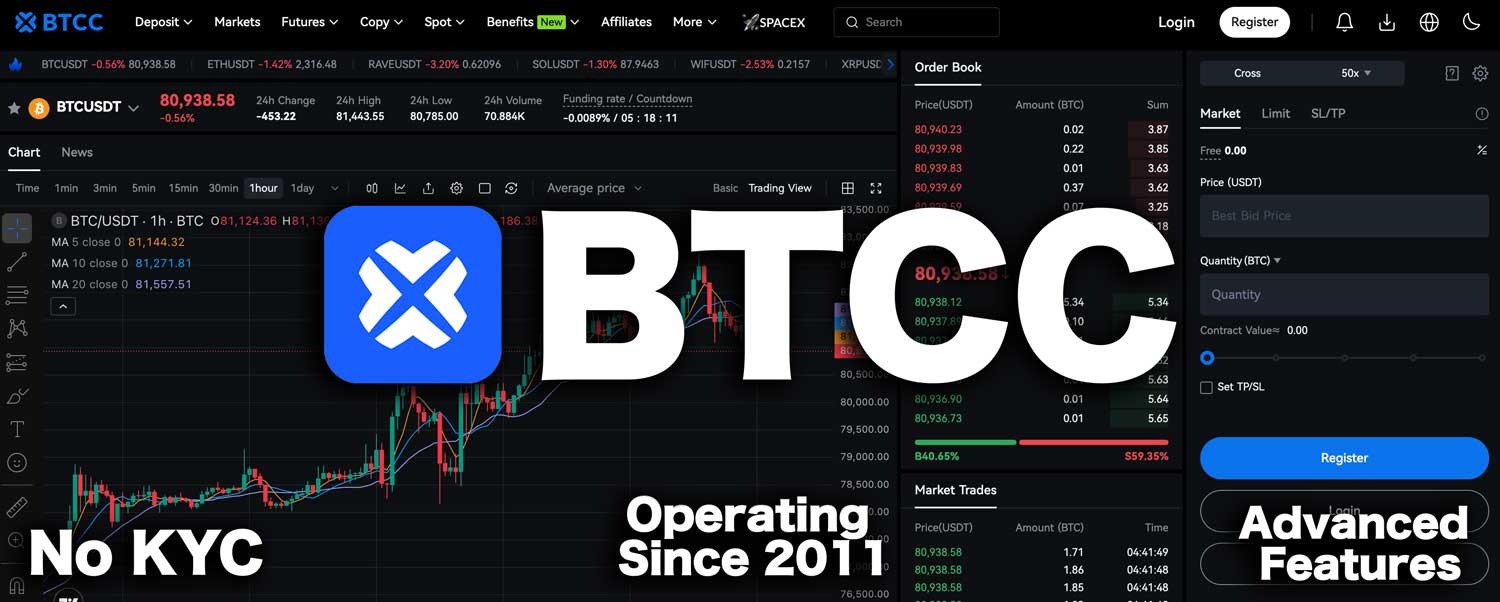
BTCC stands out because it is one of the oldest exchanges still operating without mandatory KYC, offering both crypto trading and access to traditional markets such as stocks, gold, and commodities. This makes it different from most no-KYC platforms, which typically focus only on crypto derivatives. BTCC also offers relatively strong liquidity across major trading pairs, which helps reduce slippage when entering and exiting positions.
Fees: Maker: 0.025% / Taker: 0.045%
Trading pairs: 297
Best for:
- Traders who want high withdrawal limits without KYC
- Users who want access to both crypto and traditional markets
- Beginners looking for a simple and stable trading platform
Not ideal for:
- Users who need fiat withdrawals
- Long-term holders storing large amounts of funds
Without KYC, you can:
- Trade crypto derivatives (futures and perpetuals)
- Use up to 100x leverage
- Withdraw up to $10,000 per day in crypto
- Trade traditional markets like stocks and commodities using crypto
Without KYC, you cannot:
- Withdraw fiat (bank transfers)
- Increase your crypto withdrawal limit
BTCC is one of the most stable no-KYC exchanges available, especially for users who want higher withdrawal limits and access to both crypto and traditional markets. However, users should weigh the limitations around fiat access and long-term regulatory uncertainty.
Start trading on BTCC and access crypto and traditional markets without mandatory KYC.
Note: While BTCC allows no-KYC trading, users should be aware that accounts may be flagged if suspicious activity is detected, regulatory changes can affect availability, and fiat withdrawals are not possible without completing verification.
If you want to get started with BTCC and maximize your rewards, you can follow our BTCC deposit bonus guide, where we explain how to unlock available bonuses and reduce your trading costs.
BloFin Exchange
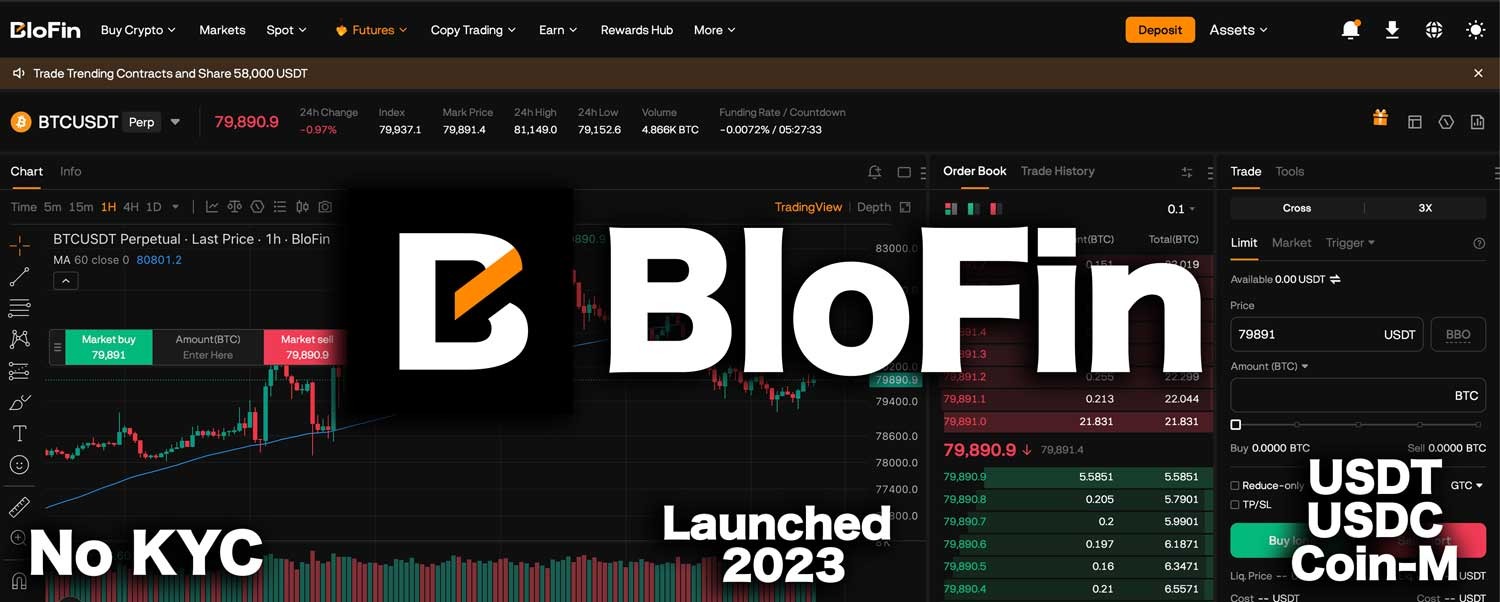
BloFin has quickly become one of the fastest-growing no-KYC futures exchanges, especially among traders looking for high leverage, flexible margin systems, and a modern trading interface. The exchange supports USDT-, USDC-, and Coin-margined futures contracts while allowing crypto withdrawals of up to $20,000 per day without mandatory KYC.
Compared to many smaller no-KYC exchanges, BloFin stands out for its strong liquidity, copy trading features, and beginner-friendly platform. It also offers selected stock-based trading contracts, although its traditional market offering is more limited than exchanges like BTCC.
Fees: Maker: 0.02% / Taker: 0.06%
Trading pairs: 400+
Max leverage: 150x
Best for:
- High-leverage futures trading without KYC
- Traders want flexible margin systems
- Users looking for higher no-KYC withdrawal limits
Not ideal for:
- Users in restricted countries without VPN access
- Traders wanting full commodities and TradFi exposure
- Fiat withdrawals
Without KYC, you can:
- Trade perpetual futures
- Use up to 150x leverage
- Withdraw up to $20,000 daily in crypto
- Access copy trading features
Start trading on BloFin if you want a modern no-KYC exchange with strong liquidity and high withdrawal limits.
If you want to maximize your rewards, check out our BloFin deposit bonus guide where we explain how to unlock bonuses of up to 5,000 USDT and reduce trading costs.
BTCC vs BloFin (Quick Comparison)
|
Feature |
BTCC |
BloFin |
|
Track record |
Longer track record (more established) |
Newer platform |
|
Trading fees |
Lower fees |
Slightly higher fees |
|
Markets available |
Crypto + stocks, commodities, gold, silver |
Mainly crypto (Some stocks) |
|
Withdrawal limits |
Lower limits ($10k per day) |
Higher withdrawal limits ($20k per day) |
|
Leverage |
Standard leverage (100x) |
Higher leverage options (!50x) |
In short: BTCC is a slightly better option because it has a longer track record and lower fees. However, BloFin offers bigger withdrawal limits and higher leverage. But to be fair, 150x leverage most traders will not even use as it comes with significant risks.
Tip: You could consider in spreading your trades across multiple platforms; in that case, you can increase your withdrawal limits and risks by using multiple platforms.
These are the best no-KYC centralized exchanges right now. But rules can change quickly. That’s why more traders are moving to decentralized exchanges. Let’s have a look at them.
Apex Omni Exchange
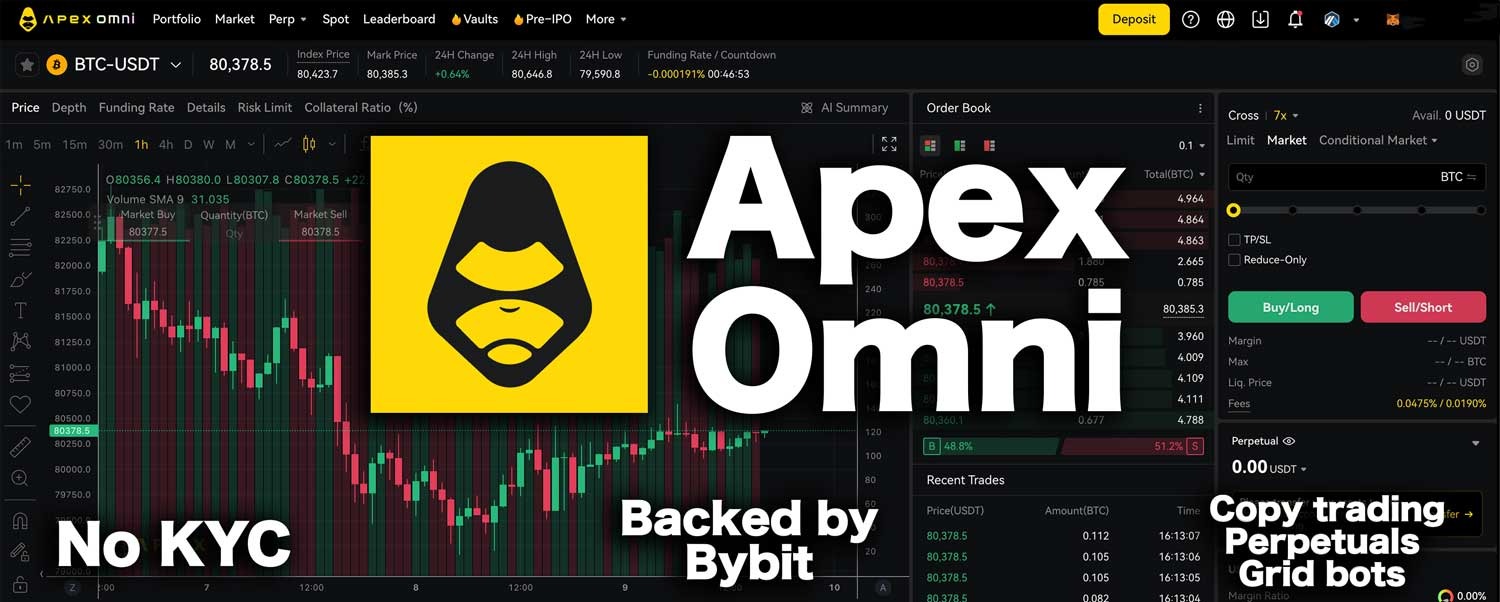
Apex Omni is one of the best decentralized exchanges right now, backed by the team behind Bybit. Instead of creating an account, you simply connect your wallet, deposit funds, and start trading instantly. If you’ve never used a DEX before, check out our Apex Omni tutorial for a full step-by-step guide.
What makes Apex Omni stand out is how close it feels to a centralized exchange. You get access to advanced features like grid bots and copy trading, while still keeping full control over your funds. On top of that, Apex Omni offers more than just crypto trading. Alongside around 100 trading pairs, you can also trade spot markets, prediction markets, and even real-world assets like stocks, gold, and commodities.
Fees: Maker: 0.02% / Taker: 0.05%
Trading pairs: ~100
Best for:
- Traders who want full control over their funds (self-custody)
- Users who want to trade without any KYC or restrictions
- Traders looking for advanced features like copy trading and bots on a DEX
Not ideal for:
- Complete beginners unfamiliar with wallets
- Users who want fiat deposits or withdrawals
- Traders who prefer a fully managed, centralized experience
Without KYC, you can:
- Trade crypto, spot, and real-world assets
- Use leverage trading
- Access copy trading (Vaults) and grid bots
- Withdraw funds freely without limits
Apex Omni is one of the most complete decentralized exchanges available today. It combines the user experience of a centralized platform with the benefits of self-custody, making it a strong option for traders who want more control and fewer restrictions.
Start trading on Apex Omni and get 5% lifetime discount on your fees
Note: Because Apex Omni is a decentralized exchange, you are fully responsible for your wallet security. Always double-check websites before connecting your wallet and never share your private keys.
Aster DEX Exchange
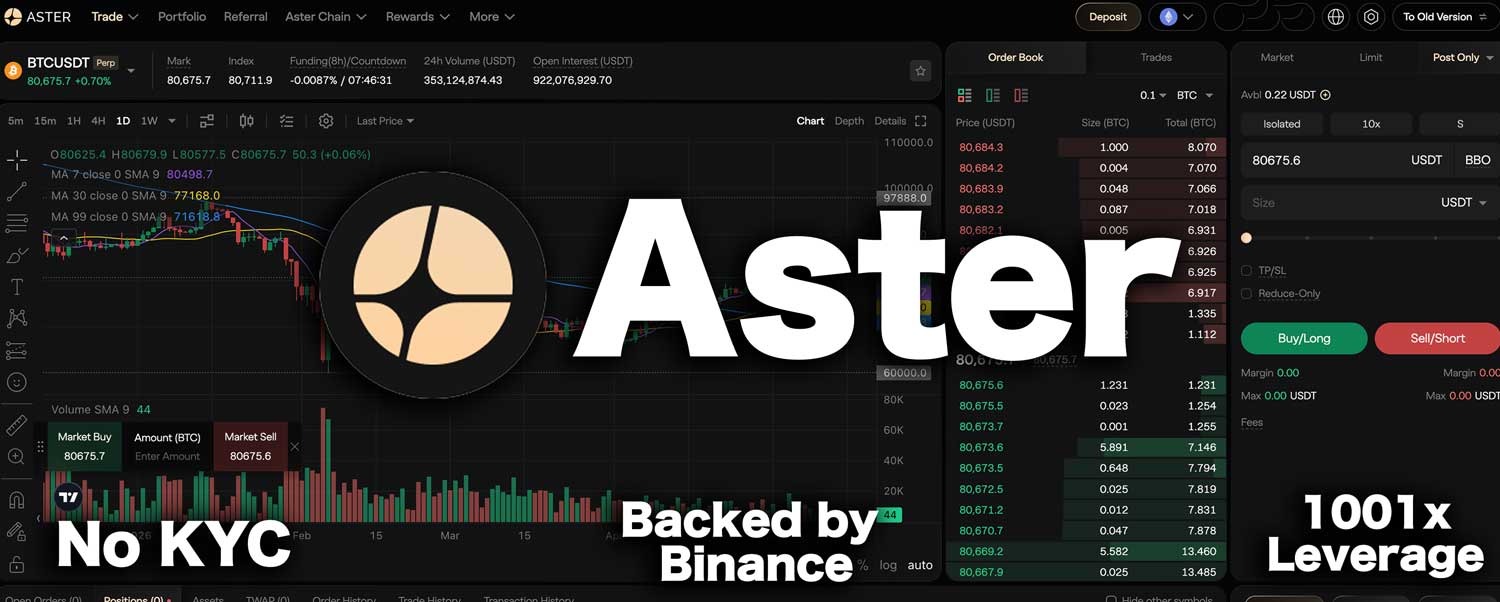
AsterDEX is a decentralized exchange backed by Binance, designed for traders who want access to a wide range of markets without going through KYC. Instead of creating an account, you connect your wallet and start trading directly, giving you full control over your funds.
What makes AsterDEX stand out is the combination of high liquidity, a large number of trading pairs (400+), and advanced trading features. It supports both spot and perpetual futures trading, making it one of the more complete DEX options available right now.
A unique feature is the Shield function. This acts as an extra layer of protection during trading. In simple terms, it helps limit unexpected losses caused by extreme volatility or liquidation events, making trading slightly more controlled compared to standard DEX environments.
If you want a full walkthrough, check out our AsterDEX tutorial to see exactly how to set everything up.
Fees: Maker: 0.01% / Taker: 0.035%
Trading pairs: 400+
Best for:
- Traders who want a large selection of trading pairs
- Users who want low fees on a decentralized exchange
- Traders looking for both spot and futures markets without KYC
Not ideal for:
- Complete beginners unfamiliar with wallets
- Users who need fiat deposits or withdrawals
- Traders who want a fully managed platform with support
Without KYC, you can:
- Trade spot and perpetual futures
- Access 400+ trading pairs
- Use leverage trading
- Keep full control over your funds (self-custody)
AsterDEX is one of the more advanced decentralized exchanges, especially for traders who want low fees and a wide range of markets. Combined with features like the Shield function, it offers more control compared to typical DEX platforms, while still keeping the benefits of self-custody.
Start trading on AsterDEX and get 2% discount on your fees
Note: As with any DEX, you are responsible for your wallet security. Always double-check links before connecting your wallet and never share your private keys.
HyperLiquid Exchange
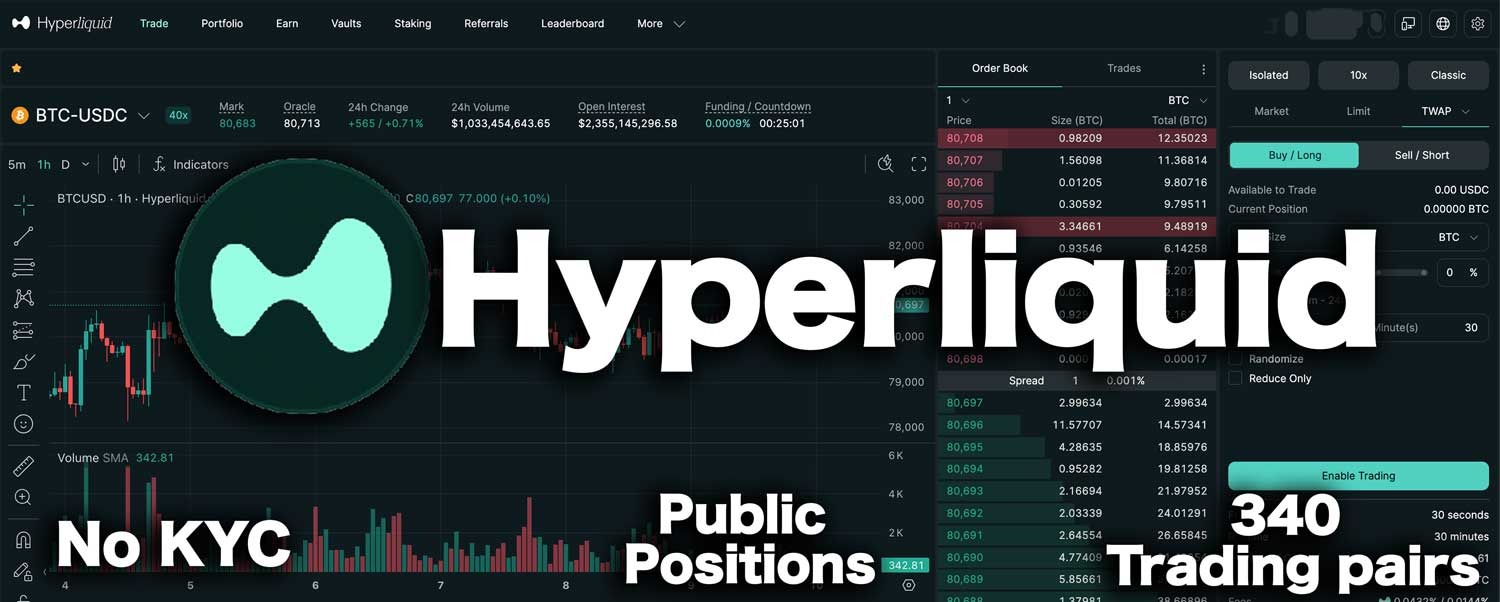
Hyperliquid Exchange
Hyperliquid is one of the most advanced decentralized exchanges right now, known for its deep liquidity and smooth trading experience. Unlike many DEXs, it feels very close to a centralized exchange, with fast execution and a clean interface.
The platform focuses mainly on perpetual futures trading, offering around 340 trading pairs with strong liquidity across major markets. This makes it a solid option for active traders who care about execution and low slippage.
One thing to be aware of is that positions on Hyperliquid are public, meaning other traders can see open positions. This reduces privacy compared to some other DEXs, but it also allows for transparency and features like copy trading.
Hyperliquid also supports Vaults, where you can either copy other traders or create your own strategy for others to follow. On top of that, there are staking options available, adding another layer of passive income opportunities.
If you want a full walkthrough, check out our Hyperliquid tutorial to see exactly how to set everything up.
Fees: Maker: 0.015% / Taker: 0.045%
Trading pairs: 340+
Max leverage: 40x
Best for:
- Active traders who want high liquidity on a DEX
- Users looking for copy trading (Vaults) and passive income
- Traders who want a fast, CEX-like experience without KYC
Not ideal for:
- Users who want full privacy (positions are public)
- Traders looking for spot or traditional markets
- Complete beginners unfamiliar with wallets
Without KYC, you can:
- Trade perpetual futures
- Use up to 40x leverage
- Access Vaults (copy trading or create your own)
- Stake assets for additional yield
- Withdraw funds freely without limits
Hyperliquid is one of the most liquid decentralized exchanges available today. It’s especially strong for traders who want a fast, professional trading environment without giving up control over their funds. However, the lack of privacy due to public positions is something to consider.
Start trading on Hyperliquid and get 4% discount on your fees
Note: Because Hyperliquid is a decentralized exchange, you are fully responsible for your wallet security. Always double-check websites before connecting your wallet and never share your private keys.
Apex Omni vs AsterDEX vs Hyperliquid
|
DEX |
Best Feature |
Difficulty |
|
Apex Omni |
Best overall features & smooth experience |
Easy |
|
AsterDEX |
Lower fees & more privacy |
Easy |
|
Hyperliquid |
Advanced trading tools & liquidity |
Medium |
Apex Omni is currently one of the best decentralized exchanges for most traders because it offers an experience that feels very close to a centralized exchange while still allowing users to keep custody of their funds. The platform includes features like copy trading, grid trading, real-world asset trading, prediction markets, and perpetual futures, all inside a smooth and beginner-friendly interface.
AsterDEX comes next, thanks to its lower fees and stronger privacy options, making it attractive for traders who prefer a lightweight and more private trading experience.
Hyperliquid is still a very strong platform, especially for advanced traders looking for deep liquidity and professional trading tools, though the interface can feel more advanced and slightly less privacy-focused compared to other DEXs.
How to Trade Crypto Without KYC (Step-by-Step)
There are two main ways to trade without KYC, using a centralized exchange (CEX) or a decentralized exchange (DEX).
Centralized Exchange (CEX)
This is the easiest way to get started.
Step 1: Choose an exchange (e.g. BTCC or BloFin)
Step 2: Click “Sign up” (only email + password needed)
Step 3: Deposit crypto into your account
Step 4: Transfer funds to your trading account (e.g. futures/perpetual)
Step 5: Open your first trade
Decentralized Exchange (DEX)
A DEX works differently. Instead of creating an account, you connect your wallet.
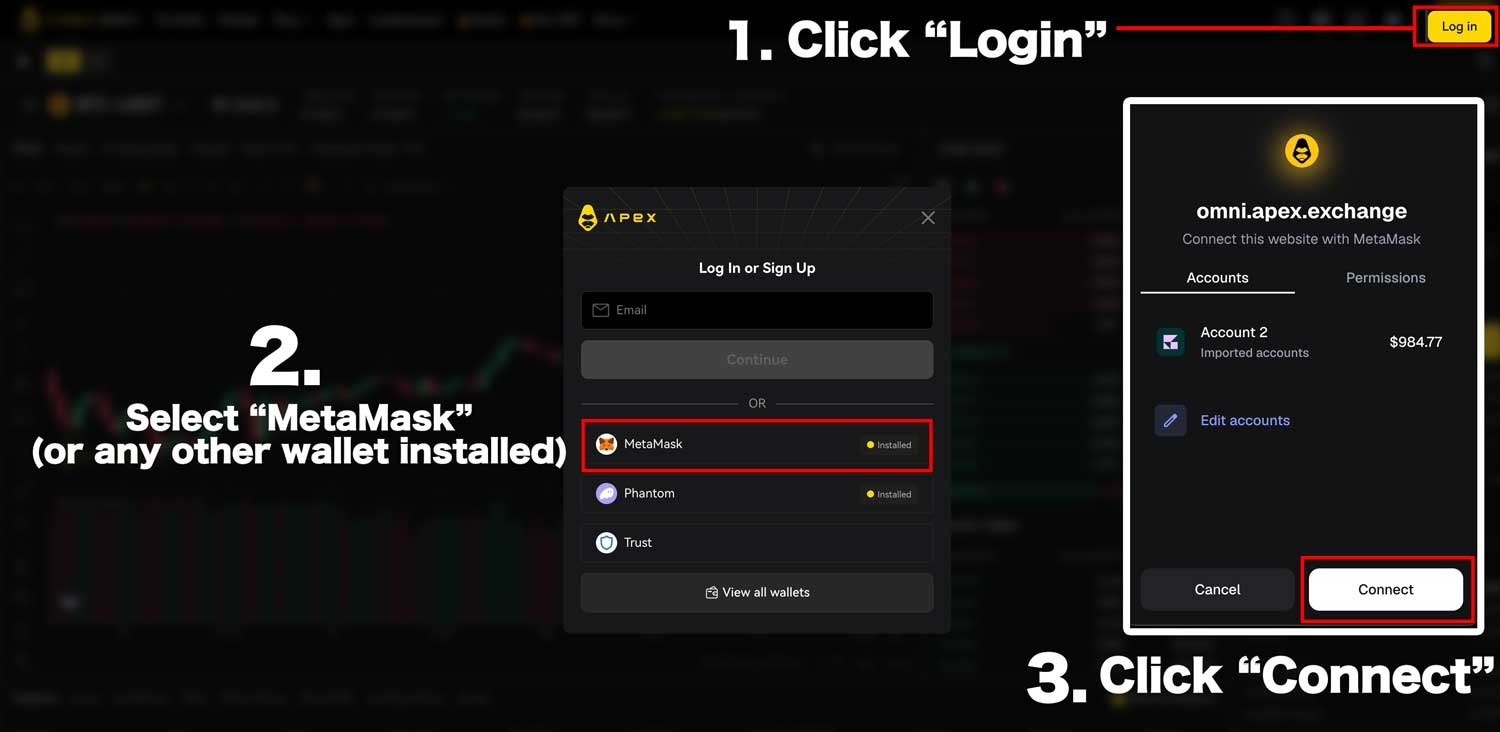
Step 1: Download MetaMask (or another wallet) and create a wallet
Step 2: Visit a DEX (e.g. Apex Omni official website)
Step 3: Click “Login”
Step 4: Select your wallet (MetaMask, etc.)
Step 5: Approve/sign the connection
Step 6: Deposit funds into the platform
Step 7: Start trading
Important Note: If you don’t have a wallet like MetaMask, some DEXs allow you to sign up with an email. They will create a wallet for you in the background. However, it’s usually better to use your own wallet, you stay in full control of your funds and security.
No-KYC Exchange Comparison (Fees, Limits & Features)
Now, let’s compare the basics of these no-KYC exchanges.
|
Exchange |
Type |
Fees (Maker / Taker) |
Trading Pairs |
Max Leverage |
|
BTCC |
CEX |
0.025% / 0.045% |
297 |
100x |
|
BloFin |
CEX |
0.02% / 0.06% |
400+ |
150x |
|
Apex Omni |
DEX |
0.02% / 0.05% |
100 |
100x* |
|
AsterDEX |
DEX |
0.01% / 0.035% |
400+ |
1001x* |
|
Hyperliquid |
DEX |
0.015% / 0.045% |
340+ |
40x |
On the surface, these exchanges look quite similar. Most traders won’t use every trading pair, and many avoid leverage above 50x due to the significantly increased risk. However, beyond fees and trading pairs, there are several other important differences we examined.
For example, BTCC has a lower withdrawal limit than BloFin, but it also has a longer track record in the industry. Based on our research, the overall risk of using BTCC appears to be slightly lower than with BloFin, which is also reflected in user feedback and reviews on platforms like Trustpilot.
When it comes to decentralized exchanges, Apex Omni charges slightly higher fees, but it still delivers a very smooth all-around trading experience that feels comparable to Bybit. Apex Omni is also backed by Bybit, which we consider one of the best centralized exchanges based on our research.
Ultimately, the most important question traders should ask themselves is whether they prefer using a centralized or decentralized exchange, as both options come with their own advantages and disadvantages.
No-KYC Exchange Bonuses & Promos
Centralized exchanges are well known for offering large bonuses to attract new traders, and both BTCC and BloFin currently provide competitive welcome campaigns for new users.
BTCC Bonus
BTCC offers one of the largest exchange promotions available, with rewards of up to $30,000 in trading bonuses and fee credits. New users can earn rewards by completing tasks such as registration, KYC verification, making a first deposit, and futures trading.
The bonus structure is especially attractive for active futures traders, while beginners can still unlock smaller rewards with relatively low deposit requirements.
Create your BTCC account today and read our complete BTCC deposit bonus guide to learn how to unlock the available rewards.
BloFin Bonus
BloFin provides up to 5,000 USDT in welcome rewards through a combination of mystery boxes, deposit bonuses, and futures trading campaigns.
The platform offers beginner-friendly rewards during the first 7 days after registration, while higher-volume traders can unlock additional trading bonuses over a 14-day period. BloFin’s bonus structure is slightly more complex than BTCC’s, but it can still provide strong value when used correctly.
Sign up on BloFin today and check out our full BloFin bonus guide to see which rewards are actually worth claiming.
Apex Omni Bonus
Apex Omni does not offer a traditional deposit bonus like centralized exchanges, but users who register through our affiliate link receive a lifetime 5% discount on trading fees.
This can be especially valuable for active traders who prefer decentralized trading while still wanting a smooth user experience comparable to centralized platforms.
AsterDEX Bonus
AsterDEX offers users a 2% lifetime discount on trading fees when signing up through our exclusive affiliate link.
While the discount is smaller compared to some competitors, it still helps reduce long-term trading costs for active users.
Hyperliquid Bonus
Hyperliquid users can receive a 4% lifetime trading fee discount through our unique referral link.
Although Hyperliquid does not currently offer large signup bonuses, the lower trading fees can provide meaningful savings over time, especially for high-frequency traders.
How We Ranked These Exchanges
We reached out to multiple exchanges while researching this guide, and some of them openly told us that the no-KYC model may not last forever. Regulations are becoming clearer worldwide, and the grey area many platforms used to operate in is slowly disappearing.
Because of that, we didn’t want to focus too heavily on centralized exchanges. In our view, many no-KYC CEXs are more of a short- to medium-term solution rather than the long-term answer to privacy-focused trading.
We also compared all the important specifications ourselves, including:
- withdrawal limits
- trading fees
- liquidity
- available markets
- trading features
- leverage options
- overall usability
There are actually quite a few other no-KYC exchanges out there, but many of them suffer from poor liquidity, unreliable withdrawals, low trust, or very limited features. That’s why we decided not to include them in this list.
We also reviewed user feedback on platforms like Trustpilot. To be fair, most crypto exchanges have relatively low ratings overall, which is pretty common in this industry. However, among centralized no-KYC exchanges, BTCC and BloFin were still among the better-rated platforms with a large enough number of reviews to give a more realistic sample of user experiences.
At the same time, it’s important to keep reviews in perspective. Most satisfied users usually don’t rush to leave a review, while users with a bad experience are far more likely to take the time to post complaints. So reviews should never be the only factor when evaluating an exchange.
Another important point: every exchange mentioned in this article has been personally tested by the editor. We didn’t just copy rankings from other websites or compare marketing pages. We actually used the platforms ourselves to evaluate how they work in practice.
After taking everything into consideration, we still believe decentralized exchanges are the safest long-term option for trading without KYC. You keep control over your own funds, there are fewer restrictions, and you’re less exposed to sudden policy changes from centralized companies.
That said, we also understand that many readers simply want the easiest and most practical solution right now. That’s why we included the centralized exchanges that, in our opinion, currently offer the best balance between usability, liquidity, withdrawal flexibility, and overall risk.
Is No-KYC Crypto Trading Legal?
This depends entirely on where you live. In some countries, trading on no-KYC exchanges is allowed, while in others certain platforms or features may be restricted. The rules are also changing quickly, especially in regions like the EU and the United States, where regulators are putting more pressure on crypto exchanges to verify users and comply with stricter financial laws.
That’s why many no-KYC platforms operate in a legal grey area. Some exchanges may still allow access from your region today, but could later introduce restrictions, mandatory verification, or block certain countries altogether. This is one of the main reasons why the no-KYC landscape changes so fast.
It’s also important to understand that trading without KYC does not remove your tax obligations. In most countries, crypto profits are still taxable, regardless of whether you used a centralized exchange, decentralized exchange, or traded anonymously.
In short: no-KYC trading is not automatically illegal, but the legality depends on your local laws, the platform you use, and how regulations evolve over time. Always check what is allowed in your jurisdiction before using any exchange.
Risks of No-KYC Exchanges
No-KYC exchanges can offer more freedom and privacy, but they also come with additional risks compared to regulated platforms. One of the biggest problems is that the space is filled with unreliable exchanges. Some platforms have poor liquidity, delayed withdrawals, weak security, or in the worst cases, turn out to be outright scams.
With centralized no-KYC exchanges, there is always the risk that policies suddenly change. An exchange that allows no-KYC trading today could require mandatory verification tomorrow. In some situations, users may face withdrawal restrictions or temporary account freezes until verification is completed.
Decentralized exchanges remove some of these risks because you keep control over your own funds, but they introduce different risks instead. Since you are fully responsible for your wallet, simple mistakes can become expensive. Connecting to the wrong website, signing a malicious transaction, or losing access to your wallet can permanently result in lost funds. Unlike a centralized exchange, there is usually no support team that can recover your assets.
There are also practical limitations to keep in mind. Many no-KYC platforms have withdrawal limits, restricted regions, or lower liquidity compared to larger regulated exchanges. This may not matter for smaller traders, but it can become important when trading larger amounts. Again, making the option to use a decentralized exchange more favourable.
If you decide to use no-KYC exchanges, risk management becomes extremely important. The biggest mistake traders make is depositing too much money onto an exchange. Honestly, you should not even do this with a fully regulated KYC exchange. At the end of the day, centralized exchanges always introduce a single point of failure, and if something goes wrong, it can affect your funds immediately.
A better approach is to only deposit what you actually need for trading. Since most of these platforms offer leverage, you usually do not need to keep your entire portfolio on the exchange anyway. Many experienced traders prefer to withdraw profits regularly while still keeping a smaller balance available so they can react quickly when trading opportunities appear.
For decentralized exchanges, security works differently. Because you control your own wallet, there is no company holding your funds, but that also means you are fully responsible for your own security. We strongly recommend using a separate wallet specifically for decentralized trading, such as MetaMask. This keeps your long-term holdings separated from the wallet you actively connect to websites and trading platforms.
It’s also very important to be careful with which applications you connect your wallet to. One wrong approval or malicious website can put your funds at risk. Always double-check URLs, avoid random links on social media, and never approve transactions you do not fully understand.
Another thing traders often underestimate is trading fees from smaller platform features. For example, instant reverse trading can be very useful in volatile markets, but these functions are usually executed using market orders. That means you often pay higher taker fees and potentially more slippage if you use them frequently. Small costs like this add up over time, especially for active traders.
Finally, depending on your location, you may need to use a VPN to access certain no-KYC centralized exchanges. Some platforms restrict specific countries or hide certain features based on region. However, users should always understand the potential legal and compliance risks involved before doing this.
In short: no-KYC trading can be done relatively safely, but the key is minimizing exposure, staying in control of your funds, and understanding the additional risks that come with using these platforms.
Summary:
- Never store all your funds on an exchange, even on regulated KYC platforms.
- Only deposit what you actually need for trading.
- Withdraw profits regularly and limit your exposure.
- Use a separate wallet for decentralized exchanges, preferably MetaMask.
- Be very careful which websites and apps you connect your wallet to.
- Always double-check wallet addresses and blockchain networks before sending funds.
- Features like instant reverse trading can increase fees because they use market orders.
- Some no-KYC exchanges may require a VPN depending on your location.
- Decentralized exchanges are generally the safer long-term option because you control your own funds.
Common Mistakes to Avoid
One of the biggest mistakes traders make is assuming that “no-KYC” automatically means unlimited access and unlimited withdrawals. In reality, most no-KYC exchanges still have withdrawal caps, regional restrictions, or may eventually request verification depending on account activity.
Another common mistake is not checking whether the platform is actually available in your country. Some exchanges restrict certain regions, and users only realize this later when features become unavailable or withdrawals get limited.
Traders also regularly lose funds by sending crypto through the wrong blockchain network or copying incorrect wallet addresses. Since crypto transactions are usually irreversible, even a small mistake can permanently result in lost funds.
Finally, many users ignore smaller trading fees, spread costs, or withdrawal limits. These may not seem important at first, but over time they can significantly affect profitability, especially for active traders using leverage or market orders frequently.
Quick Summary
- No-KYC does not mean unlimited withdrawals (unless a decentralized exchange)
- Always check regional restrictions before depositing
- Double-check wallet addresses and blockchain networks
- Pay attention to trading fees, spreads, and withdrawal limits
- Small mistakes in crypto can become expensive very quickly
Final Verdict: What Is the Best No-KYC Exchange in 2026?
After testing the platforms ourselves, comparing liquidity, withdrawal limits, fees, trading features, user feedback, and long-term reliability, one thing became very clear:
The future of no-KYC trading is moving toward decentralized exchanges.
That doesn’t mean centralized no-KYC exchanges are bad. Platforms like BTCC and BloFin still offer a very practical and beginner-friendly way to trade without mandatory verification. They are easier to use, have strong liquidity, and feel more familiar to most traders. For many people, especially beginners, this will still be the easiest way to get started.
But there is also a bigger trend happening in the background.
Regulations around crypto are tightening globally, and many centralized exchanges are slowly moving away from the no-KYC model. We already spoke with several exchanges during our research, and even they admitted that the regulatory grey area is shrinking quickly. That makes centralized no-KYC exchanges feel more like a temporary solution rather than the long-term future of anonymous trading.
That’s why decentralized exchanges stand out the most to us.
Platforms like Apex Omni, AsterDEX, and Hyperliquid allow you to trade while keeping full control over your own funds. There are no withdrawal limits tied to identity verification, no centralized company holding your assets, and generally fewer restrictions overall. In our opinion, this is simply a safer and more sustainable model long term, especially for traders who value privacy and control.
If we had to summarize it very simply:
- Want the easiest experience? → BTCC
- Want the highest leverage and bigger withdrawal limits? → BloFin
- Want the best long-term no-KYC solution overall? → Apex Omni
- Want the lowest fees on a DEX? → AsterDEX
- Want the most advanced DEX trading environment? → Hyperliquid
At the same time, no platform is perfect. Every exchange mentioned in this guide comes with trade-offs, whether that’s regulation risk, withdrawal limits, wallet responsibility, lower privacy, or liquidity differences.
That’s why the most important takeaway is probably this:
No-KYC trading is not about finding a “perfect” exchange. It’s about understanding the risks, minimizing exposure, and choosing the platform that fits your specific situation best.
For most traders looking at the long term, decentralized exchanges are likely the direction the industry is heading. But for users who simply want a fast and easy solution right now, some centralized no-KYC exchanges still offer a practical alternative while they remain available.
Frequently Asked Questions (FAQ)
Can I trade crypto without verification?
Yes, it is still possible to trade crypto without completing KYC verification on certain centralized exchanges (CEXs) and decentralized exchanges (DEXs). However, most no-KYC platforms still apply certain limitations, such as withdrawal caps, restricted regions, or limited features. On decentralized exchanges, you usually only need to connect a wallet like MetaMask to start trading.
Are no-KYC exchanges safe?
Some are relatively safe, while others are extremely risky. This is why choosing the right platform matters. Larger exchanges with strong liquidity and a longer track record are generally safer than unknown platforms with little reputation. Decentralized exchanges also remove some centralized risks because you control your own funds, but they introduce different risks related to wallet security and smart contracts.
In general, no-KYC exchanges can be used relatively safely if you manage risk properly, avoid storing large amounts on exchanges, and use trusted platforms only.
What are the withdrawal limits on no-KYC exchanges?
This depends entirely on the platform. Most centralized no-KYC exchanges still apply daily withdrawal limits unless you complete verification. For example, some platforms allow withdrawals of around $10,000–$20,000 per day without KYC.
Decentralized exchanges are different because you control your own wallet directly. In most cases, there are no identity-based withdrawal limits on DEXs.
Can I use no-KYC exchanges in the US?
This depends on the exchange and the specific regulations in your state or region. Many no-KYC exchanges officially restrict users from the United States and certain other countries due to regulatory pressure.
Some users still access these platforms through VPNs, but this can violate the platform’s terms of service and may create legal or account-related risks. Always check your local laws and the exchange’s restrictions before using any no-KYC platform.