BTCC vs Bitunix: Which Crypto Exchange Is Better in 2026?
In the crypto space, traders choose exchanges for different reasons. New traders often look for bonuses, demo trading, copy trading, and beginner-friendly trading tools, while experienced traders lean towards security, advanced trading models, and lower fees.
Centralized exchanges like BTCC or Bitunix offer a smooth trading experience for beginners and professional traders. However, these exchanges operate differently. Therefore, users should understand how an exchange works before depositing funds.
In this article, we provide an overview of two leading centralized exchanges, BTCC and Bitunix, comparing their trading models, trading fees, and available crypto bonuses for new and existing users.
Want a CEX-like trading experience without KYC? Check out our article on the two leading decentralized exchanges: Apex Omni vs AsterDEX.
BTCC vs Bitunix Exchange: Key Differences
|
Features |
BTCC |
Bitunix |
|
Exchange Type |
Centralized |
Centralized |
|
KYC Verification |
Required |
Required for full access |
|
Trading models |
Spot, futures, and TradFi trading |
Spot & futures trading |
|
Beginner support |
Up to $30,000 USDT bonus
Demo trading & Copy trading |
Up to $10,000 USDT bonus Copy trading |
|
Leverage |
Up to 250x |
Up to 200x |
|
Order types |
Market & limit orders |
Market, limit & trigger order |
|
Trading pairs |
400+ |
700+ |
|
Trading fee (Maker/Taker) |
Spot: 0.2% / 0.3% Futures: 0.03%/ 0.06% |
Spot: 0.08% / 0.10% Futures: 0.02%/ 0.06% |
|
Fee discount |
VIP benefits & bonus |
VIP benefits & bonus |
Sign up on BTCC with our affiliate link to enjoy up to a $30,000 bonus, or see our previous article on how to make the most out of the BTCC $30,000 deposit bonus.
What is BTCC Exchange?
BTCC is a leading centralized exchange founded in 2011 with access to operate in the United States, Canada, and other countries. This makes it a less restricted exchange compared to other leading exchanges that are not available in the listed countries.
Another standout feature of BTCC is its 250x leverage for futures trading. Regular centralized exchanges offer leverage of 100-200x, but advanced traders can use up to 250x leverage on BTCC for major cryptocurrencies.
What is Bitunix Exchange?
Bitunix is a popular centralized exchange founded in 2021, featuring an easy-to-use interface and enhanced liquidity for seamless trade execution. As a custodian exchange, Bitunix provides high-level transparency through Proof of Reserves for on-chain auditing.
However, unlike BTCC, it offers 200x leverage (which is good enough for most traders), and it is currently unavailable in the United States, Canada, and 21 other restricted countries. Check whether Bitunix is available in your country on the Bitunix restricted countries list.
Like BTCC, Bitunix exchange offers several ongoing crypto promotions where users can earn free USDT rewards.
Sign up on Bitunix to get started.
To access more exciting crypto bonuses, check out our article on the best crypto bonuses in 2026 to earn more rewards.
BTCC vs Bitunix Exchange: Trading Models, Order Types and Trading Fees Compared
BTCC Trading Models and Order Types
BTCC offers various trading models, including spot, copy, and futures trading. The exchange also provides access to TradFi assets, allowing users to trade gold, silver, and S&P Index futures.
Though the exchange offers up to 500x leverage, the maximum leverage traders can access for significant crypto assets like BTC, ETH, SOL, and XRP is 250x. On other altcoins, you get up to 50x leverage.
On BTCC, futures traders can place only 2 types of orders with 2 margins as capital. You can place a limit or market order using either USDT (USDT-M) or other crypto assets (COIN-M) as margins. Additionally, trading functionalities such as stop-loss and take-profit are available for risk management.
These options allow advanced traders to navigate between different trading models and assets for a more diverse portfolio. Additionally, beginners can leverage its demo trading to learn or perfect trading strategies using $100,000 virtual USDT without risking actual capital.
BTCC Limit and Market Order Explained
A limit order is an order to buy (long) or sell (short) a crypto asset at a price that is lower or higher than its current market price. The order is not executed immediately; instead, it is added to a wait list, where it can add liquidity to the exchange's order book. Placing this order makes you a market maker; therefore, the exchange applies maker fees on the order.
A market order, on the other hand, is an order filled immediately at the current market price. A market order removes liquidity from the order book, so it attracts a taker fee, which is usually higher than the taker fee on other exchanges.
Bitunix Trading Models and Order Types
Bitunix offers spot, futures, and copy trading, but it does not provide access to TradFi assets or demo trading.
Unlike BTCC, Bitunix offers a maximum leverage of 200x on major crypto assets and 75x on other altcoins. While the leverage is lower than on BTCC, Bitunix offers additional features that make it a good option as well. For instance, compared to BTCC, Bitunix offers 3 order types and 3 margins.
With this, futures traders can execute limit, market, or trigger orders using various crypto assets as margin. The USDT-M pair assets with USDT, the USDC-M pair assets with USDC, and the COIN-M pair assets with other crypto assets.
What is the Bitunix Trigger Order?
A trigger order lets you set a preset price and order quantity, so your order is placed only when the preset price is reached. The order does not lock the margin or position, meaning that if the preset price is reached and you do not have sufficient margin to cover it, the order will not be placed or executed.
Quick Summary
|
BTCC |
Bitunix |
|
|
1 |
Spot, TradFi & perps with limited order types and margins
|
Spot and perp with more order types and margins.
|
|
2 |
Robust copy trading and demo trading.
|
Copy trading
|
|
3 |
250x leverage on major assets 50x leverage on other altcoins
|
200x leverage on major assets 75x leverage on altcoins.
|
Trading Fees: Maker, Taker, and VIP Discounts
BTCC Trading Fees
On BTCC, users pay trading fees for spot and derivatives trading based on a maker-taker model.
On spot trades, BTCC applies a 0.2% maker fee on limit orders and a 0.3% taker fee on market orders. Futures trades attract the standard 0.03% maker fee or 0.06% taker fee.
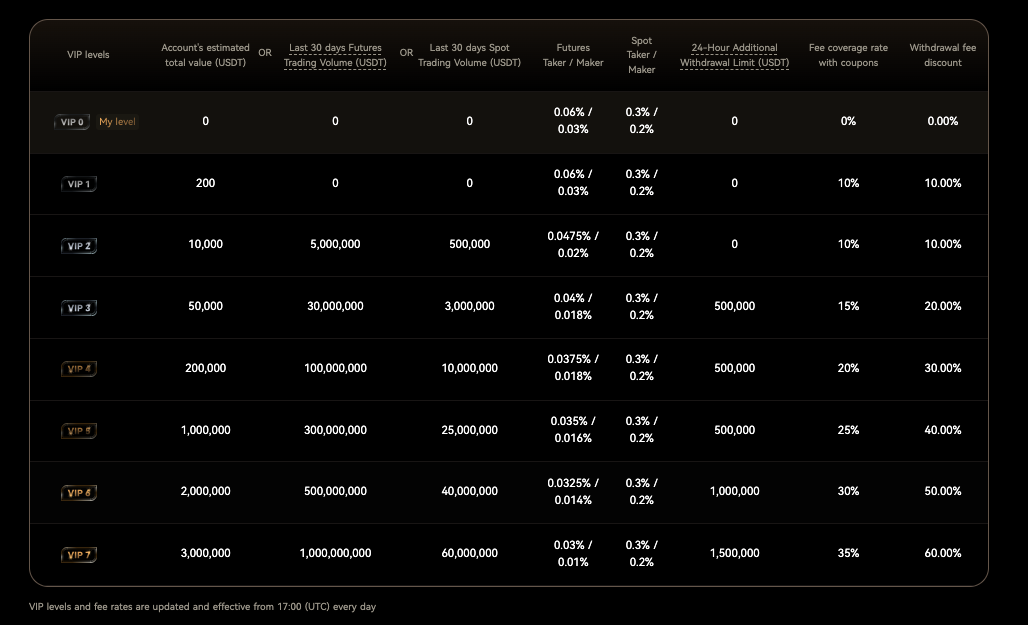
While it is clear that BTCC charges high trading fees, high-volume traders can leverage BTCC VIP benefits to reduce their fees significantly. For instance, BTCC VIP level 7 users enjoy a 50% discount on trading fees.
To get this benefit, users must have completed at least $1 billion in future trading volume, $60 million in spot trading volume, or hold at least $3 million in crypto assets on the exchange. Lower trading volume may qualify you for other VIP levels, as shown in the VIP table.
Bitunix Trading Fees
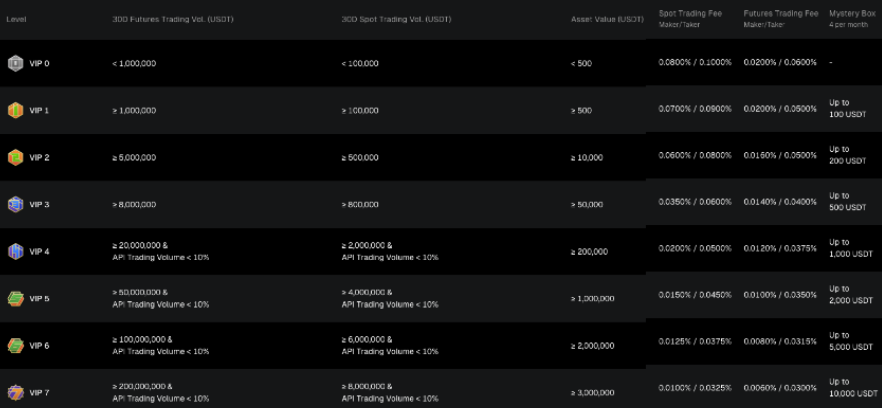
Trading fees on Bitunix are also based on a maker-taker model. The exchange applies a 0.08% maker fee and a 0.10% taker fee on spot trades, while futures trades attract a 0.02% maker fee and a 0.06% taker fee.
Like BTCC, Bitunix offers VIP benefits for high-volume traders, providing significant discounts on trading costs for traders with high trading volume or asset balance.
As a Level 7 VIP user, you get a 50% discount on taker fees and over 70% discount on maker fees. To enjoy these VIP benefits, users must achieve a minimum of $200 million in future trading volume and at least 10% API trading, or $8 million in spot trading volume and at least 10% API trading, or hold at least a $3 million asset balance on the exchange.
Quick Summary:
|
BTCC (Maker/Taker) |
Bitunix (Maker/ Taker) |
|
Spot: 0.2% / 0.3% Futures: 0.03% / 0.06% Fee discount: VIP benefits and crypto bonus |
Spot: 0.08% / 0.10% Futures: 0.02% / 0.06% Fee discount: VIP benefits and crypto bonus |
Is BTCC Cheaper Than Bitunix Exchange?
With the fee structure above, BTCC is clearly not cheaper than Bitunix. For instance, while BTCC applies 0.2% maker and 0.3% taker fees on spot trades, Bitunix charges 0.08% maker and 0.10% taker fees. As a result, Bitunix's spot trading fee is 60% lower than BTCC's.
Comparing the original trading fees, fee discounts, and VIP requirements shows that traders pay higher trading fees on BTCC. VIP-7 users on Bitunix can reduce futures maker fee from 0.02% to 0.008% with $200 million in futures trading volume. BTCC requires $1 billion in futures trading volume and still applies a 0.01% maker fee.
BTCC vs Bitunix Exchange: Features and User Experience
BTCC and Bitunix offer an easy-to-use interface and moderate liquidity, suitable for both new and experienced traders. However, Bitunix provides a modern look with additional features that enhance the trading experience.
Blockchain support: BTCC and Bitunix offer multi-chain support, allowing users to interact with assets across different blockchains. However, Bitunix offers more blockchain options than BTCC.
Liquidity:
BTCC has 7+ million registered users and very high overall trading volume across spot and derivatives markets. This provides the exchange with a deep orderbook and a tight spread, allowing traders to execute large trades with very low slippage.
Bitunix has over 2 million users and relatively low trading volume when compared to BTCC. However, it offers a deep order book that allows traders to execute high-volume trades without necessarily affecting the asset's price.


Deposit and withdrawal
Deposit:
On BTCC, users can deposit crypto assets from another wallet or buy directly with fiat. For on-chain deposits, BTCC offers limited blockchain support, with some assets supported on only 1 blockchain. For instance, you can deposit $BNB on the BNB Smart Chain.
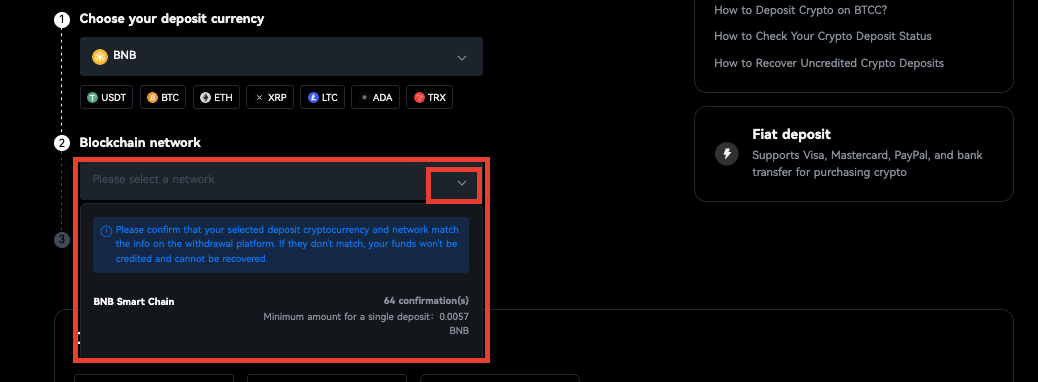
On Bitunix, traders can complete on-chain crypto asset deposits across multiple blockchains. For instance, you can send USDT across 7 different blockchains, and assets like BNB and BTC can be sent via at least 2 blockchains. Bitunix also allows traders to buy assets with fiat.
Withdrawal:
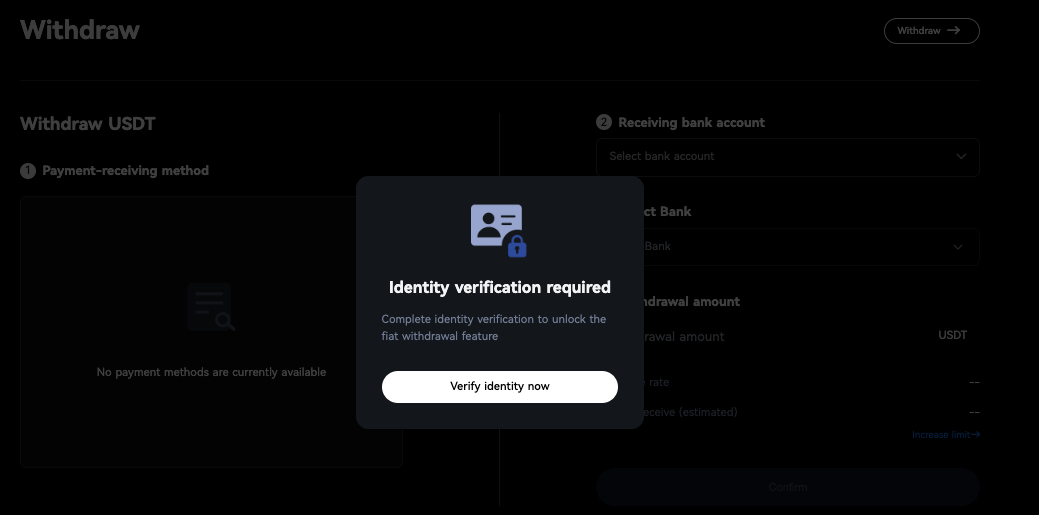
BTCC offers only on-chain withdrawals to wallet addresses, which require KYC verification. Hence, it is recommended that you wait until your ID verification is approved before moving assets on the exchange for trading, as you may not be able to withdraw the asset before approval.
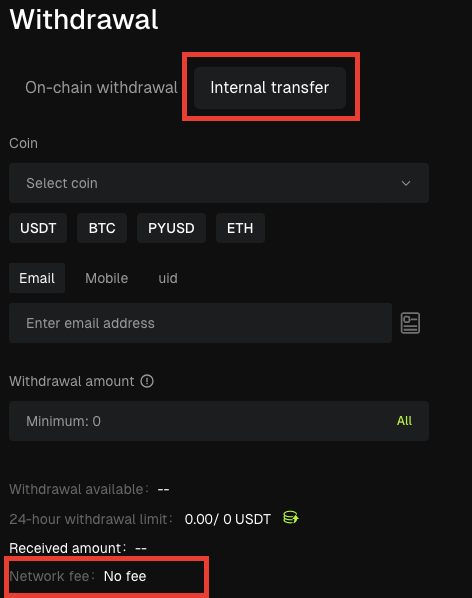
Bitunix, on the other hand, offers both on-chain withdrawal and internal transfer between Bitunix users. With on-chain withdrawal, you can send assets to different wallet addresses and pay network fees.
Bitunix users can transfer their crypto assets to other users at no cost via Bitunix UIDs, mobile numbers, or registered email addresses.
Security: For centralized exchanges, security is a significant concern because users' assets are stored in an exchange-controlled wallet.
BTCC is a popular exchange with no history of breaches or hacks. The exchange uses layered security mechanisms to protect users' funds. This includes using asset segregation systems that store users' margin in a separate trust account and keep assets in a multi-signature cold wallet. Also, assets are stored on a one-to-one basis.
Bitunix, on the other hand, combines advanced security protocols, such as a multi-sig cold wallet for storage, with high-level transparency through Proof of Reserves for on-chain auditing.
Which Is Better, BTCC or Bitunix Exchange?
BTCC and Bitunix offer different features and benefits that make them better options for different traders. For beginners, BTCC's demo trading features let you perfect futures trading strategies without risking real capital.
New traders can leverage copy trading on BTCC and Bitunix, as well as staking for passive income. Experienced traders with an interest in diverse portfolios and high leverage can access TradFi assets on BTCC and use up to 250x leverage on major assets.
For altcoin traders, Bitunix offers up to 75x leverage. However, it is essential to note that using extremely high leverage increases the risk of liquidation.
BTCC vs Bitunix: Which Exchange Is Better for Beginners?
Both BTCC and Bitunix offer beginner-friendly features, but they appeal to new traders in slightly different ways.
BTCC is particularly attractive for beginners because it provides demo trading with $100,000 in virtual funds. This allows users to practice futures trading strategies without risking real capital. The platform also offers copy trading, enabling new traders to follow experienced traders and replicate their strategies automatically.
Bitunix also supports copy trading and provides a simple trading interface, but it does not currently offer demo trading. However, it does provide lower trading fees and more order types, which can benefit users who already have some trading experience.
Overall, BTCC may be the better choice for complete beginners who want to practice first using demo trading, while Bitunix can be attractive for traders who prioritize lower fees and additional order options.
How to Earn Passive Income on BTCC & Bitunix Exchange
Users can earn passive income on Bitunix and BTCC through copy trading and staking.
On BTCC, users can trade passively by following active traders' strategies for profits, or lock up assets (mostly USDT) under 'BTCC wealth management' for up to 120 days to earn 5% - 20% Annual yields.
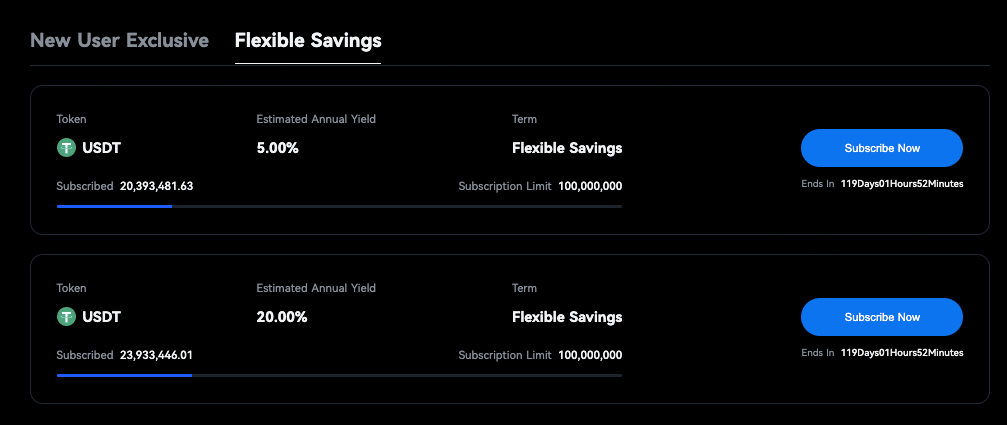
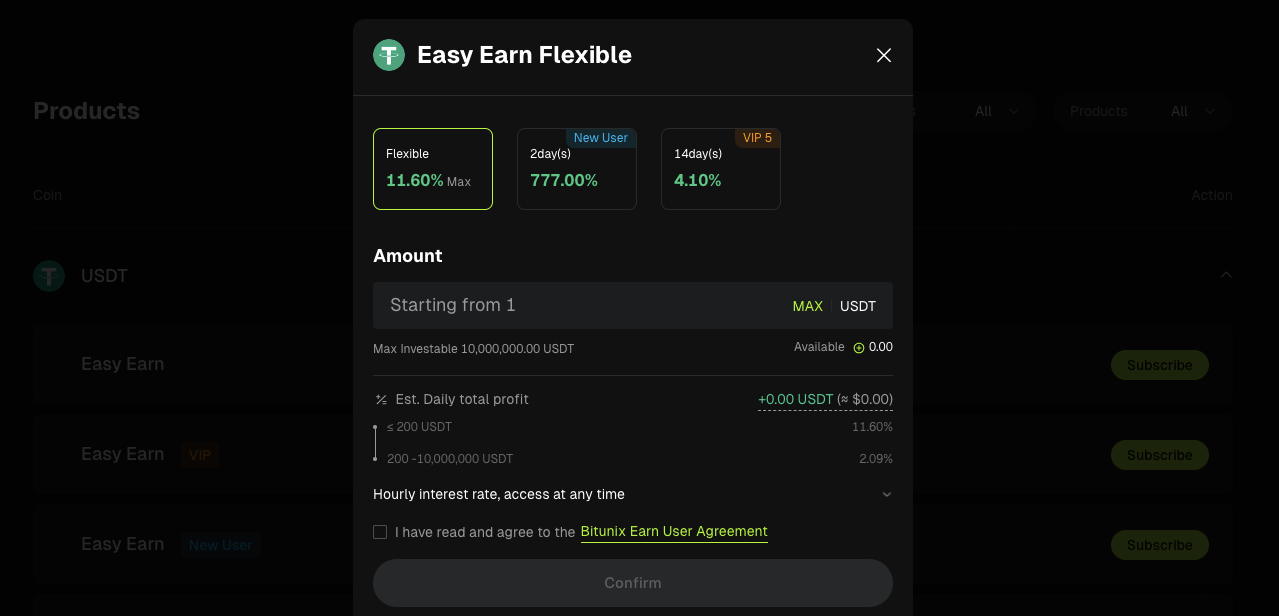
Bitunix offers a more structured staking system. Here, users can enjoy flexible staking to earn hourly yield and redeem or unlock staked assets at any time. Alternatively, you can lock up assets for a specific period for higher yields, and new users can enjoy the 2-day staking promotion for up to 777% yield.
Conclusion
BTCC and Bitunix are two major centralized exchanges in the crypto space with notable similarities and differences. While BTCC is a long-standing exchange with a presence in the United States, Bitunix was founded in 2021 and offers a more seamless interface. To know which of the two exchanges is best for you, we recommend trading with small capital.
The good thing is you can try trading without losing capital when you participate in the BTCC 30,000 deposit bonus or join the Bitunix crypto bonus.
BTCC vs Bitunix: Quick Verdict
| Category | Winner |
|---|---|
| Best for beginners | BTCC |
| Lowest trading fees | Bitunix |
| Highest leverage | BTCC |
| Best altcoin trading | Bitunix |
Frequently Asked Questions
Can I use BTCC and Bitunix in the US and Canada?
Yes, you can use BTCC in the United States and Canada, but you cannot use Bitunix in these two countries or in the other 21 restricted countries.
Should I use up to 250x leverage on my future trades?
The level of leverage to use depends mainly on trading experience and the quality of trading signals. Experienced traders can use higher leverage when they are considerably confident in the price direction. However, if you are a new trader, using as low as 1x leverage is recommended to prevent liquidation.
Which platform is better for perpetual futures trading?
Both exchanges offer strong perpetual trading; however, BTCC has deeper liquidity and higher leverage on major crypto assets, making it more ideal for high-volume, experienced traders.
What is API Trading?
API trading allows high-volume traders to connect execute trades by connecting their own software and trading bots using their own API key. With this, trades are executed automatically without manual input