dYdX Order Types Explained (Market, Limit, Stop & Advanced Orders)
When you start trading on dYdX, it’s important to understand the available order types. Each order type determines how and when your trade is executed, whether you prioritize speed, price accuracy, or risk management.
If you’re familiar with centralized exchanges, most order types will look familiar. Still, knowing how they behave specifically on dYdX can help you trade more efficiently and avoid unnecessary fees.
In this guide, we explain every dYdX order type in a simple and practical way, so you know exactly which one to use for your trading strategy.
Market Orders
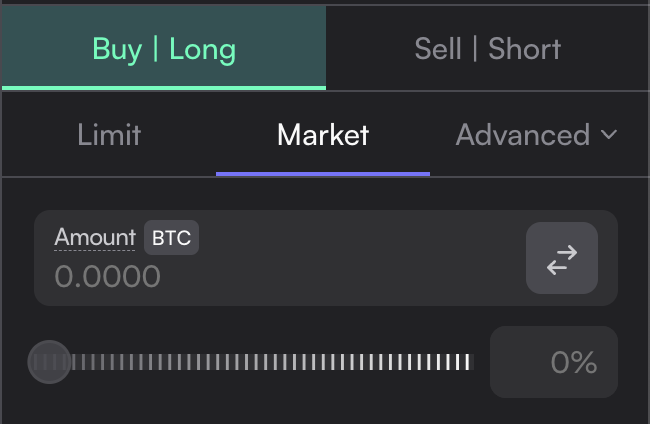
A market order is the easiest way to open or close a position on dYdX.
When you place a market order, your trade is executed immediately at the best available price in the order book. This means you are prioritizing speed over price precision and using existing liquidity.
Because market orders remove liquidity from the order book, they are charged a taker fee, which is higher than the maker fee.
Pros
-
Instant execution
-
Very easy to use
-
Ideal for fast entries and exits
Cons
-
No control over the exact execution price
-
Slippage can occur during high volatility or low liquidity
Market orders are commonly used during breakouts, strong momentum moves, or when you want to exit a position quickly.
Limit Orders
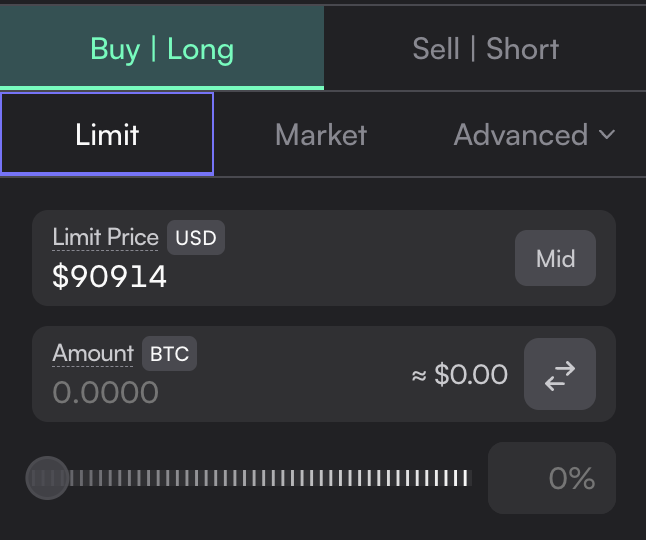
A limit order allows you to set the exact price at which you want to buy or sell. The order will only be executed if the market reaches your specified price.
This gives you more control over execution, but there is no guarantee the order will be filled.
Limit orders add liquidity to the order book, which means they are charged the maker fee, usually lower than the taker fee.
Pros
-
Full control over execution price
-
Helps avoid slippage
-
Lower trading fees
Cons
-
Execution is not guaranteed
-
Order may remain open if price never reaches your level
Limit orders are ideal for trading ranges, placing planned entries, or reducing fees over time.
Trading Fees on dYdX (Maker vs Taker)
On dYdX as with most exchanges, trading fees depend on whether you add or remove liquidity from the order book.
If you place a limit order that sits in the order book, you are a maker and pay a lower fee. If you use a market order or instantly fill an existing order, you are a taker and pay a higher fee.
At the base fee tier, maker fees start at 0.01%, while taker fees start at 0.05%. These fees can decrease as your trading volume increases, which is why many traders prefer limit and post-only orders whenever possible.
Stop & Conditional Orders
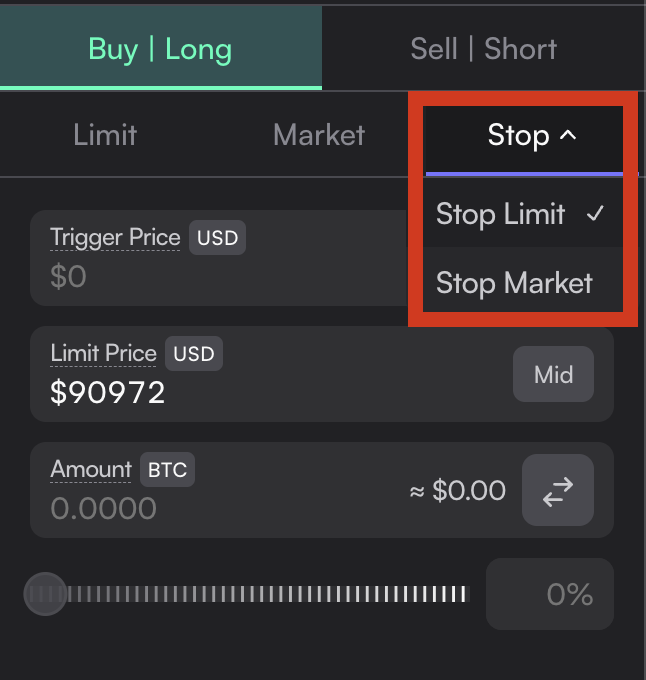
Stop orders, also known as conditional orders, only become active once a predefined trigger price is reached.
After the trigger price is hit, the order is submitted as either:
-
a market order, or
-
a limit order
Depending on how you set it up.
For example, if Bitcoin is trading at $87,000 and you only want to go long after it breaks above $90,000, you can set a conditional order with a trigger price at $90,000. Once that level is reached, the order is automatically placed.
On other exchanges, these orders are often called conditional orders, but dYdX is using "stop market" or "stop limit". In this case, "stop" stands for conditional.
Pros
-
Useful for stop-loss and take-profit strategies
-
Helps automate risk management
-
Can be used to enter breakout trades
Cons
-
Market execution price is not guaranteed
-
Fast price movements may skip levels
Advanced Order Options (Time-in-Force)
dYdX offers several advanced execution rules for limit orders, commonly referred to as time-in-force options.
Post-Only
-
Ensures your order is added to the order book
-
Prevents execution as a market order
-
Often used to avoid taker fees and earn maker fees
Immediate-Or-Cancel (IOC)
-
Attempts to fill the order immediately
-
Any unfilled portion is canceled instantly
-
Useful when you don’t want open orders
Good-Til-Date (GTD)
-
Order remains active until a specific date
-
Automatically expires if not filled
-
Suitable for planned or longer-term strategies
Best Order Type for Beginners
For beginners, market orders are the easiest way to start because they execute immediately and require no price planning.
However, as you gain experience, limit orders usually make more sense. They give you better price control and lower fees, especially when trading ranges or placing strategic entries.
In simple terms:
-
Market orders are easier
-
Limit orders are cheaper
Common Mistakes to Avoid
A common mistake is placing a limit order too close to the current market price. If the price moves while submitting the order, it may execute immediately as a market order.
This can be avoided by using the post-only option, which ensures your order never executes as a taker order.
If you want to do your own due diligence in checking whether an exchange is trustworthy? We have a 5-minute exchange safety checklist which you can use to check whether an exchange is shwoing any red flags before using them.
Final Thoughts
Understanding dYdX order types helps you trade with more confidence and fewer mistakes. When you match the right order type to your goal, speed, price precision, or risk management, your trading becomes more consistent.
Before placing trades, many traders use tools like Whaleportal to track funding rates, open interest, and overall market sentiment for better context.
Join DyDX Today and Enjoy The Benefits Of A Decentralised Exchange
FAQ
What are order types on dYdX?
Order types on dYdX are different ways to execute trades depending on whether you want instant execution, a specific price, or automated triggers. The main types are Market, Limit, and Conditional orders.
What is a Market Order on dYdX?
A Market Order executes immediately at the current market price. It is the fastest way to enter or exit a position but uses the taker fee.
When should I use a Market Order?
Use a Market Order when speed matters more than price, such as during high volatility or fast breakouts.
What is a Limit Order on dYdX?
A Limit Order lets you choose the exact price you want to buy or sell. The order only fills if the market reaches that price and uses the lower maker fee.
What is a Stop or Conditional Order?
A Conditional Order activates only when a trigger price is reached. Once triggered, it places either a market or limit order automatically.
What is Post-Only on dYdX?
Post-Only ensures your limit order is added to the order book and never executes immediately as a market order, helping you avoid taker fees.