Hyperliquid vs Binance Comparison (Fees, Leverage & Safety)
Would you rather trade on Binance, the number one trading platform with over 250 million global users, or move to a recently launched DEX? Hyperliquid's popularity has increased rapidly since 2023, leading many traders to wonder if the platform is as described - fast, transparent, and fully decentralized.
From the massive $HYPE token airdrop to whale tracking and near-instant trade execution, Hyperliquid provides users with a CEX-like trading experience while improving on-chain transparency and decentralization. In contrast, Binance retains its edge in adoption and maximum liquidity.
With over $76 billion in 24-hour derivatives trading volume and 1500+ trading pairs, Binance remains a safe choice for institutions and large-volume traders. Additionally, Binance maintains a $1 billion reserve, the Binance SAFU Fund, to provide full asset security.
In this guide, we break down the key differences between Hyperliquid and Binance, covering fees, custody, leverage, access, and trading experience, to help you make the right call.
Short on time?
Start trading on Hyperliquid (Get 4% fee discount + no KYC required)
Quick Summary
|
Exchange |
Ideal User or Situation |
|
Binance |
|
|
Hyperliquid |
|
What is Hyperliquid?
Hyperliquid is a decentralized exchange designed for spot and futures trading using an on-chain orderbook. With this, traders can execute low- to high-volume crypto trades within seconds, access a wide range of trading pairs, and even trade with minimal fees. Hyperliquid stands out for combining centralized features with full decentralization. For instance, while trading is faster and cheaper on Hyperliquid than on some centralized exchanges, users still retain custody and access full features, including unrestricted asset withdrawals, without Identity Verification.
If you’re new, check out our full step-by-step guide on how to use Hyperliquid.
Additionally, Hyperliquid was co-founded by Jeff Yan, a Harvard graduate with solid trading experience, to resolve some of the notable issues with decentralized trading, which include speed and transparency. First, Hyperliquid relies on a purpose-built Layer-1 blockchain, the HyperEVM layer. It was built with 0.07 second block confirmation and can handle up to 200,000 transactions per second.
Additionally, using the on-chain orderbook and a public blockchain, Hyperliquid increased transparency in crypto trading. This allows users to discover popular Hyperliquid whales, such as the Trump Insider; however, traders' real identities remain hidden while only their wallet addresses are visible.
Start trading on Hyperliquid with our affiliate link to get a 4% discount on your trading fees.
Quick Note: Hyperliquid transparency increased the insider-trading conversation in the crypto space. By tracking large-volume orders and traders' behavior, the whole market is gaining insight into how whales predict market conditions and place profitable trades around upcoming global news and financial headlines.
What is Binance?
Binance is one of the early movers in the crypto space. Founded in 2015, Binance remains the largest crypto exchange despite the growing concerns about centralized exchanges. The FTX fraud highlights the need to protect users against mismanagement. In response, Binance introduced a public auditing and fund reserve, the Binance SAFU Funds.
Binance runs on its own internal structure that can handle up to 1.4 million transactions per second. With this, it completely outperforms Hyperliquid; however, the difference in trading speed is only noticeable during extreme congestion, so trading on Hyperliquid is not necessarily slower under normal conditions.
It should be noted that traders enjoy limited privacy or transparency on Binance. The exchange uses an off-chain orderbook, which means that transactions are completed off-chain and recorded in the Binance database. Therefore, trades are largely protected, and only the account owner (or anyone with access) can view transaction history and details. However, while users enjoy public privacy, they are required to complete full identity verification on Binance, which denies them the regular blockchain anonymity.
Quick note: If you like Binance but prefer more decentralization, you can also check out AsterDEX, a decentralized exchange built within the Binance ecosystem.
What Does This Mean?
On Binance, traders' real identities are known to the exchange and can be traced because wallet addresses are linked to the original users through verification. On Hyperliquid, traders' real identities are unknown to the exchange because no verification is required; therefore, connecting a wallet address to a real user requires tracking wallet activities to the point of converting crypto into fiat, which is only possible for authorized entities like governments or regulators.
Is Hyperliquid Better Than Binance? Comparing Trading Experience, Leverage, Speed, and Performance
Orderbook, Liquidity, and Trade Execution


Hyperliquid and Binance facilitate transactions via orderbooks; however, while Hyperliquid uses an on-chain orderbook, which makes it easy for traders to monitor trading positions in real time and even predict market sentiment, Binance uses an off-chain orderbook without any real blockchain support.
Both Hyperliquid and Binance feature deep liquidity and fast execution. That is, all transactions are executed on a price-time basis, meaning orders with the best price are executed first.
At the time of writing, Binance has the highest number of global users and over $76 billion in 24-hour derivative trading volume, while Hyperliquid has over $10 billion in 24-hour derivative trading volume.
This reflects a major liquidity gap between the two exchanges; however, this does not stop Hyperliquid from handling large volume trades in practice. Retail and mid-size traders can still complete millions of dollar trades without meaningful slippage; however, Binance is a better option for institutions moving hundreds of millions in a single trade.
Trading Pairs, Leverage, and Market
Binance offers a robust trading environment with a wide range of assets. Users can interact with over 1,500 trading pairs. This means you can easily access popular coins and other altcoins. Note that this is not available on Binance.us because it has limited trading pairs and does not support derivative trading.
Hyperliquid has over 243 trading pairs, which means limited access to crypto assets, particularly low-cap altcoins with little exposure.
- Leverage: Traders can access up to 40x leverage on Hyperliquid. Binance offers up to 150x leverage, particularly on popular assets.
- Order Types: On Hyperliquid, you can place market, limit, TWAP, and stop-limit orders. On Binance, you can place market, limit, top limit, stop market, trailing stop, OCO, and TWAP orders. Additionally, you can use features such as stop-loss and take-profit orders on both exchanges to manage margin and avoid liquidation.
- Trading models and extra products: Hyperliquid is mainly designed for spot and perpetual futures trading, but you can access tradfi assets or copy trading via the Hyperliquid vault. Binance supports spot, derivatives, options, perpetual tradfi, and P2P trading.
Binance Extra products:
Copy trading & grid bots
Staking (Simple Earn, Launchpad)
Binance Card (fiat spending)
P2P + fiat on/off-ramps
Crypto-backed loans
What Does This Mean?
If you are a low-cap altcoins hunter, trading on Binance means a seamless trading experience where you can access up to 75x leverage on less popular cryptocurrencies or tokens (usually memecoins), while opting for Hyperliquid will most likely reduce exposure.
Is Binance Cheaper Than Hyperliquid? Comparing Trading Fees, Fee Discounts, and VIP Benefits
Binance Fee Structure
Binance offers four main trading models: spot, futures, options, and perpetual trading. The exchange charges different fees for each trading model, with futures trading fees the lowest.
- Spot trading fees: 0.1% maker and taker fees
- Futures fees: 0.02% maker fee / 0.05% taker fees
- Options trading fees: 0.03% maker and taker fees
- Perpetual tradfi: 0.02% maker fee and a 0.05% taker fee
Hyperliquid Fee Structure
On Hyperliquid, traders pay:
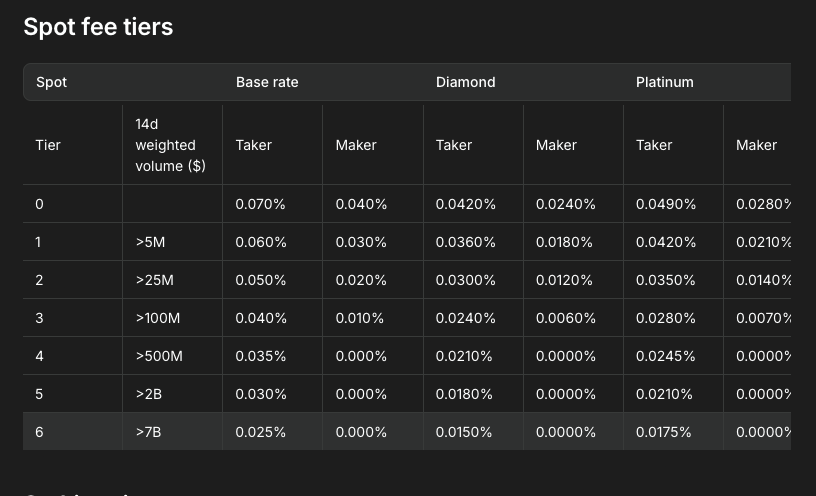
- Spot trading: 0.04% maker fee and 0.07% taker fee.
- Perpetual futures trading: 0.015% maker fee and 0.045% taker fee.
Trading Fee Discounts on Hyperliquid and Binance and How to Get Them
Binance has 4 ways for users to enjoy a fee discount. These are:
- Ongoing trading fee promotion for USDC-M positions. Currently, users can enjoy 0% maker fee and 0.04% taker fee for these trades.
- Get 25% discount on spot trading fees and 10% fee discount on future trades when you pay trading fees with $BNB. No discount on tradfi and options trading.
- Get 5% discount when you pay margin interest with $BNB.
- Qualify for Binance VIP Tier by increasing your futures trading volume to get up to 50% fee discount.
Binance VIP Levels & Benefits
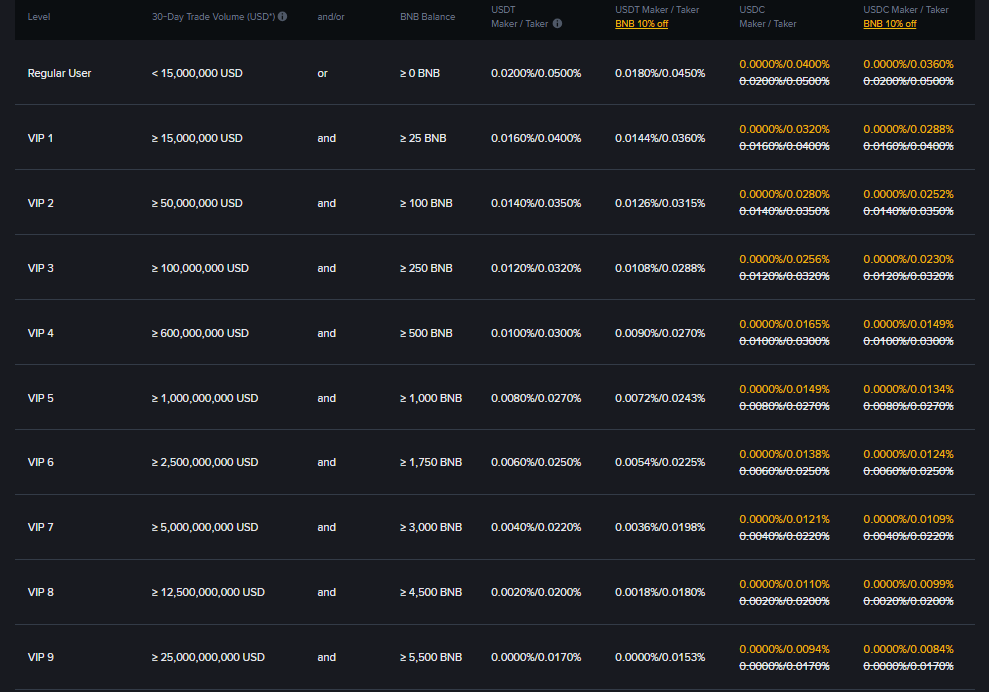
Binance also offers VIP benefits for high-volume traders. For instance, VIP 2 traders get up to 37% discount on trading fees when they hold at least $100 BNB or complete at least $50,000,000 futures trading volume or maintain a 5,500 BNB balance within 30 days.
Hyperliquid VIP Tiers & Benefit
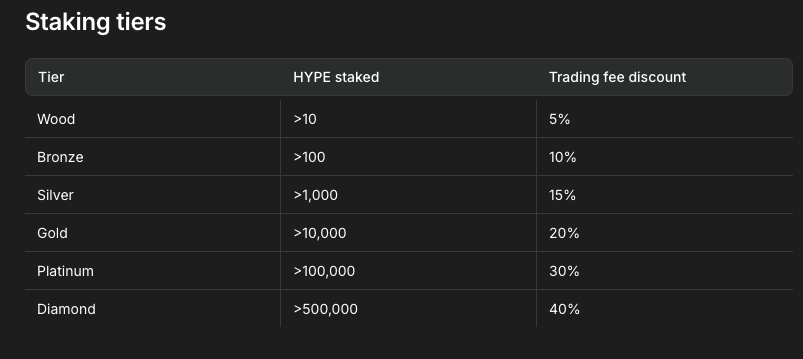
On Hyperliquid, you can reduce trading fees drastically when you qualify for the VIP tiers. With this, Hyperliquid offers a maximum 40% discount on trading fees. To qualify, traders must stake $HYPE tokens. For instance, Hyperliquid's Wood users enjoy a 10% fee discount on staking between $10 and $99 $HYPE.
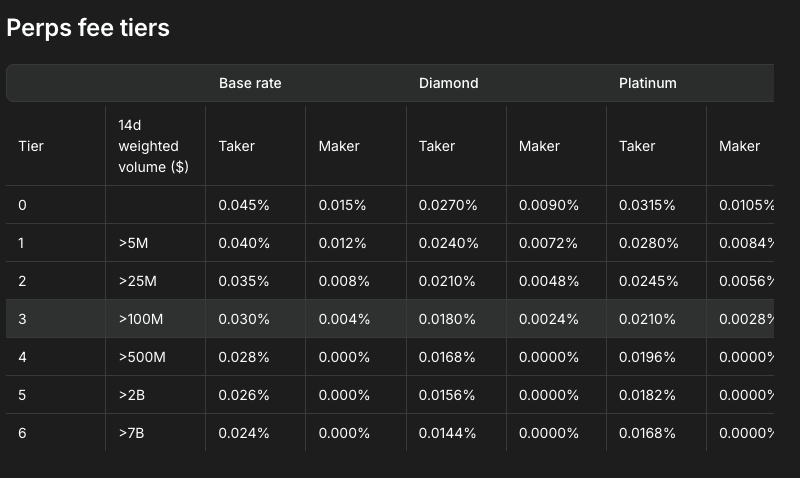
In addition to this, users can also reduce trading fee by increasing perps or spot trading. You can get up to 50% fee discount under this category when you reach certain trading volume within 14 days. For a clear guide on how it works, visit the Hyperliquid official fee structure page.
Hyperliquid Perps Fee Tiers (with Fee Discount)
Hyperliquid Spot Fee Tiers (with Fee Discount)
How to Earn Passive Income on Hyperliquid and Binance
Hyperliquid is not only one of the best DEXs in 2026; it also offers attractive passive-income mechanisms for traders with little to no desire or experience for active trading. You can lock stablecoins in the Earn section for APR rewards. Alternatively, you can contribute to Hyperliquid security by staking $HYPE with any of the validators under the Stake section. Finally, Hyperliquid provides crypto vaults where users can add funds for a share of the profit made.
Similarly, you can access a wide range of products on Binance to earn passive rewards, either through airdrops, flexible and fixed staking, or direct profits from copy trading. One interesting staking you may want to try is the $BNB flexible or fixed staking. When you stake $BNB, Binance rewards you with estimated APR and token airdrops.
Hyperliquid Vault vs Binance Copytrading
Binance copy trading and Hyperliquid Vaults offer traders a way to earn good returns without actively trading, but they work differently.
Hyperliquid has two types of vaults: the protocol vault (Hyperliquid Provider and Liquidation Vaults) and the user vault. Users can add their funds to the community-owned vault to provide liquidity and handle liquidation events on the exchange. Alternatively, you can join any user’s vault. The vault owner uses all funds in the vault to execute perpetual futures trades. For contributing to the vault, investors get 90% of the profit or loss incurred.
Read more on how to join a crypto vault and the possible risks to keep in mind when joining a Hyperliquid vault.
On Binance, you can copy other users' trades directly to your own account. The good part is that you can start copytrading on Binance with virtual funds. This means Binance offers you a test fund for copytrading. With this, you can confirm traders’ strategies and profit levels before using your own capital.
Note that you do not earn any profit when using virtual funds; you can only monitor potential profit or loss without any financial commitment. Before you copy a trader or join a crypto vault, carefully review their performance and past trades.
Which is Safer? Comparing Security Model, Custody, and Trade Safety
Binance (Custodial):
Binance stores users' assets in an exchange-controlled wallet, where the exchange can access them. As a user, you create an account on Binance, where you can also access your funds for trading or withdrawal. However, without completing your KYC verification, you may not be able to withdraw assets.
Hyperliquid (Non-custodial):
When you trade on Hyperliquid, your USDC remains in your control. The exchange never holds your funds in its own wallet; instead, smart contracts manage your margin, trades, liquidations, and settlements. This means you will not be dealing with accounts getting blocked, paused withdrawals, or losing your funds due to an internal breach or mismanagement.
Hyperliquid and Binance have different security measures because they expose traders to different risks.
Security Risks on Binance (And Safety Measures)
Custodian risks: Anyone with the right authority can access your funds on Binance. Though the majority of the assets are stored on a cold wallet with multisignature access and strong private-key protection, it is not entirely safe from breaches or misappropriation. To further prevent this, Binance created a reserve to cover any losses users may suffer if the exchange system or wallet is successfully breached.
Account risks: Your Binance account is protected by a password, like a regular bank app, which means anyone with your password and email address can access it. The good thing is you can recover access to your account if you forget your password. Binance offers additional protection by requiring biometric or passkey sign-in, whitelisting withdrawal addresses, setting anti-phishing codes, and enabling 2FA.
Liquidation risks: Finally, Binance offers up to 150x leverage, which exposes users to a high risk of liquidation when the market moves against their expectations. The higher the leverage, the higher the liquidation. Therefore, to prevent getting liquidated, you should opt for low leverage.
Security Risks on Hyperliquid (And Safety Measures)
On Hyperliquid, users are exposed to smart contract risk, wallet breach, and liquidation risks.
Smart contract risk: Hyperliquid uses different smart contracts to offer permissionless, fast spot and perpetual trading. While this means transactions are executed without delay or intermediation, smart contracts are vulnerable to bugs and breaches, and, if successfully attacked, users may face loss of assets from wrongful liquidation and system exploitation.
Wallet Risk: On decentralized exchanges like Hyperliquid, your wallet can be compromised if you click a phishing link, fall for a scam, or expose your private key or seed phrases. Additionally, you can lose access without any chance of recovery if you do not store seed phrases securely. To prevent this, you must learn about wallet security and ensure you write your seed phrases down in a secure physical location. Eg, write it down on a piece of paper or a book and store it somewhere safe and private.
Liquidation Risk: Similar to what you have on Binance, trading with high leverage on Hyperliquid increases liquidation risks. However, Hyperliquid offers a maximum of 40x leverage, which is low compared to Binance. It also has a margin maintenance mechanism that helps prevent total liquidation.
To ensure you trade securely, learn how to avoid getting liquidated in crypto trading.
Full Overview: Hyperliquid vs Binance
|
Features |
Hyperliquid |
Binance |
|
Exchange type |
Decentralized |
Centralized |
|
On-chain transparency |
Excellent |
Very low |
|
Whale/wallet tracking |
Available |
Not-available |
|
KYC verification |
Not required |
Required |
|
Asset Management |
Self-custody |
Exchange custody |
|
Native Coin |
$HYPE |
$BNB |
|
Trading fees (Maker/Taker) |
Spot: 0.04%/0.07% Futures: 0.015%/ 0.045% |
Spot: 0.1%/0.1% Future: 0.02%/ 0.05% |
|
Max Fee discount |
40% |
50% |
|
Blockchain support |
Multi-chain |
Multi-chain |
|
Leverage |
Up to 40x |
Up to 150x |
|
Order types |
Market, limit, TWAP, stop limit. |
Limit, market, conditional, TWAP, and Iceberg. |
|
Trading models |
Spot, perpetual futures, tradfi, HIP-3 market |
Spot, futures, tradfi, grid trading, API trading, P2P |
|
Trading pairs |
243+ |
1,500+ |
|
Reward |
$HYPE airdrop |
Signup, deposit, trading, KYC rewards |
Final Thought: Which is Better for Beginners
As a beginner, choosing between Hyperliquid and Binance can be challenging because, beyond a user-friendly interface and fast trading speed, you also have to consider other features.
For a start, Binance offers a more straightforward approach to trading. You can simply transfer crypto into your account from a different wallet, receive assets from other Binance users using your Binance UID, or buy crypto directly with your bank card on the exchange.
Additionally, new traders can access a Binance demo account to learn futures trading or try test copy trading with virtual funds. However, it is restricted in some countries and also comes with high trading fees. So, if you prefer self-custody with little to no location barrier and low trading fees, Hyperliquid is a good place to get all of that.
Frequently Asked Questions
What is the best alternative to Hyperliquid?
Alternative decentralized exchanges to Hyperliquid include Apex Omni, AsterDEX, dYdX, and more. We compared Apex Omni vs AsterDEX here.
What is the best alternative to Binance?
Other centralized exchanges you can try out include Bybit, MEXC, Bitget, and BTCC. Check out our full guide on how to set up your Bybit account.
What is slippage?
Slippage is the difference between the expected price of a trade and the actual price at which the order to buy the asset was executed.