Funding Rate Explained (Simple) + How Traders Use It to Spot Reversals
Funding Rate Explained: Using Funding Rate As a Trading Indicator For Beginners
You want to know when everyone’s on the same side with a trade? Check the funding rate.
Most traders mistake the term ‘funding rate’ for trading interest or fees, which is not the case. Funding rates are fees that traders pay or receive for maintaining their positions. It is exchanged between traders depending on market conditions. And it is not the same with trading fees, because trading fees are paid for executing a position (opening or closing).
Currently, the Bitcoin Funding rate has been mostly negative in the last 30 days. This means that traders with short BTC positions (bears) are paying the funding rate to traders with long BTC positions (Bulls).
What you need to know is that the funding rate is not random data; when used carefully or combined with other important crypto trading indicators, it can improve your trading strategy. We often recommend it for beginners because it is easy to read and provides real-time data.
While professional traders know more about it, new traders still struggle with ways to use it in their trading. This article answers all your questions about the funding rate, from how to use it to what it means, when to combine it with liquidation heatmaps or other indicators, how exchanges calculate it, and how to track it using crypto analytical tools.
In short: Funding rates are periodic payments used by crypto exchanges to balance perpetual contracts against the spot market price of an asset and also ensure that the amount of long positions on the exchange balances with short positions. It can also serve as a good indicator of market direction or sentiment.
Check out the current funding rates on leading exchanges using the Whaleportal Funding Rate Tracker.
What Are Funding Rates?
Funding rate is a mechanism used by most cryptocurrency exchanges (centralized and decentralized) to keep perpetual contracts close to the spot market price of an asset. Given that perpetual contracts have no expiration date and asset prices are highly volatile, exchanges use funding rates to align perpetual prices with spot prices.
Perpetual futures trading is different from spot trading because spot trading allows traders to buy and hold an asset. In contrast, perpetual futures expose you to the price movement of the asset. When you open a $BTC perpetual position, you are not buying BTC; you are only trading its price movement.
Funding rates are calculated every 8 hours or daily and paid to traders by most exchanges, which creates an arbitrage opportunity for traders.
When the majority of the traders maintain long positions, the funding rate is considered positive, which means long traders pay the funding rate to short traders. When the majority of traders maintain short positions, there is a negative funding rate, and short traders pay the fee to traders with long positions.
How Exchange Calculates Funding Rate
Unlike trading fees, funding rates are not fixed by crypto exchanges; instead, they are calculated based on the market interest rate and the difference between the contract and the underlying asset price.
The essence is to ensure that perpetual contracts are balanced against the spot prices of the assets and to prevent price manipulation.
Funding rate also differs across exchanges. At the time of writing, the current Bitcoin funding rate on Binance is -0.0001%, while Bitget applies -0.0058%. Exchanges apply different funding rates because the amount of long and short positions on each exchange at a given interval (the 8-hour range) is not the same. Before trading, you can easily track the funding rate on leading exchanges by using the Whaleportal Funding Rate tracker.
How To Read Funding Rate For Perpetual Futures Trading
Reading the funding rate is now possible due to the availability of crypto analytical tools. On Whaleportal, you can easily track the funding rate once you understand what each data point means.
When the rate is displayed in white, it represents a baseline rate; when it is displayed in green, it indicates a positive rate; and when it is displayed in red, it represents a negative rate.
Unlike technical data that provides insight into market trends, analyzing funding rates offers useful insights into market sentiment, making it a good leading indicator for identifying potential price reversals or entry points.
To learn more about trading indicators, check out our article on the best crypto trading indicators.
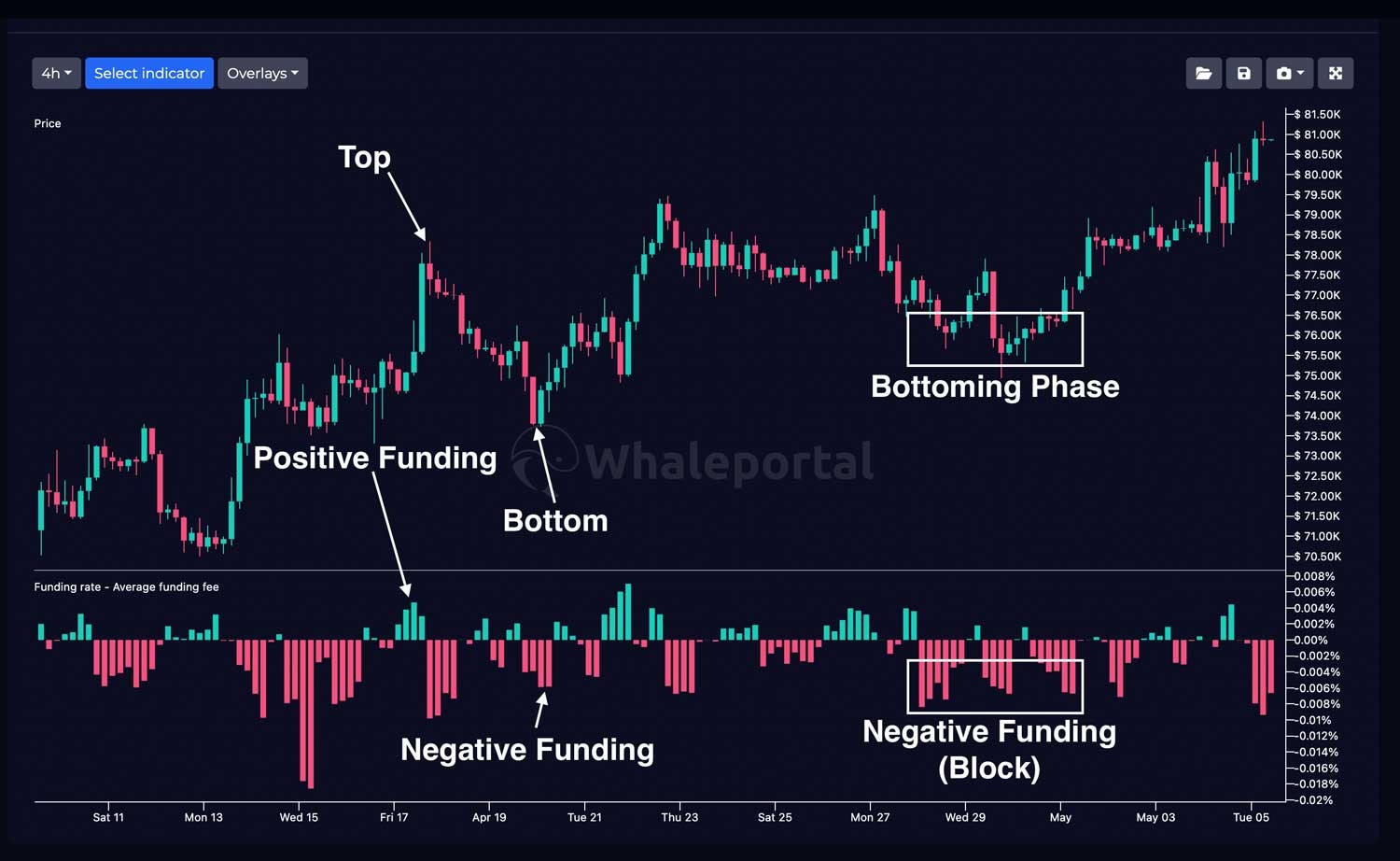
Now, back to reading the funding rate. To know whether the market is bullish or bearish, focus on the percentage change and what it means when rates are positive or negative.
- Negative: means shorts are paying longs (Market is potentially bullish)
- Positive: means longs are paying shorts (market is potentially bearish)
A detailed breakdown of market sentiment using funding rates
|
Funding rate % |
Meaning |
Implication |
|
+0.1% or higher |
Extremely Positive |
Historically, this signals extreme optimism with a potential for a reversal. |
|
+0.01% to +0.05% |
Moderately Positive |
Shows that longs are in control and could signal a stable bullish market |
|
-0.01% to +0.01% |
Neutral Market |
Indicate a balance between the perp contract and spot prices. |
|
-0.01% to -0.05% |
Moderately Negative |
Shows shorts are in control and could signal a potential upside move. |
|
-0.1% or lower |
Extremely Negative |
The market is extremely bearish with potential for a relief rally. |
Note: Funding rates are best used in combination with other indicators, not in isolation. They are not always clear or perfectly reliable, but they offer a useful additional perspective on market sentiment.
How to Use Funding Rate in Your Trading Strategy
The funding rate signals the prevailing sentiment, and you can also use it to identify the sentiment level at any given point. For instance, there is a clear difference between a moderately positive funding rate and an extremely positive one.
An extremely positive funding rate is not always a positive signal, as it often indicates the market is overextended. Historically, this is when traders are tired of being bullish, and the selling mode is activated to take profit. This shift may precede major corrections. On the contrary, a moderately positive funding rate signals a less volatile bullish sentiment.
A good example was when the Bitcoin funding rate on major exchanges increased by over 0.1% after Coinbase's public listing in April 2021. Though the listing event triggered bullish sentiment, selling pressure was activated a few days after the extremely positive funding rate. By May 2021, Bitcoin had already lost over 50% of its price.
For more explanation of other factors that led to the 2021 crash, read the Chainalysis report.
While many traders mainly use the funding rate to measure sentiment, we have repeatedly used it as a contrarian indicator to identify potential reversals or bounces. However, relying solely on the funding rate does not necessarily ensure accuracy; experienced traders often combine it with other indicators to improve their predictions.
What to do after reading the funding rate chart
- Hedge position: When the funding rate indicates a bearish sentiment, you can adjust the stop loss for long positions.
- Take profit: If the funding rate is extremely positive, it may indicate a potential dump. It is best to take profit at this point.
- Secure position: If the funding rate is moderately positive, there is still upside potential.
Best Indicators to Combine with Funding Rate
Combining multiple indicators is a good way to understand market conditions and sentiment. It means you stop guessing the next price and start predicting price movements in real time.
For instance, we usually confirm whether the market is truly overextended or the bullish trend is moderate by combining the funding rate with the Fear and Greed Index. This way, we can monitor sentiment levels and understand the underlying feelings.
Summary of crypto trading indicators to use with the funding rate
Funding Rate + EMA Ribbon: Monitor and confirm the current market trend relying on historical data.
Funding Rate + Liquidation Heatmaps: Understand liquidity direction and discover when a large cluster of leveraged positions is likely to be liquidated
Funding Rate + Fear & Greed Index: Confirm the underlying sentiment. An extremely positive funding rate (+0.1%), combined with an extreme greed index (75+), will mean the market is driven by pure emotion.
Funding Rate + Open Interest: An increase in open interest can indicate liquidity. When combined with the funding rate, you can determine whether liquidity is flowing into long or short positions.
Beyond market sentiment, you can also use the funding rate for arbitrage.
What is Funding Rate Arbitrage?
Funding rate arbitrage is a strategy that allows traders to exploit differences in funding rates across exchanges. The aim is to ensure you are positioned to receive the funding rate on one exchange while opening a second position on the other exchange to hedge against potential losses.
Sometimes, funding rates are different across exchanges. One exchange might have very high positive funding, while another is lower. This difference creates an opportunity to open trades on both sides and collect the funding.
Traders use this strategy to generate profits while protecting their capital from losses. Always keep in mind that profit can also be affected by trading fees and slippage. And you can miss out on potential earnings if order execution is delayed.
How it works: You identify two exchanges with a significant disparity in funding rates using Whaleportal's funding rate tracker. Then open two opposite positions of the same value on the two exchanges. Open a long position on Exchange A and open a short position on Exchange B.
If the price of the asset falls beyond your margin level or stop-loss, your long position on Exchange A is liquidated; however, you receive the funding rate on Exchange B because the situation implies shorts are in control and are receiving the funding fee. You also make profits on your short position, which should be enough to cover the loss you suffered on exchange A.
The real profit here is the funding rate you receive. The profit made on Exchange B is then used to offset the loss incurred on Exchange A. Therefore, your capital remains the same.
Another way to execute funding rate arbitrage is by executing spot and perpetual orders on the same exchange. This does not involve two exchanges; however, you must determine the funding rate (positive or negative) before opening the positions.
If the funding rate is negative, you buy the crypto asset on spot and then open a short perpetual position. This means you are positioned to receive the funding rate, and if the asset price starts to pump, your spot asset profits cover the loss from the short position.
Simple version:
- Check which side is paying (longs or shorts)
- Take the opposite side
- Open the same trade on another exchange (or hedge it with spot)
- Hold and collect the funding payments
You’re not trading price, you’re just collecting the fee from the crowded side.
Is Funding Rate Arbitrage Worth Trying?
Funding rate arbitrage sounds simple, but it only makes sense if you have significant funds and you don’t mind accumulating profit slowly over days or weeks. Also, since the rates are calculated every 8 hours, market sentiment must remain stable to keep earning.
Over a 4-month period, BTC funding rate arbitrage has, in some cases, generated returns of around 11%, depending on market conditions, fees, and execution. For example, with $100 in capital, that would equal roughly $11 in profit, while $100,000 would translate to around $11,000 under similar conditions.
For traders with high capital, it offers a market-neutral opportunity to earn moderate returns without exposing capital to high risk, but you must keep the risk level in check by using very low leverage (1x) to ensure that your trading capital (margin) will not completely deplete when price volatility hits.
Key Summary
- Profit earned is very low compared to actual crypto trading, but with lower risk
- Opposite trades protect your positions, ensuring that the loss incurred on one exchange is covered by the profit made on another.
- It is only profitable when you use low leverage (max leverage should be 1x)
- Adjusting the order will increase the trading fee, and that can wipe out your earnings from the funding rate.
Final Thought
It is essential to always keep in mind that funding rates do not only indicate trading positions on exchanges; they are actually useful indicators that can be used to analyze market sentiment and monitor traders’ behavior.
Also, as funding rate arbitrage becomes popular among traders, cryptocurrency exchanges now offer funding rate arbitrage bots that enable traders to execute positions more quickly. When selecting a trading bot for this purpose, it is important to focus on time precision and fast execution.
Finally, using Whaleportal makes it possible to track the exchange's funding rate. You can combine with our liquidation heatmap to gain a deeper view of market sentiment and conditions.
To access real-time data on heatmaps, charts, and trading indicators, activate the Whaleportal Pro package in 2 minutes.
Frequently Asked Questions
What are funding rates?
Funding rates are periodic payments between long and short traders in perpetual futures to keep the contract price close to the spot price. If positive, longs pay shorts; if negative, shorts pay longs.
How can I use funding rates to improve my trading strategy?
You can use funding rates to track market sentiment or earn profit from funding arbitrage.
Why do crypto exchanges charge funding rates?
Exchanges use funding rates to balance long and short positions and ensure perpetual futures prices are aligned with the underlying asset.
What is the difference between the funding rate and trading fees?
Funding rates are paid to traders for holding perpetual positions, while trading fees are paid to the exchange for executing trades.
What are crypto trading indicators?
Crypto trading indicators are tools (such as RSI, MACD, and moving averages) that help traders analyze price, trend, and volume when making trading decisions.