Hyperliquid Vault Explained: Passive Income or Hidden Risk?

What if you could earn from crypto trading without trading yourself? Hyperliquid Vaults make this possible.
Crypto trading is not just for active traders; passive traders or beginners in the crypto space can also earn good returns on their capital without trading actively themselves, although vaults still involve meaningful market risk. Traders can explore options such as staking or copy trading on crypto exchanges. These offers were originally available only on centralized exchanges like Bybit; however, users can now access similar mechanisms through crypto vaults on different decentralized exchanges.
Also, if you live in countries where Bybit or Binance is restricted, using decentralized exchanges like Hyperliquid helps you eliminate location restrictions while you explore available options on DEXs. In this article, we examine the Hyperliquid Vault, which is similar to copy trading on exchanges like Bybit or MEXC.
Ready to explore Hyperliquid? Get started on Hyperliquid now.
What is Hyperliquid Vault
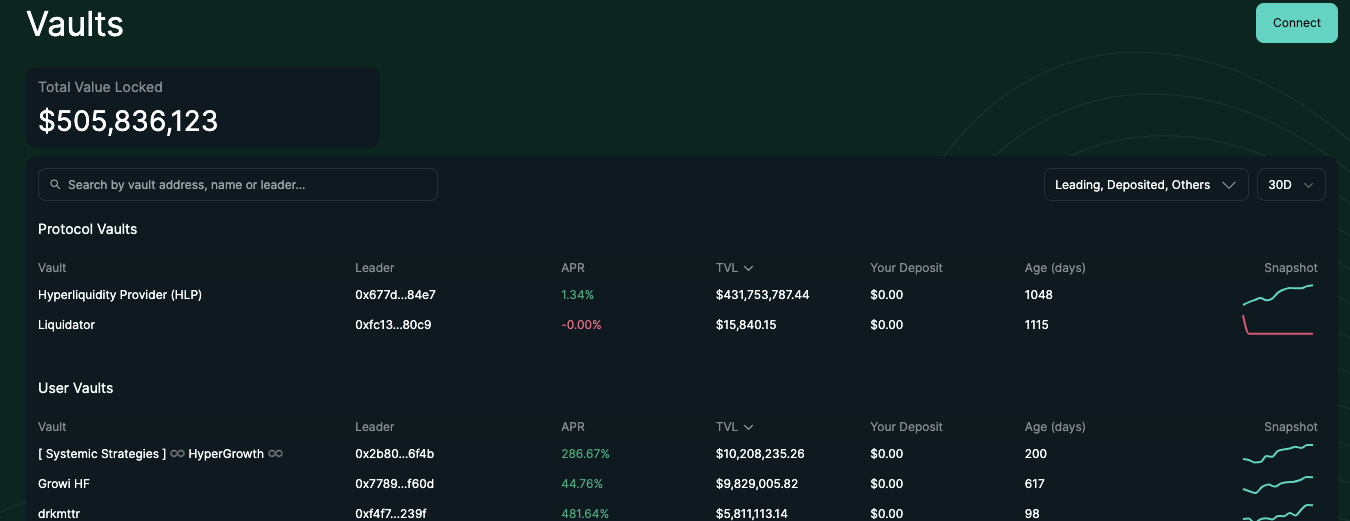
The Hyperliquid Vault uses smart contracts to provide a decentralized copy trading system that runs on code without intermediaries. With this, new traders can check out different Vaults, monitor performance, and deposit funds into profitable vaults to earn part of the 90% profit made by the Vault owner from trading.
To get started after connecting your wallet to Hyperliquid, it is recommended that you take some time exploring the available Vaults to understand how it works and monitor Vaults’ performance over time.
Unlike copy trading, joining a vault increases trading capital since all the funds contributed can be used to execute trades. It comes with certain conditions that ensure that Vault owners manage the Vaults properly. For instance, the Vault owner is required to deposit $100 USDC when creating a Vault. Vaults also have a lock-up period to prevent investors from initiating withdrawal immediately after depositing funds.
One of the best alternatives to Hyperliquid Vault is the Apex Omni Vault. To use, learn how the Apex Omni Vault works here.
Who Should Use Hyperliquid Vaults?
The Hyperliquid vault is for users with a moderate risk appetite and little trading experience. With it, you do not need to trade actively; you only need to review available vaults, monitor past performance, and track order types to determine if it is the right one for you. The Hyperliquid vault is also for you if you love to explore different passive income mechanisms outside staking and yield farming.
Combining its on-chain transparency and vault performance dashboard allows you to carefully select a vault. For instance, you can review lead traders on any Hyperliquid leaderboards and see if your favorite traders have an existing vault. This allows you to invest in vaults managed by traders who share a similar risk appetite and trading philosophy as you.
Who Should Avoid It?
You should avoid joining a vault if you are looking for a completely stable passive income mechanism, because joining a vault is not completely risk-free. While the exchange prevents vault owners from withdrawing funds, assets added to a vault are used to execute several perpetual futures positions, and profit or loss is shared equally among the investors based on the percentage contributed to the vault.
This implies that aside from not receiving any profit, you may end up withdrawing less than the amount of USDC you added to the vault if the vault’s positions get liquidated.
Types of Hyperliquid Vaults
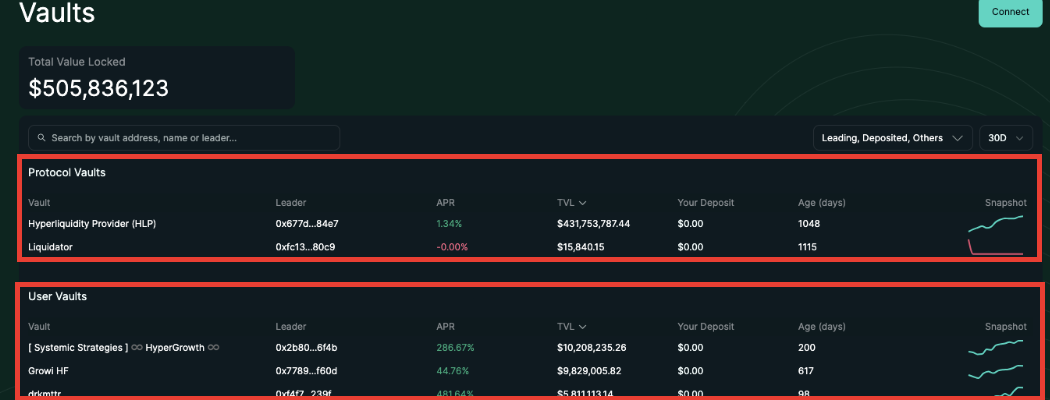
The Protocol Vaults:
What are Hyperliquid Provider (HLP) and Liquidator Vaults
Hyperliquid offers two vaults, which are essential for smooth trade execution on the platform. HLP and liquidator vaults provide liquidity to the exchange through several market-making strategies like facilitating liquidations, supplying USDC via earn, and occasionally acting as a counterparty to traders' positions to ensure fast execution.
Unlike other exchanges, where liquidity provision is offered to selected traders, HLP and Liquidator vaults are community-owned vaults that allow anyone to deposit funds for a share of the profit and loss based on their contribution percentage.
What is Hyperliquid Provider (HLP)
It is the backbone of the Hyperliquid exchange because the Vault significantly affects how traders execute trades and maintain positions. For instance, it can act as a market maker, providing deep liquidity for tight spreads and quick trade execution to reduce slippage.
This means the vault constantly takes multiple positions to provide liquidity. For instance, when a trader on Hyperliquid places a sell/long order, Hyperliquid vault may open a short/buy order. This is how orders get filled. As a market maker, HLP is positioned to earn a share of trading and funding fees, as well as capture spreads. This is how the vault PnL grows over time, increasing the Vault's value.
What is Hyperliquid Liquidator Vault
This is the second community-owned Vault on Hyperliquid that focuses mainly on providing liquidity for liquidation events in perpetual futures and spot trading. Unlike HLP, which uses many market-making strategies, the liquidator vault aims to ensure that traders' positions, including large-volume orders, are liquidated smoothly without impacting asset prices or market conditions.
Therefore, when the price of an asset moves against a futures trader or when a spot trader opens an order to sell a crypto asset, these are liquidation events. The Liquidator's Vault facilitates these processes to earn part of the liquidation fees and rebates.
Note that a single user does not manage any of these vaults. It relies on smart contracts to function, which means activities are pre-determined. While this ensures fast execution, it also exposes the Vault to significant risks. A good example is the Jelly attack of 2025. HLP was forced to take unfavorable positions when a big holder of the $JELLY token executed coordinated deposits and withdrawals to manipulate the token's price. HLP lost over $15 million due to this incident.
Finally, the protocol vaults have a 4-day lock-up period, meaning users cannot complete a withdrawal until 4 days after their most recent deposit.
Users’ Vault
Experienced traders with solid crypto trading strategies on Hyperliquid exchange can easily create individual vaults without huge restrictions. This makes it a better alternative to copy trading on centralized exchanges, where lead traders must complete verification and have their trading history scrutinized. On Hyperliquid, the process of creating a Vault, managing it, and executing traders runs entirely on smart contracts, which means anyone can create a vault, and vault owners can close the Vault at any time.
To protect vault contributors or investors, the exchange imposed certain conditions. First, the lead trader or vault owner must deposit at least $100 USDC into the Vault. Also, as a self-custody exchange, Hyperliquid ensures that vault owners do not have access to investors' funds; instead, users retain access and custody of their funds. Vault owners can only execute trades with the fund; they cannot withdraw it.
Finally, to keep a vault running, you must also maintain at least 5% of the total value locked in the Vault.
How Does Hyperliquid Vaults Work for Traders?
Creating a user vault on Hyperliquid allows experienced traders to share their trading strategies with a large community of investors. The investors deposit funds, usually USDC, into the Vault, giving vault owners or traders access to large capital for trading. This also means that vault owners can increase their profit margin considerably compared to trading solo.
As a trader with good strategies but low capital, you can create a vault with a $100 USDC deposit and watch the Vault's total value increase as investors deposit funds into it. However, it is important to note that your vault performance is available to users to review specific trading details, such as pnl, max drawdown, volume, open positions, trade history, and the number of contributors or investors. Therefore, a vault with a good trading history attracts more investment.
The vault owner uses the fund in the Vault to open several crypto positions. In return, you earn 10% of the profit or loss made. For instance, if you create a vault with $100 in USDC and investors deposit a total of $ 1,900 USDC, that will increase trading capital to $2,000. Instead of trading with your $100 USDC, you can now open several trading positions with $2,000 USDC and receive 10% of the profit made.
Benefits
- Increased trading capital: More contributors means access to high trading capital
- Profit sharing: Earn 10% of the total profit made
- Low entry barrier: Traders can create a vault with as little as $100 USDC
Think you can manage a crypto vault? Start trading on Hyperliquid to create one
How Does Hyperliquid Vaults Work for Investors
Investors on Hyperliquid have access to two types of vaults: the protocol Vaults (HLP and liquidator vault) and the user vaults. With the protocol vault, investors act as liquidity providers and market makers by indirectly providing liquidity on the exchange. These vaults use several market-making strategies to generate profits and share them among all vault contributors.
Alternatively, investors can deposit funds into vaults created by other traders on the exchange to earn 90% of the profit made within the Vault. A typical user's Vault is a decentralized copy trading protocol that allows investors to earn from the trading strategies of the vault owner, or the lead trader. It comes with a 1-day lock period, meaning you must wait at least 1 day after your most recent deposit before making a withdrawal.
How to Join a Hyperliquid Vault
Step 1: Visit the official Hyperliquid website and connect your decentralized wallet, like Metamask.
Step 2: Add USDC to the exchange via your wallet using the deposit menu.
Step 3: Transfer the USDC from your spot account to your Futures account within the exchange. You can complete this at zero gas fee.
Step 4: Navigate to the top menu options, then click on 'Vault'
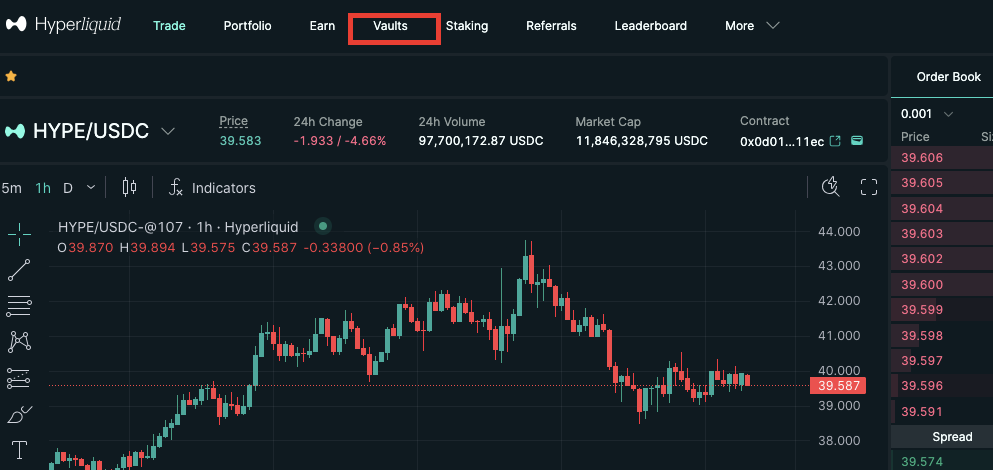
Step 5: Check out the available protocol and users' vaults, then click on any to add your USDC
Step 6: On the next page, click on deposit and add the value of USDC you wish to deposit into the Vault. No particular restriction here.
Step 7: Click on 'Deposit.'
With this, you have successfully joined a Hyperliquid vault. However, note that it is essential to review the Vault's performance before joining. A vault with a linear profit margin and low drawdown is more likely to generate good profits compared to a vault with poor performance and high losses.
How to create a Hyperliquid Vault
Anyone on the Hyperliquid exchange can create a vault following these 5 simple steps:
Step 1: Visit the official Hyperliquid website and connect your decentralized wallet
Step 2: On the top menu, click on 'Vault', then click on 'Create Vault'
Step 3: Choose a name and write a description for your Vault (You cannot change these)
Step 4: Deposit at least $100 USDC into your Vault
In 4 easy steps, you have created a Hyperliquid vault. Now, start trading to improve performance and attract more investors. Note that you must always maintain at least 5% of the Vault.
Risks of Hyperliquid vaults
Creating or depositing into a Hyperliquid vault comes with significant risk. Aside from the smart contract risks noted under the protocol vaults, joining users' vaults on Hyperliquid can also expose you to certain risks, including impermanent loss of assets and significant losses in a volatile market.
For investors, the main risk of depositing funds into a user vault is that trading outcomes are not always predictable. Generally, investors take 90% of the profit and losses; therefore, if the vault owner executes a couple of trades and loses some money, that loss is deducted from the Vault's total value. Your share remains the same percentage, but the actual value may reduce.
For instance, if you deposited $400 USDC into a vault worth $4,000 USDC, you have a 10% share of the Vault. If the vault owner executes trades repeatedly and loses $ 3,000 USDC in total, the total value is now $1,000 USDC, which means your 10% share is now $100 USDC.
Is there a way to reduce or prevent this?
Yes, you can reduce the chances of losing your funds by carefully reviewing the vault performance; however, you cannot completely prevent it. While you can track the Vault's performance and history, past performance is not necessarily a guarantee of future performance.
This means that you cannot be 100% certain that a vault will remain profitable just because it has performed well in the past. Drastic changes in market conditions, traders' experience, and even the personal circumstances of the vault owner may still affect future trading and profits.
Though Hyperliquid has a robust security model, traders and investors must keep in mind that the Hyperliquid vault runs on smart contracts to eliminate intermediation. However, smart contracts are still prone to bugs and attacks, which means a breach of the smart contract can lead to price manipulation, wrong liquidation, and may lead to impermanent loss of assets.
Interested in earning passive income on Hyperliquid? Get started on Hyperliquid with our affiliate link to join Hyperliquid Vaults.
How To Reduce Risk When Using Hyperliquid Vaults
One effective way to reduce risk is diversification. Instead of depositing all your funds into a single vault, you can spread your capital across multiple vaults with different strategies.
This way, if one vault underperforms, profits from other vaults can help balance your overall returns.
For example, you could allocate:
- 50% to a stable, low-risk vault
- 30% to a higher-risk, high-return vault
- 20% to protocol vaults like HLP
Final Thought
Earning without active crypto trading has become increasingly easy for professional and new traders. With approaches like crypto vault, beginners can now benefit from profitable crypto trading strategies while they perfect their personal trading plan.
Also, creating a vault means traders can reduce risk exposure. The $100 USDC minimum deposit means professional traders can reduce their financial commitment, trade with low personal capital, and enjoy access to the total funds contributed by investors.
Frequently Asked Questions
What is the minimum amount I can deposit into the Vault?
You can deposit as low as $10 into any vault on Hyperliquid. Keep in mind that this amount determines the profit you receive. This means adding more funds can increase profit significantly.
Are there alternatives to Hyperliquid vault?
Yes, decentralized exchanges like Apex Omni and dydX offer solid vaults for passive income. Check out some of the best crypto vaults or try copy trading on centralized exchanges like Bybit or Binance.
What is the difference between copy trading on centralized exchanges and crypto vaults on decentralized exchanges?
The main difference is that while centralized exchange offers centralized copy trading, which requires verification and third-party approval (usually the exchange) to operate, exchanges like Hyperliquid and Apex Omni offer decentralized copy trading, which is permissionless.
What happens when a vault is closed by the owner?
Before a vault leader can close the vault, all positions must be closed, and once the vault is closed, investors will automatically receive their share of the vault
How do I withdraw from a vault?
On a vault’s page, click on ‘Withdraw’, then enter the amount you’d like to withdraw and click “Withdraw.” Note that the Hyperliquid Provider vault has a lock-up period of 4 days. User vaults have a lock-up period of 1 day.
Related Articles:
- Is Hyperliquid Safe in 2026? Risks, Security & Real Incidents
- How to Safely Follow Whales on Hyperliquid (With Alerts & Indicators)
- How to Copy HyperLiquid Wallets (Whales, Risks & Smart Strategies)