Hyperliquid vs Apex Omni (2026): Which DEX Is Better for Traders?

Hyperliquid is currently the most dominant decentralized exchange, but is it actually the best choice for traders in 2026? Or could a DEX backed by Bybit, the most stable centralized exchange, be better?
Hyperliquid is considered the most transparent decentralized exchange right now, where traders can easily track orders, positions, trades, sentiment, and wallet addresses, or execute futures and spot trades without liquidity delays. However, Hyperliquid is not the only option. Launched in 2023, Apex Omni is another decentralized exchange built on Apex Pro and backed by Bybit.
Unlike regular DEXs like Uniswap, Hyperliquid and Apex Omni replace Automated Market Maker (AMM) with on-chain orderbooks used by centralized exchanges to provide fast and seamless trading experiences; however, they are not the same. Two key differences stand out: Hyperliquid is built on a Layer-1 blockchain with complete on-chain visibility. Apex Omni relies on a Layer-2 blockchain and enhanced privacy features.
Let’s discover some of the leading differences between Hyperliquid and Apex Omni
Need alternative DEXs to Hyperliquid and Apex Omni? Check our article on some of the best DEXs in 2026.
Hyperliquid vs Apex Omni: Key Differences
|
Features |
Hyperliquid |
Apex Omni |
|
Blockchain |
Hyperliquid (L1) |
Arbitrum (L2) |
|
Market visibility |
Full on-chain visibility |
Limited visibility |
|
Security model |
Uses its own security model |
Relies on the Ethereum security model |
|
Multi-chain support |
Available. Only receive USDC via Arbitrum Chain |
Available. Can receive USDC / USDT from any chain |
|
Trading fee (Maker/Taker) |
Spot: 0.04% / 0.07% Perps: 0.015% / 0.045% |
Spot: 0.0425% Perps: 0.02% / 0.05% |
|
Trading pairs |
243+ |
130+ |
|
Leverage |
Up to 40x |
Up to 100x |
|
Margin maintenance |
Available |
Available |
|
Stablecoin |
USDC, USDT, USDH |
USDT, USD |
|
Trading type |
Spot, Perpetual, Tradfi, HIP-3 & Pre-launch trading |
Spot, Perpetual, Grid, and RWA |
|
Gas fee |
Zero on in-exchange activities |
Zero on in-exchange activities |
|
Order types |
Market, limit, TWAP, stop limit |
Market, limit, conditional orders |
What Is Hyperliquid?
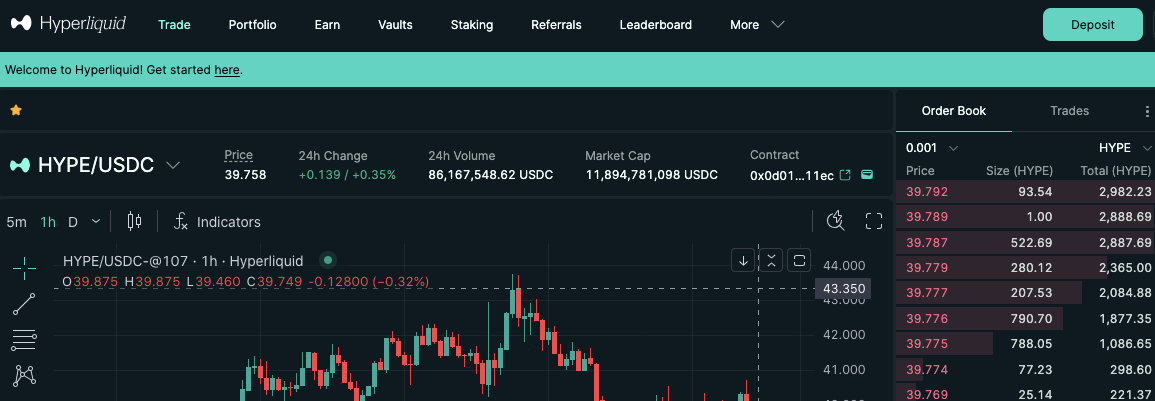
One feature that sets Hyperliquid apart from some of the latest decentralized exchanges is how it prioritizes transparency over complete privacy. With this, it becomes easier for traders to track whale trades and monitor market sentiment. However, aside from the feature, Hyperliquid is still a solid exchange for trading.
Known for its deep liquidity, Hyperliquid was first introduced in 2022 by Jeff Yan and Iliensinc. Over time, Hyperliquid adoption has grown significantly among traders, making it the number one DEX on CoinMarketCap.
The exchange is built on its own Layer-1 blockchain, Hyperliquid, for fast transaction execution and transparency. Hyperliquid now supports multi-chain access via third-party bridges like Unit.
New to Hyperliquid? Check out our complete Hyperliquid tutorial to learn how to deposit, trade, and withdraw step-by-step.
Quick Note: I find the multi-chain support quotes interesting because it allows traders to deposit over 15 crypto assets from different blockchains. To trade, you’ll need to convert other crypto assets or stablecoins like USDT to USDC as the only functional trading margin on Hyperliquid. Note that when making a deposit, you cannot send below the minimum amount or use a different blockchain. For example, you can only send at least 0.0003 BTC via the Bitcoin Blockchain.
Start trading on Hyperliquid via our affiliate link to receive a 4% fee discount on all trades.
What Is Apex Omni?
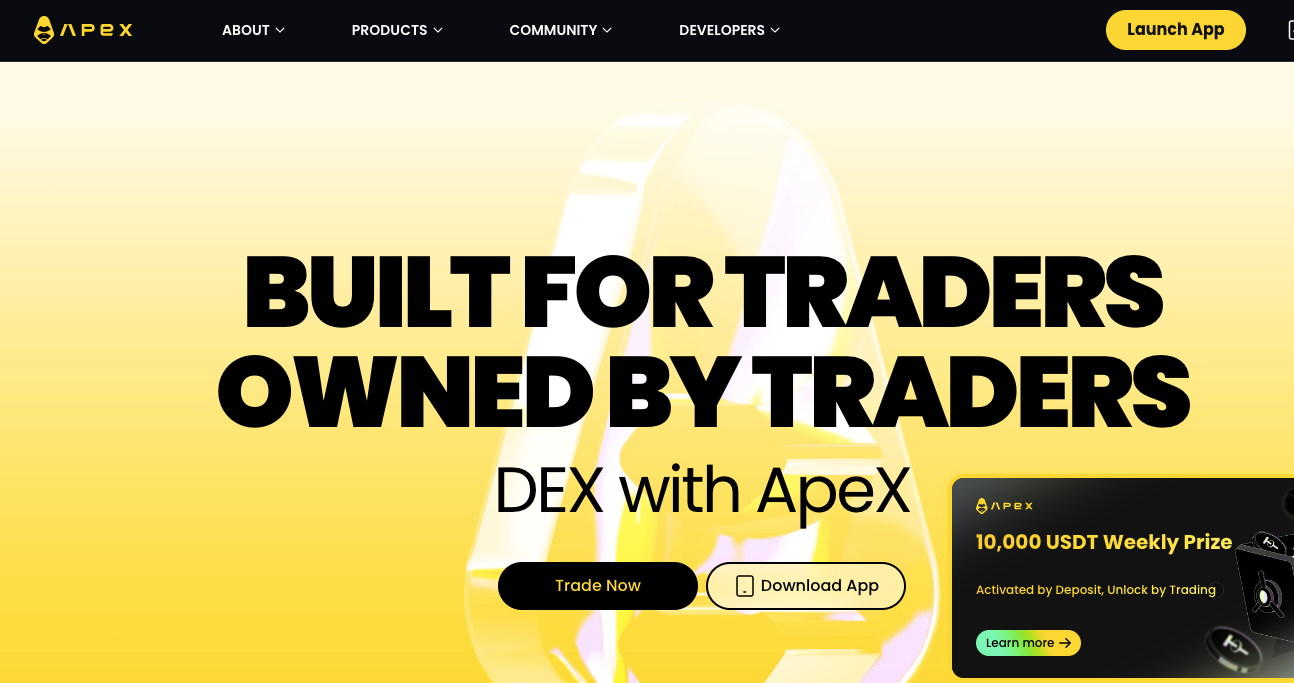
Backed by Bybit, Apex Omni is a leading decentralized exchange built on Arbitrum, a Layer-2 blockchain known for faster transactions and low gas fees. Though the Arbitrum chain is known for slow finalization, Apex Omni overcomes this challenge by introducing a fast withdrawal process, which means traders can withdraw assets without delay.
Like Hyperliquid, Apex Omni also offers multi-chain support and deep liquidity. With this, users can complete high-volume trades without impacting asset prices.
Check our Apex Omni tutorial for a complete guide on how to trade on Apex Omni.
Blockchain Infrastructure: Hyperliquid vs Arbitrum
Hyperliquid blockchain is a Layer 1 blockchain with 0.07 block time and a capacity to process up to 200,000 TPS. The blockchain has two broad components: HyperCore and HyperEVM.
HyperEVM is designed specifically to support Hyperliquid perpetual futures and spot trading. It offers faster throughput and high-level transparency. This means that while traders can enjoy the regular blockchain anonymity since transactions are completed via wallet addresses, transaction details remain available for anyone to trace and view.
Apex Omni relies on Arbitrum, a Layer 2 blockchain with a 0.25-second block time. As a Layer-2 chain, it is designed to provide decentralized applications and networks with enhanced scalability through rollup technology while retaining Ethereum's security models. On Arbitrum, microtransactions are bundled off-chain and sent to Ethereum for finalization. This structure makes trading on Apex Omni safe and cheap, but due to the finalization process, withdrawals may be slow.
Summary: With Hyperliquid, you get a dedicated trading environment that is fast, transparent, and relies on its own security model. Apex Omni is built on the Arbitrum chain with a lower block time and a wide ecosystem.
Wallet Connection
To trade on Hyperliquid or Apex Omni, users need to connect their decentralized wallets like Metamask, Rabby, Phantom, or Web3 wallets. Hyperliquid works with OKX or Coinbase Web3 wallets, while you can easily connect a Bybit Web3 wallet on Apex Omni.
Connecting any of these wallets means you can transfer funds to the exchange, execute trades, and withdraw your assets back to the wallet.
Also, Hyperliquid and Apex Omni allow users to create an account directly on the exchanges. With this, you can create a Hyperliquid or Apex Omni account, get a unique wallet address that can be used to receive or transfer crypto. No identity verification.
How to Create a Hyperliquid or Apex Omni Account
Step 1: Visit Hyperliquid or Apex Omni to get started
Step 2: Click on 'Connect' on the home page
Step 3: In the available options, select 'Log in with Email'
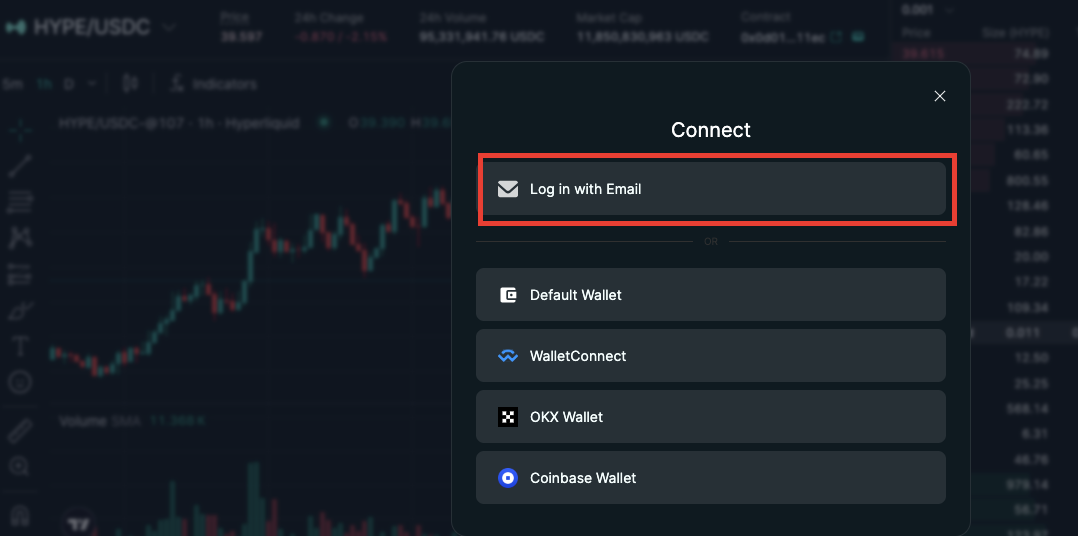
Step 4: Now, input your email address
Step 5: At this point, the exchanges will send you a verification code. Input the code to verify your email address.
Step 6: Accept the exchange Terms and Conditions to gain full access
On the home page, you can click on ‘Deposit’ to view your unique wallet address and add funds.
Quick Note: Your wallet address can receive USDC from the Arbitrum or HyperEVM chain. Sending different crypto assets like $BTC or $ETH or sending USDC from different blockchains may result in loss of asset. On Apex Omni, you can only send a minimum of 10 USDT from the Arbitrum One Chain.
Security and Privacy
To stabilize trading and protect users' assets, Hyperliquid and Apex Omni feature robust security models that safeguard users' assets and protect trades.
For instance, Hyperliquid combines MEV protection with regular smart contract auditing and bug bounties. Apex Omni, on the other hand, offers enhanced security through the StarkEx Layer 2 scalability model.
Whales & Wallet Tracking on Hyperliquid
Many traders consider Hyperliquid to be very transparent due to its design. With this, users can track all wallets and transaction details on the exchange. However, like every decentralized network, Hyperliquid does not require personal details or identity verification. Hence, traders' identities remain hidden, but wallet addresses are publicly available for tracking.
Check out our article on some of the best Hyperliquid tools in 2026 for whale and wallet tracking.
zkLink Privacy on Apex Omni
Apex Omni combines Arbitrum infrastructure with zkLink X technology and Stark-tech, a cryptographic proof that validates transactions without revealing full transaction details.
This technology ensures transactions are recorded on-chain for transparency, but only the sender and receiver have access to full transaction details. Hence, details such as the amount sent, wallet balance, sender, and recipient wallet addresses may not be available. This is how Apex Omni balances privacy and transparency.
Trading Fees: Maker, Taker, and VIP Discounts
Hyperliquid Fee Structure
On Hyperliquid, traders pay:
- 0.04% maker fee and 0.07% taker fee on spot trading.
- For perpetual futures, Hyperliquid applies 0.015% maker fee and 0.045% taker fee.
Apex Omni Fee Structure
- Apex Omni applies 0.0425% trading fee on all spot trading.
- For futures trading, Apex Omni applies 0.02% maker fee and 0.05% taker fee.
Comparing the fee structures shows that Apex Omni applies a higher fee on futures trading, making Hyperliquid a better option for high-frequency traders. If you are only interested in buying cryptocurrencies at their current prices on spot, Apex Omni has a lower fee.
Finally, users can complete in-exchange activities across all blockchains at zero gas fee. However, you pay a gas fee for deposits or withdrawals from another wallet.
How to Reduce Trading Fees on Hyperliquid and Apex Omni
For large-volume traders, even small trading fees can compound quickly. This is why exchanges often offer several ways to reduce trading fees.
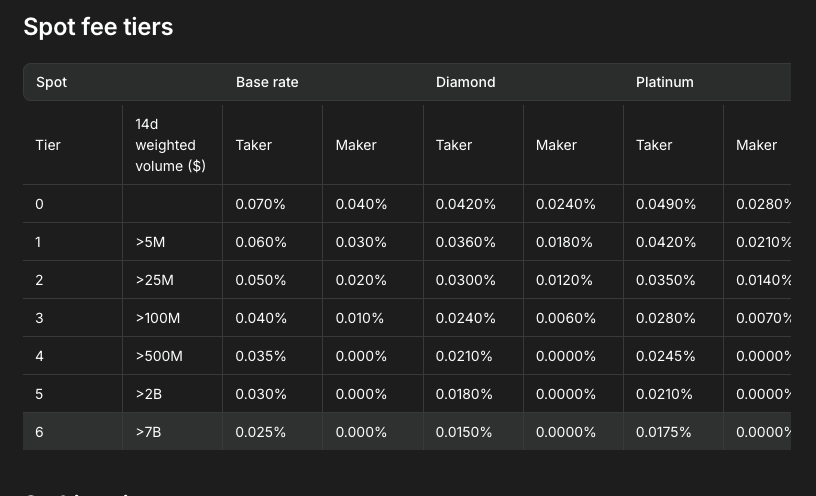
On Hyperliquid and Apex Omni, you can reduce trading fees drastically when you qualify for the VIP tiers. With this, Apex Omni offers a 50% fee discount, and Hyperliquid offers a maximum 40% discount on trading fees.
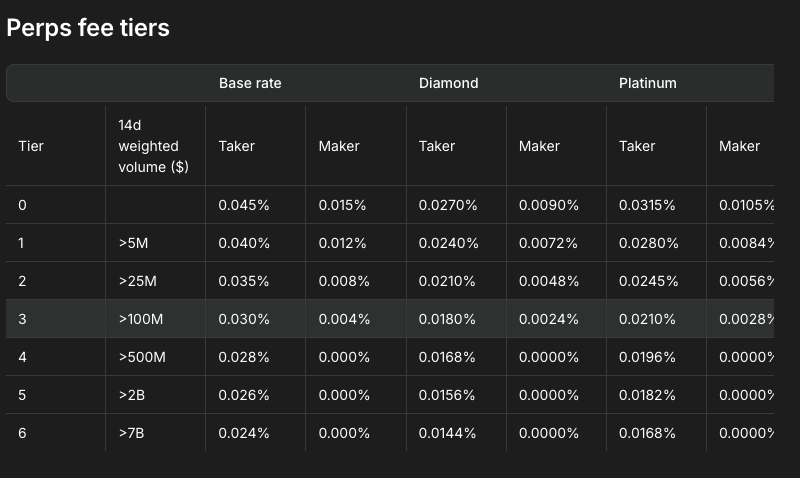
Also, users can also reduce trading fee by increasing perps or spot trading. To get up to 50% fee discount, you must reach certain trading volume within 14 days. For a detailed guide on how it works, visit the Hyperliquid official fee structure page.
Hyperliquid Perps Fee Tiers (with Fee Discount)
Hyperliquid Spot Fee Tiers (with Fee Discount)
Also, Apex Omni currently offers a 10,000 USDT weekly reward in an ongoing deposit and trade campaign. With this, users can earn sufficient crypto bonus to cover trading fees. Visit the Apex Omni bonus activity page to participate.
Finally, new or low-volume traders who do not qualify for this tier system can reduce trading fees using the referral fee discount. With our referral code or link, you get a 4% fee discount on Hyperliquid and a 5% discount on Apex Omni.
Start trading on Hyperliquid or sign up on Apex Omni to get a discount on your trading fees.
Liquidity and Order Book Depth (24-Hour Volume by CMC)
At the time of writing, Hyperliquid records higher daily transaction volume than Apex Omni; however, this does not mean that traders do not enjoy frictionless trading on Apex Omni. Hyperliquid remains a leading choice for large-volume traders, which has contributed to its liquidity depth.
That Apex Omni records lower trading volume when compared to Hyperliquid does not necessarily mean high slippage or shallow liquidity; users can complete large-volume orders smoothly on both Hyperliquid and Apex Omni. However, it may be important to consider liquidity coverage when interacting with less popular crypto alts.
Features and Users' Experience
- Interface: From a simplified interface to a very straightforward UI design, Hyperliquid and Apex Omni provide users with a sleek, beginner-friendly interface. With this, users can navigate features such as deposit, withdraw, transfer, convert, and spot swap easily.
- Deposit and Withdrawal: On both exchanges, deposits take a few minutes, depending on the blockchain. However, while Hyperliquid offers fast withdrawals easily, normal withdrawals on Apex Omni may take up to 4 hours.
- Trading Models: Hyperliquid offers spot, perpetual, Tradfi, and HIP-3 trading (third-party market). Apex Omni, on the other hand, offers only spot, perpetual futures, and RWA trading.
- Trading pairs: Hyperliquid has 230+ pairs, while Apex Omni has 100+.
- Supported chains: Hyperliquid supports multiple EVM and non-EVM blockchains, while Apex Omni supports 4 blockchains (Arbitrum, Ethereum, Mantle Network, and Base).
- Leverage: Hyperliquid offers up to 40x while Apex Omni offers up to 100x on popular assets like BTC and up to 50x on other alt coins.
- Margin Maintenance: To keep your trade open on Hyperliquid, you need at least 16.7% of your margin if you are using low leverage (3x), 1.25% if you are using high leverage.
What is Apex Omni Fast Withdrawal?
While normal withdrawals take longer on Apex Omni because it relies on the Arbitrum blockchain, Apex Omni offers an alternative withdrawal process for faster results. With this, you can enjoy a similar withdrawal speed to what you have on Hyperliquid.
Apex Omni's fast withdrawal option processes withdrawal requests immediately, but it attracts a handling fee. With this, the total withdrawal fee (handling fee + gas fee) is around $2 on supported chains except on Ethereum, where the withdrawal fee may be lower or higher depending on the gas fee, gas limit, and $ETH price.
Summary: From blockchain security to transparency and exchange interface, Hyperliquid and Apex Omni are good choices for traders. However, traders with a strong interest in optimal transparency, lower trading fees, and faster withdrawals can opt for Hyperliquid, while Apex Omni remains the best option if you are looking for enhanced privacy, advanced trading models, and a higher discount on trading fees.
How To Earn Passive Income on Hyperliquid and Apex Omni
Apex Omni and Hyperliquid offer passive income through referral rewards, ongoing trading challenges, staking, and crypto vaults. With this, users can add funds to a staking pool, participate in challenges, refer other traders, or join a crypto vault to earn returns.
To generate a referral code or link and earn commission, traders with at least $10,000 in trading volume can earn a referral commission on Hyperliquid. However, anyone can get a referral code or link on Apex Omni.
How Crypto Vault Works (Hyperliquid & Apex Omni)
- Traders add funds to any available vault, whether protocol vaults or a user's vault on any of the exchanges.
- The vault owners use the fund to execute several trades, and users receive 90% of the profit or loss based on their share of the Vault.
- On Hyperliquid and Apex Omni, users can monitor vault performance and easily add more funds or withdraw assets.
To learn more, check out our previous article on Hyperliquid Vault or see how Apex Omni Vault works.
Pros and Cons of Hyperliquid
Pros
- Offers 243+ trading pairs, lower trading fees, and deep liquidity
- Full transparency for wallet tracking
- Advanced trading models
- A diverse passive earnings mechanism
- Offers referral commission and fee discount
- Zero gas fees on its native blockchain
- Up to 40x leverage.
- Fast deposit and withdrawal
Cons
- No protection for orders
Pros and Cons of Apex Omni
Pros
- Traders enjoy higher privacy
- Offers 130+ trading pairs, low trading fees, and deep liquidity
- Advanced trading options
- A smooth and easy-to-use interface for all traders
- Diverse passive income mechanisms
- High referral commission and fee discounts
- Up to 100x leverage
- Offers ongoing crypto bonus ($10k USDT weekly reward)
Cons
- The trading fee is significantly higher than Hyperliquid
- Normal withdrawal takes up to 4 hours (an alternative is its fast withdrawal option)
Final Thought: Which Exchange Should You Choose?
While Hyperliquid leads in fees, liquidity, and transparency, Apex Omni is the better choice for most traders in 2026 due to its ease of use and familiar trading experience.
Apex Omni offers a more familiar, Bybit-like experience with structured tools like grid bots and copy trading, making it easier to use and more practical for everyday trading.
Choose Apex Omni if:
- You prefer a Bybit-like trading experience
- You want more privacy
- You use structured tools like grid bots or copy trading
Choose Hyperliquid if:
- You want lower trading fees
- You trade large volumes or need deep liquidity
- You value full transparency and on-chain data
Let's do a quick recap of everything.
|
Features |
Hyperliquid |
Apex Omni |
|
Exchange tokens |
$HYPE |
$APEX |
|
Liquidity |
Very high |
Medium |
|
Passive income |
Earn, referral vault & staking |
Referral, Vault, and staking |
|
Wallet connection |
Decentralized and web3 wallets |
Decentralized wallet and Bybit web3 wallet |
|
Interface |
Suitable for beginners and pros |
More suitable for beginners |
|
Multi-chain support |
Yes (limited) |
Yes (more options) |
Frequently Asked Questions
What is the difference between Maker and Taker Fees
Crypto exchanges apply maker fees on limit orders and taker fees on market orders. A limit order is filled at a predicted price; therefore, it adds liquidity to the exchange orderbook. A market order is filled at the current market price, and it takes liquidity out of the order book.
Can I access Hyperliquid and Apex Omni in the US?
These platforms are decentralized and can typically be accessed from anywhere. That said, users in the United States should always check local regulations before using them.
What is TPS?
TPS stands for Transactions Per Second, which means the number of transactions that a blockchain can process within a second.