Hyperliquid vs AsterDEX: Which DEX Is Better for Trading in 2026?
Hyperliquid and AsterDEX are two popular decentralized exchanges for perpetual futures and spot trading, but they are not exactly interchangeable. While AsterDEX focuses on protecting large volume orders to reduce MEV attacks and slippage, Hyperliquid is built around on-chain transparency.
Given that all trading activities are visible to the public, traders on Hyperliquid have discovered mysterious whales like the Trump Insider, either to improve their trading skills, track positions, or monitor market sentiment. As a trader, you can do this using the Hyperliquid leaderboard or any Hyperliquid tracking tools like Whalestreet.
In this guide, we compare Hyperliquid and AsterDEX side by side, noting the key differences in their structure and features that can impact your trading experience.
Hyperliquid vs AsterDEX: Key Differences
|
Features |
Hyperliquid |
AsterDEX |
|
Blockchain |
Hyperliquid (L1) |
BNB Chain (L1) |
|
Market visibility |
Public Wallet & position tracking |
Hidden order for privacy |
|
MEV exposure |
Considerably High |
Low - Moderate |
|
Trading fee (Maker/Taker) |
Spot: 0.04% / 0.07% Perps: 0.015% / 0.045% |
Spot: 0.005% / 0.04% Perps: 0.01% / 0.035% |
|
Fee discount |
40% with $HYPE staking 4% with affiliate link |
5% trading with $ASTER 2% with affiliate link |
|
Leverage |
Up to 40x |
Up to 1001x |
|
Margin |
USDC |
USDT, USD1 |
|
Trading type |
Spot, Perpetual, Tradfi, HIP-3 & Pre-launch trading |
Spot, perpetual, stocks, & Pre-launch trading |
|
Gas fee |
Zero on HyperEVM |
Zero on BNB Chain |
|
Multichain support |
Yes |
Yes |
|
Order types |
Market, limit, TWAP, stop limit |
Market, limit, stop limit |
Want to start trading directly?
Join Hyperliquid → Get 4% fee discount (exclusive link)
Join AsterDEX → Get 2% fee discount (exclusive link)
What Is Hyperliquid?
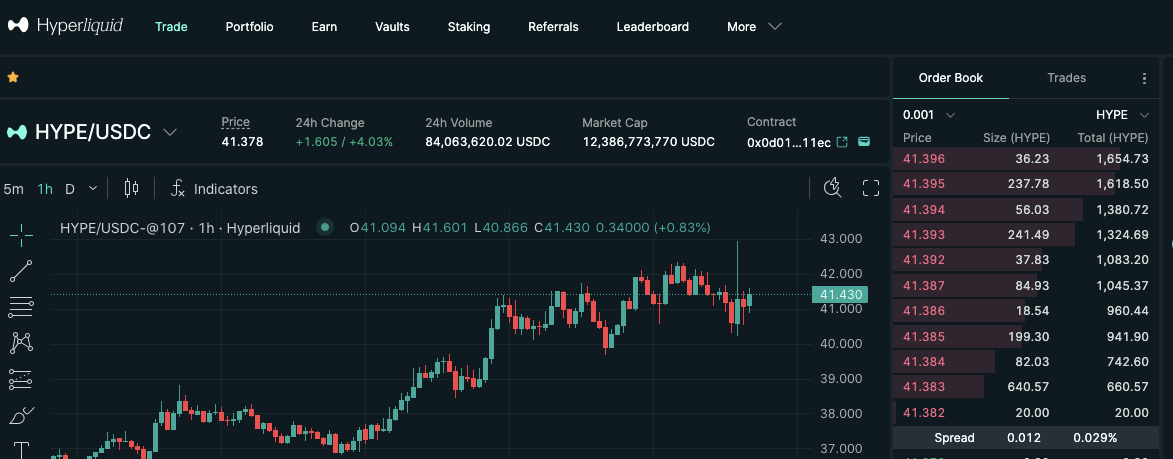
Hyperliquid is a decentralized exchange built by Jeff Yan and Iliensinc on a Layer-1 blockchain to provide spot and perpetual trading. It relies on the Hyperliquid blockchain, which can complete up to 200,000 transactions per second.
Additionally, Hyperliquid features deep liquidity and cross-chain functionalities (covering both EVM and non-EVM blockchains) that ensure that users can complete high-volume trades with low slippage and deposit from any blockchain. With this, you can send over 15 crypto assets like BTC, ETH, SOL, MON, ZEC, and several other assets from their different specific blockchains.
Quick Note: Pay attention to the minimum deposit and blockchain per asset to avoid loss of asset.
Start trading on Hyperliquid through our affiliate link for 4% fee discount.
What Is AsterDEX?
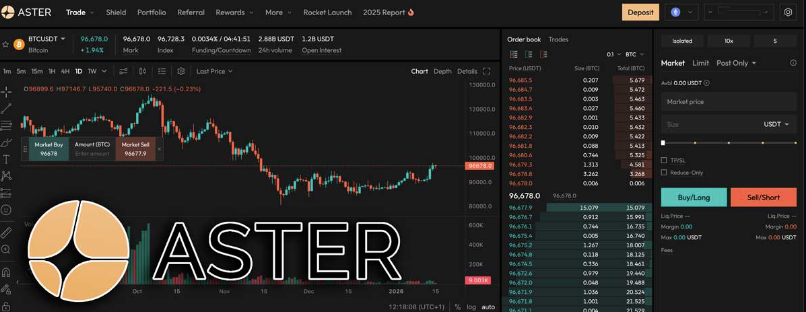
AsterDEX is a leading decentralized exchange backed by YZA Lab (ex-Binance team) to offer CEX-like spot and perpetual trading. Combining deep liquidity with extremely high leverage, AsterDEX remains a top choice for experienced crypto traders since its launch in 2025.
Though a newly launched project, the ecosystem has grown rapidly over time. In addition, it features multi-chain access, which allows traders to interact with the exchange using different blockchains.
With its hidden order feature, professional traders can hide large-volume trades from MEV bots and advanced privacy.
Check our AsterDEX tutorial for a complete guide on how to trade on AsterDEX.
Blockchain Infrastructure: Hyperliquid vs BNB Chain
Hyperliquid is a Proof-of-Stake Layer 1 blockchain with a 0.07-second block time and the capacity to handle up to 200,000 transactions per second.
Aside from its faster throughput, one feature of Hyperliquid is transparency. It is a fully permissionless public ledger where anyone can access transaction data at any time. Therefore, while traders enjoy anonymity, users can always track wallet positions and discover whale trading strategies.
AsterDEX is currently on BNB Chain, a Layer-1 blockchain developed by Binance to support decentralized applications with fast transactions (0.45-second block time) and lower fees. AsterDEX benefits significantly from BNB Chain's large ecosystem and integrates smoothly with its consensus mechanism for security and scalability. Additionally, users enjoy zero gas fees on BNB Chain.
Summary: The blockchain infrastructure for Hyperliquid and AsterDEX is quite different. The main difference between the two DEXs is that HyperLiquid has public positions and AsterDEX does not. The speed might vary slightly, but not enough to experience that as a user.
Wallet Connection
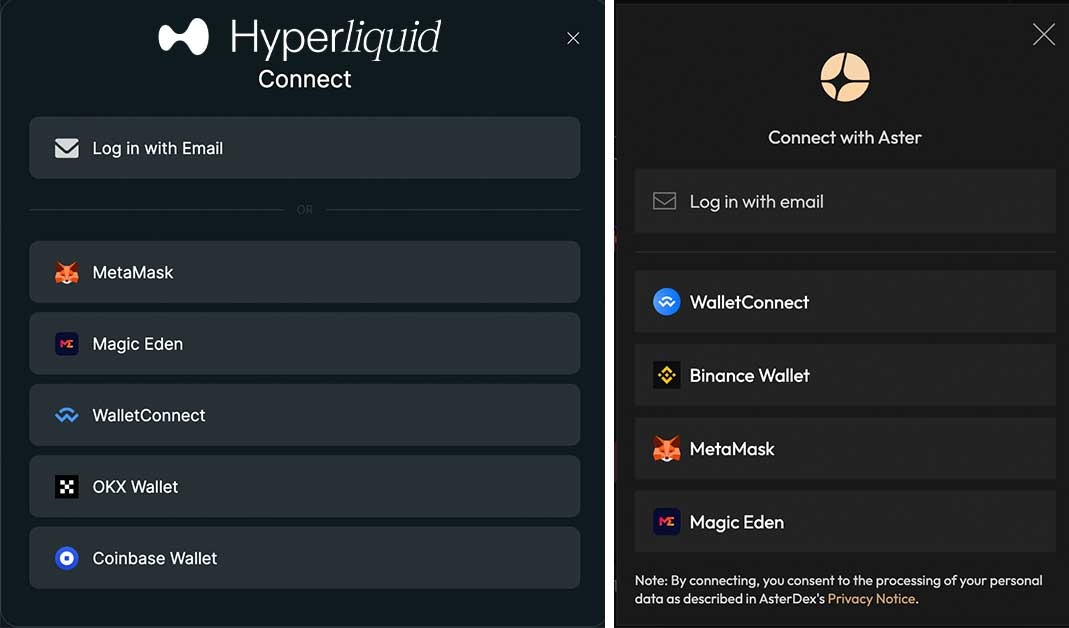
For connection, there are two options:
- Connecting decentralized or web3 wallets
- Creating an account on the exchange
Metamask or Trust Wallet are the most popular choices here if you want to connect decentralized wallets for multi-chain access. Alternatively, you can create an account using your email address to generate a unique wallet address for depositing and withdrawing funds. There is no KYC verification required.
Hyperliquid and AsterDEX also work with Web3 wallets built by centralized exchanges. You can connect AsterDEX to the Binance Web3 Wallet or use Hyperliquid with OKX or Coinbase wallet.
Quick Note: The email function will create a wallet address linked to your email. You will receive a code to access your account. The best way is to use a third-party wallet like MetaMask.
Security and Privacy
Hyperliquid and AsterDEX feature built-in MEV protection and high security models to protect users' trades. Now, let’s look at the differences in their security and privacy models.
Whales & Wallet Tracking on Hyperliquid
As a decentralized exchange, Hyperliquid combines basic self-custody with high-level security procedures like smart contract auditing, update reviews, bug bounties, and more to ensure that trading is safe and stable. However, the platform does not prioritize privacy. Instead, it focuses on transparency.
Users can track wallet activities, trading positions, and even copy or frontrun them. The core structure here is that traders enjoy blockchain anonymity, but trades are in the open for tracking.
New to wallet tracking on Hyperliquid? Check out some of the best Hyperliquid tools in 2026.
Hidden Orders & Whale Protection on AsterDEX
Compared to Hyperliquid, AsterDEX is a highly secure platform that prioritizes both security and privacy. Whales or large-volume traders can activate the Hidden Order functionalities for enhanced privacy.
With this, high-volume trades do not appear in the order book until they are executed. The feature is essential for protecting traders against MEV bots. Therefore, trades can be completed at minimal slippage without unnecessary price fluctuations.
Which is Better? Hyperliquid Transparency vs AsterDEX Privacy
The question of transparency and privacy depends largely on traders’ preferences. For beginners looking to monitor wallet positions and whale trading, Hyperliquid is the best place to start. However, AsterDEX is the complete opposite. With the hidden order feature, trades enjoy complete protection, making it a good choice for pro-traders who may be interested in advanced privacy.
Trading Fees: Maker, Taker, and VIP Discounts
Let's look at spot and perpetual futures trading fees on Hyperliquid and AsterDEX.
Hyperliquid Fee Structure
Spot trading: Traders pay a 0.04% maker fee and 0.07% taker fee
Perpetual futures: Hyperliquid applies 0.015% maker fee and 0.045% taker fee.
AsterDex Fee Structure
Spot trading: AsterDEX charges 0.005% maker fee and 0.04% taker fee.
Perpetual futures: Traders pay 0.01% maker fee on limit orders and a 0.035% taker fee on market orders.
For both spot and perpetual trading, AsterDEX offers cheaper trading fees. Additionally, you can also reduce trading fees on both exchanges by exploring their different fee discounts.
In short, AsterDEX is cheaper in fees, but Hyperliquid can narrow the gap with staking and discounts.
How to Reduce Trading Fees on Hyperliquid and AsterDEX
How to get a fee discount on Hyperliquid
- Join Hyperliquid via our affiliate link for 4% fee discount.
- Qualify for up to 40% fee discount by staking $HYPE token on the platform.
- Pay trading fees with $HYPE for an additional discount.
How to get a fee discount on Hyperliquid
- Join AsterDEX with our affiliate link for 2% fee discount on all trading.
- Qualify for up to 50% fee discount when you complete more futures trading.
- Get 5% fee discount when you pay trading fees with $ASTER.
Liquidity and Order Book Depth (24-Hour Volume by CMC)


As leading decentralized exchanges, Hyperliquid and AsterDEX offer sufficient liquidity and deep order books to facilitate smooth transactions without delay.
Hyperliquid has a large number of daily users and large volume traders; hence, its liquidity is way higher than what you have on AsterDEX. However, AsterDEX also relies on an aggregated liquidity from all supported blockchains to ensure traders can execute high-volume trades without incurring excessive slippage.
Features and Users' Experience
- Interface: Hyperliquid and AsterDEX offer a straightforward and beginner-friendly interface for users to easily navigate within the platform without unusual delay. If you found your way with a centralized exchange, the experience on Aster or Hyperliquid will not be that different.
- Deposit and Withdrawal: On both exchanges, deposit and withdrawal take between a few seconds and minutes, depending on the blockchain.
- Trading Models: Hyperliquid offers spot, perpetual, Tradfi, and HIP-3 trading (for Hyperliquid update proposal); AsterDEX offers only spot, perpetual, and grid trading.
- Trading pairs: Hyperliquid has 230+ pairs, while AsterDEX has 100+.
- Supported chains: Hyperliquid supports up to 30 EVM and non-EVM blockchains, and AsterDEX supports 4 blockchains (Arbitrum, Ethereum, BNB Chain, and Solana).
- Leverage: Hyperliquid offers up to 40x while AsterDEX offers up to 1001x.
- Margin Maintenance: To keep your trade open on Hyperliquid, you need at least 16.7% of your margin if you are using low leverage (3x), 1.25% if you are using high leverage.
In our testing, Hyperliquid’s order execution felt slightly faster, while AsterDEX’s hidden order feature helped reduce visible slippage during larger trades.
Which is Better? Hyperliquid 40x Leverage or AsterDEX 1001x Leverage?
The higher the leverage, the higher the liquidation risk. While Hyperliquid 40x is designed to offer users a moderate-high leverage, 1001x leverage on AsterDEX considerably increases the profit and loss range. With this, a slight move (0.2%) against your position may be enough to get you liquidated.
Note that while AsterDEX outperforms Hyperliquid here, using the 1001x leverage on AsterDEX offers lower returns and higher risk. With it, you get between 300% - 500% ROI in profit based on market conditions and bear 1000% in losses. Also, AsterDEX charges a standard 0.08% trading fee when you open and close a trade.
Example: If you open a trade with $200 and 1000x leverage, that is a $200,000 trade. A 2% winning rate gives you a maximum of $2,000 instead of $4,000, while a 0.1% dip in asset price liquidates your trade.
Summary: The ultimate answer is in the liquidation risk. Hyperliquid is suitable for traders with low-moderate risk appetite because it uses margin maintenance to reduce liquidation risk when you trade with lower leverage. On the other hand, AsterDEX offers extremely high leverage for those looking to maximize profits. Before trading, you must read on how to avoid liquidation in crypto futures.
How To Earn Passive Income on Hyperliquid and AsterDEX
Hyperliquid and AsterDEX share one similarity here because they both offer crypto staking for passive income earners. With that, you can stake $HYPE or $ASTER with validators on their respective exchanges to earn yields. On AsterDEX, you can earn as high as 22% APY.
Aside from staking, Hyperliquid and AsterDEX have additional passive income mechanisms. On Hyperliquid, you can access Crypto Earn and Crypto Vaults. With the earn structure, users earn lower than 1% APY when they supply either USDC or USDH (stablecoins) on Hyperliquid.
How The Hyperliquid Vault Works
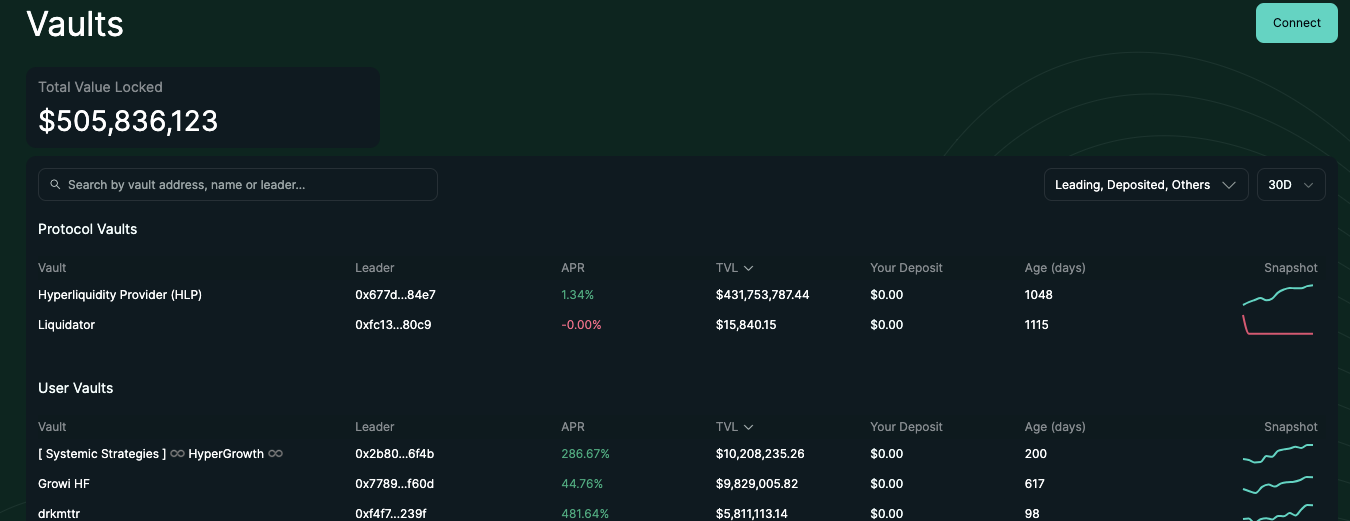
Traders add funds to the protocol or users' vaults. With protocol vaults, you are delegating your funds to provide liquidity on the exchange, while joining a user vault exposes you to decentralized copytrading. The Vault owner executes trades, and investors get 90% of the trade profit or loss.
How to Earn Passive Income on AsterDEX
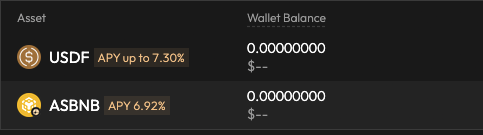
AsterDEX does not currently have a crypto vault; however, users can hold yield-bearing assets for returns. You can deposit and stake USDT or BNB on the exchange. In return, you get USDF or asBNB, which represent USDT and BNB. AsterDEX uses the underlying assets to maintain delta-neutral positions, like providing liquidity or funding rates.
You can hold or execute trades on the exchange with the USDF and asBNB for up to 15% APY or convert them back to USDT and BNB.
Hyperliquid and Aster DEX Referral and Promotions
Hyperliquid and AsterDEX offer a referral program and promotions to attract more users and reward traders. To generate your referral link or code, connect your wallet to any of the exchanges and click on ‘Referral’ on the home page menu. On Hyperliquid, you need at least $10,000 trading volume to do this. Also, the fee discount for the invitee applies to their first $25 million trading volume.
|
Referral Reward |
Hyperliquid |
Aster DEX |
|
Referrer's Commission |
10% on all trades |
Up to 10% on all trades |
|
Invitee's Fee discount |
4% fee discount |
Set by referrer |
|
Promotion |
No ongoing promotion |
Trade to Earn USD1 perp contract trading |
Pros and Cons of Hyperliquid
Pros
- Offers 230+ trading pairs, low trading fees, and deep liquidity
- Full transparency for wallet tracking
- Advanced trading models
- User-friendly interface
- Decentralized copytrading, earn structure, and staking for passive income
- Combines leverage with margin maintenance
Cons
- High potential for MEV attacks
- The trading fee is higher
- Public Positions (if you value privacy)
Pros and Cons of AsterDEX
Pros
- Advanced privacy and MEV protection for whales
- 100+ trading pairs, deep liquidity, lower trading fees
- 5% fee discount when you pay the trading fee using $Aster
- Up to 1001x leverage on a specific mode
- Offer ongoing promotion for more rewards/points
- No restriction on generating a referral code
Cons
- Few trading models.
- Limited passive income mechanism
Hyperliquid vs AsterDEX: Which One Should You Choose
To choose between Hyperliquid and AsterDEX, you must consider their core functionalities. Beyond fast trade execution, traders must choose between Hyperliquid transparency and AsterDEX advanced privacy. Alternatively, you simply decide to use Hyperliquid for low-volume trades and execute your high-volume orders on AsterDEX. With that, you enjoy whale tracking on Hyperliquid and eliminate the risks of being front-ran by MEV bots.
If you value,
Privacy: Choose AsterDEX
Liquidity: Choose HyperLiquid
A quick recap
|
Features |
Hyperliquid |
AsterDEX |
|
Exchange tokens |
$HYPE |
$ASTER |
|
Liquidity |
Very high |
Medium-high |
|
Passive income |
Earn, vault & staking |
Staking & Yield-bearing assets |
|
Wallet connection |
Works with major decentralized and Web3 wallets |
Decentralized wallets and only the Binance Web3 wallet |
|
Multi-chain support |
Yes (30 EVM and non-EVM chain) |
Yes (limited to 4 blockchains) |
Start trading Hyperliquid with our link to get 4% off trading fees, or join AsterDEX for a 2% trading fee discount.
Frequently Asked Questions
What is WhaleStreet?
WhaleStreet is a Hyperliquid whale alert tool that provides traders with data on Whale trading on Hyperliquid. Using WhaleStreet, you get real-time notifications on your mobile devices, which allows you to easily monitor whale activities and discover profitable trading positions. Click here to use WhaleStreet
Can I access Hyperliquid and AsterDEX in the US?
Hyperliquid and AsterDEX are decentralized exchanges that typically do not require KYC, making them accessible to users in many regions, including the United States. However, availability may vary depending on local regulations, so it’s important to check your jurisdiction before trading.
Can I use any other DEXs aside from Hyperliquid and AsterDEX?
Yes, the crypto space in 2026 features a lot of decentralized exchanges offering CEX-like perpetual trading without the limitations of centralized exchanges. For more options, you should check our article on the best decentralized exchanges for crypto trading in 2026.
What are MEV Bots?
MEV (Maximal Extractable Value) bots are automated programs used by malicious traders that scan pending transactions in the mempool and insert their trades before or after any transactions to make profits