Hyperliquid vs Bybit: Which Exchange Is Better in 2026?
Is Hyperliquid actually better than Bybit, or just an overhyped DEX? Could a DEX be better than a centralized exchange?
Hyperliquid's popularity has grown significantly among crypto traders, given its on-chain transparency and CEX-like trading structure. With this, traders can now execute million-dollar trades seamlessly on a DEX or track whale activities without easily
Bybit, on the other hand, is a leading centralized exchange. It features a decentralized crypto wallet that allows users to retain self-custody while trading on a centralized exchange. Using this, we had to constantly move assets from the Web3 wallet to the exchange, which led to paying excessive gas fees.
In this article, we compare Hyperliquid to Bybit to provide new and experienced traders with a complete overview of how trades are executed on the exchanges, trading fees, asset custody, and more
Short on time and want to use Hyperliquid or Bybit directly?
Join Bybit (Up to $30,000 deposit bonus)
Start trading on Hyperliquid (4% fee discount + no KYC)
Quick Summary
|
Exchange |
Ideal User or Situation |
|
Bybit |
|
|
Hyperliquid |
|
Need an alternative to Hyperliquid? Check out some of the best decentralized exchanges in 2026
What is Hyperliquid?
Hyperliquid is a leading decentralized exchange launched in 2023 to solve some of the problems of trading on regular decentralized platforms. With Hyperliquid, perpetual futures and spot trading are now fast, secured and transparent. Even better, traders also get multi-chain support to deposit 15+ assets on the exchange.
Hyperliquid retains features such as anonymity, transparency, and self-custody. Hyperliquid uses smart contracts and an on-chain orderbook, so all trades happen on the blockchain.
Aside from its fast trade execution, Hyperliquid stands out as a high-performance exchange with full transparency and deep liquidity. With this, users can easily track large volumes, learn about potential profitable positions, monitor market sentiment, and execute fast futures and spot trades.
If you're new to the platform, you can follow our step-by-step guide on how to use Hyperliquid to get started quickly.
What is Bybit?
Though trading on centralized exchanges has come under heavy scrutiny since the FTX crash, Bybit remains the second-largest centralized exchange with over 80 million global users. Founded in 2018, Bybit is known for its robust security model, deep liquidity, multi-chain support, and seamless trade execution.
As a custodian exchange, Bybit relies on a centralized asset storage system and an orderbook. With this, trades are completed off-chain without gas fees and recorded on the platform database. Only deposits or withdrawals attract gas fees.
To sum it up, both Hyperliquid and Bybit feature multi-chain support, but Bybit definitely offers a wider ecosystem here. Also, the minimum deposit amount on Hyperliquid is higher than what you have on Bybit for most assets. For instance, you can only deposit 0.12 SOL via the Solana Blockchain on Hyperliquid, whereas you can send as low as 0.001 SOL on Bybit.
Quick Tip: Bybit allows users to transfer funds to other Bybit accounts instantly via User IDs or email addresses without paying trading or network fees. Unlike Hyperliquid, you can also enjoy up to $30,000 USDT bonus on Bybit as a new user. Check our Bybit Deposit Bonus and Referral Guide to participate.
Blockchain Infrastructure: How Hyperliquid and Bybit Interact with Blockchain
Hyperliquid relies on its own blockchain, the HyperEVM layer, designed to support the exchange with a 0.07 block time and to process over 200,000 transactions per second. Literally one of the fastest blockchains out there. Every transaction on Hyperliquid interacts with the blockchain and is recorded accordingly.
Start trading on Hyperliquid with our affiliate link for 4% discount on your trading fees.
Bybit, on the other hand, does not interact with the blockchain for trading; instead, it relies on its internal system. Actual trading is completed off-chain, while deposits and withdrawals are processed on the blockchain.
Sign up now on Bybit to join the $30,000 in its ongoing USDT bonus
How Transaction and Wallet Tracking Works on Hyperliquid and Bybit
Using an on-chain orderbook and a fully distributed blockchain makes Hyperliquid transactions publicly available. With the right tools, you can view the entire state of the exchange on the Hyperliquid blockchain. For instance, you can access a Hyperliquid leaderboard on CoinGlass, track all open positions with entry price and liquidation level, or use WhaleStreet to get real-time notifications on whale positions and liquidation.
Check out the best tools for Hyperliquid in 2026
Unlike Hyperliquid, Bybit uses an off-chain orderbook; hence, trades are handled by its order-matching engine. Only withdrawals and deposits between wallets are recorded on the blockchain, and they can be traced using their unique transaction IDs (TXIDs). This gives Bybit greater control over execution, but it reduces transparency.
For example, you can trace any ERC-20 deposit and withdrawal on ETHScan. Still, trading and balance history are recorded on the exchange database, where the account owner can monitor balances and assets across Bybit main and sub-accounts.
Summary
|
Wallet/Order Tracking |
Hyperliquid |
Bybit |
|
Wallet tracking scope |
All wallets |
Only your accounts |
|
Data source |
Public chain |
Bybit internal data |
|
Wallet Tracking result |
Traders' assets, PnL, positions, transfer fills |
Balances and withdrawal/ deposit history |
|
Order tracking result |
All perps' orders placed, filled, and liquidated |
Only your trading history |
|
Benefit |
Good for tracking market sentiment and placing profitable traders |
Suitable for personal asset management |
Is Hyperliquid Better Than Bybit? Comparing Trading Experience, Leverage, Speed, and Performance
Orderbook, liquidity, and trade execution


Bybit enjoys a slight liquidity edge over Hyperliquid as it consistently handles over $15 billion in derivative trades within 24-hour. However, considering that Hyperliquid is a recent exchange, it has gained decent exposure and now handles over $10 billion in 24-hour trading volume as reported by CoinMarketCap.
Both Hyperliquid and Bybit use order books for trade execution, where orders are matched on a price-and-time basis, meaning the first order at the best price is filled first. However, while Hyperliquid uses an on-chain orderbook, Bybit uses an off-chain orderbook, which contributes significantly to trading speed.
Hyperliquid can process up to 200,000 transactions under normal conditions; however, during periods of congestion, traders may experience significant delays or increased slippage. Bybit is managed internally, which means traders do not experience slippage, but orders can be delayed during a system downtime.
Trading Models, Trading Pairs, and Leverage
Compared to Bybit, Hyperliquid offers fewer trading models due to its decentralized nature. However, Hyperliquid outperforms regular DEXs in this regard. Bybit offers a wide range of crypto-related products.
- Trading Model on Hyperliquid: Perpetual futures trading, spot trading, Tradfi Trading, HIP-3 market, Pre-launch trading
- Trading Models on Bybit: Perpetual futures trading, spot trading, Tradfi, option trading, convert, in-account transfer, OTC trading, copy trading, demo trading, pre-market perpetual, spread trading, grid bot/AI trading, and P2P trading.
- Leverage and Trading Pairs on Hyperliquid: Up to 40x leverage on over 243 crypto trading pairs
- Leverage and Trading Pairs on Bybit: Bybit currently has 650 trading pairs. Users can access up to 100x when trading major assets.
- Additional products on Hyperliquid: Crypto vault, staking.
- Additional products on Bybit: Launchpool, ByStarter, crypto loan, Bybit Pay, Bybit Earn, Staking, web3 wallet.
Is Hyperliquid Cheaper than Bybit? Trading fees compared
Hyperliquid trading fee structure
- Spot trading: 0.04% maker fee and 0.07% taker fee
- Perpetual futures trading: 0.02% maker fee and 0.04% taker fee
How To Reduce Trading Fees on Hyperliquid
Hyperliquid offers a stake-to-earn mechanism that rewards users with a fee discount when they stake the $HYPE token with any validator on the exchange. For this, Hyperliquid offers a maximum of 40% fee discount when you stake 500,000 $HYPE. Keep in mind that the $HYPE price can get volatile with time; hence, staking may lead to significant loss if the asset price drops.
You can also enjoy 4% fee discount on your first $25 million trades when you start trading on Hyperliquid with our affiliate link.

Bybit trading fee structure
- Spot trading: 0.1% maker fee and taker fee
- Derivative trading: 0.02% maker fee and 0.055% taker fee
- Tradfi: Applicable fee is based on commission level
How to Reduce Trading Fees on Bybit
You can reduce your trading fees by applying the MNT discount or through the Bybit VIP benefit. Covering trading fees with MNT reduces your spot trading fees by 25% and cuts futures trading fees by 10%.
The VIP benefit offers up to a 50% fee discount when you meet any of the trading thresholds below.
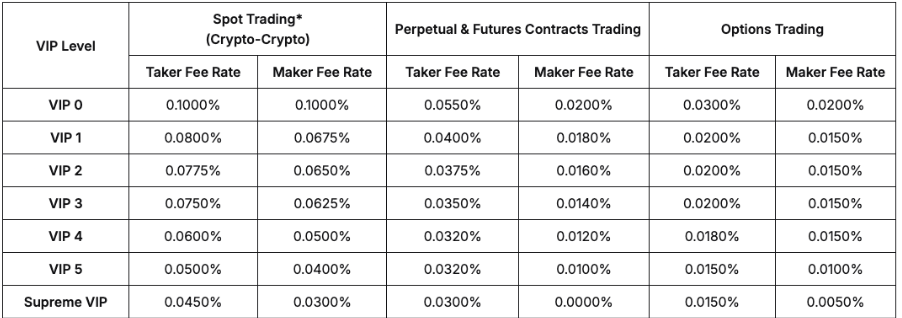
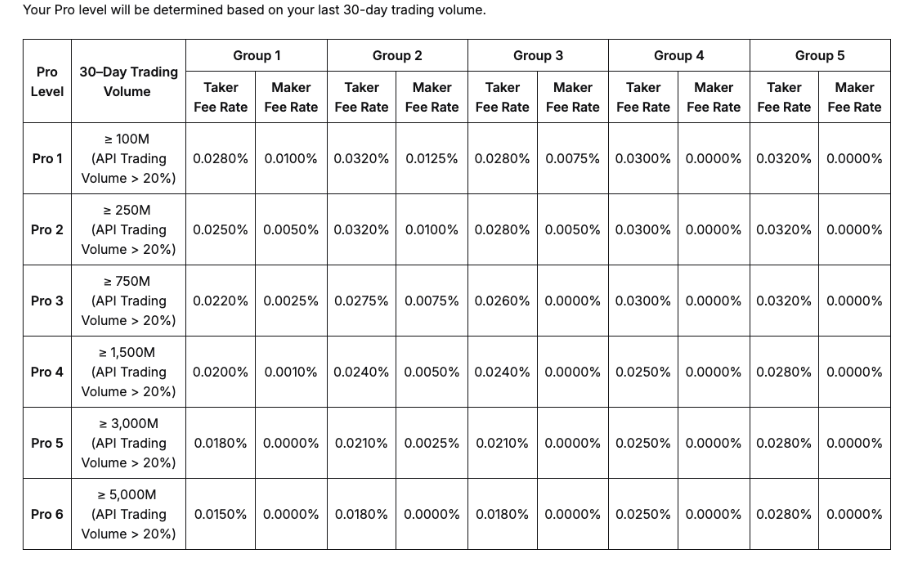
Aside from the VIP Levels, Bybit also offers a Pro-Level discount for highly active and professional traders who engage in substantial trading volumes. Here, traders can enjoy up to 90% discount on market orders and complete limit orders at zero trading fees, but they cannot apply MNT discount.
Finally, you can participate in the Bybit ongoing promotion to win USDT rewards, which may include Trading vouchers and fee discounts. To participate, sign up on Bybit now.
Summary: At the VIP levels, Hyperliquid offers a cheaper trading fee structure compared to Bybit; however, high-frequency traders like API or bot traders may prefer the Bybit pro-level fee discount.
How to Earn Passive Income on Bybit and Hyperliquid
To earn passive income on Hyperliquid, you can join a crypto vault, lock up stablecoin for low returns, or stake $HYPE with a validator. In contrast, Bybit offers more options here, from copy trading to flexible earn, staking, project launchpool, and ongoing promotions.
Staking on Hyperliquid vs Staking on Bybit
When you stake $HYPE with a validator on Hyperliquid, you are contributing to the security of its Proof-of-Stake blockchain. To process and confirm transactions, Validators are required to lock up $HYPE and earn a share of trading fees in return. The locked asset serves as collateral to ensure that they act honestly within the system.
If a validator behaves maliciously, the portion of the staked $HYPE gets slashed as a penalty, which may affect anyone staking with that validator.
Staking on Bybit comes with an estimated APY based on the staking pool. Users can stake assets directly on the exchange to provide liquidity. If you stake any asset on Bybit, you contribute to the asset liquidity pool.
You can also join several ongoing launchpools and launchpads on Bybit. You are required to stake USDT or $MNT to get airdrops of newly listed tokens. Note that the reward could be less than $5 if the asset locked is within $100- $500.
Bybit vs Hyperliquid: Copytrading or Crypto Vault
Bybit copytrading allows you to copy the trades of more experienced traders (lead traders). With this, you can directly open similar trades to lead traders. Additionally, you can make a few adjustments to your own trades. For instance, you can increase or decrease leverage, set a different stop loss or take profit, or close the trade at any time.
Hyperliquid has a similar structure called a crypto vault. Joining a crypto vault does not directly open trades in your account; instead, it allows you to invest your funds in another user's vault or the protocol's vault. Funds are used to open several trading positions. The vault owner receives 10% of the profit made, while investors get a share of the remaining 90% base on the amount contributed.
Quick Summary
|
Features |
Bybit Copytrading |
Hyperliquid Vault |
|
Limit |
Can copy up to 10 traders |
No limit on the number of vaults you can join |
|
Trading restriction |
The lead trader can pause copy trading |
Vault is decentralized, so that anyone can create or join |
|
Trading performance |
Available |
Available |
See our previous article to learn more about how Hyperliquid vault works and possible risks.
Hyperliquid vs Bybit: Which is Safer?
Comparing centralized exchanges to decentralized exchanges often focuses on security models and risks. Hyperliquid and Bybit are designed differently; therefore, they expose users to different types of risks.
Custodial Risk: Breach and Fund Mismanagement
On Bybit, due to its centralised asset control, users' funds are stored in an exchange-controlled wallet or vault, leaving them exposed to a single point of failure. That is, a single breach means attackers can access significant, if not all, assets owned by different users on the exchange. Also, this level of control means users have to always trust that the exchange will not mismanage funds.
To prevent system breaches and protect users, Bybit employs robust security measures. For instance, Bybit has a fund reserve that backs users' assets on a 1:1 basis. Also, assets are stored mainly on cold wallets with multiple signatures for withdrawals and proper key distribution controls for security.
Even better, the system combines real-time risk monitoring and control with bug bounty programs to detect external security threats.
Account Risk: Loss of Access or Exposed Details
When creating an account on Bybit, users must set login details and complete KYC verification to use the platform. Log-in details are recoverable using “Forgotten Password.”
As a user, your account can be compromised when your password is exposed. To prevent unauthorised access to your account, Bybit offers security measures such as 2FA, a withdrawal password, a passkey or biometric authentication, and a withdrawal address whitelist. These tools offer additional protection beyond unauthorized access.
This does not mean that Bybit is completely risk-free. In fact, $1.5 billion in crypto assets was stolen in a recent breach. However, Bybit managed the situation efficiently by drawing on its reserves.
Smart Contract Risk
Hyperliquid replaces centralized control with a public blockchain and smart contracts. This essentially means that users' assets are stored directly on the blockchain. This eliminates some of the popular risks associated with centralised exchanges like Bybit; however, it also introduces its own risks, including smart contract risk.
Smart contracts are vulnerable to bugs and attacks, which can compromise system integrity and result in loss of assets. Also, trading activities are susceptible to price manipulation, which may result in wrongful liquidation.
Account Risks: Loss of Access and Wallet Breach
Using a decentralized exchange or wallet means users enjoy self-custody, but it also comes with the duty to always protect their assets. You must carefully store the private key and seed phrases in a secure location to prevent unauthorized access. Also, the seed phrase is required to access your wallet and fund and it can be recovered. Losing it means losing access to your funds permanently.
A wallet breach is possible when your private key is exposed. To prevent this, avoid linking your main wallet to random websites and always confirm that you are interacting with the right site to avoid phishing links.
Conclusion
Hyperliquid and Bybit are not necessarily competing because they serve different users. New traders with limited wallet security and trading experience should consider opting for Bybit. It offers advanced account protection mechanisms to keep your funds safe and provides a demo trading account to learn futures trading without losing real capital.
Hyperliquid, on the other hand, remains one of the best options for moderate or experienced traders with good security experience who reside in countries where Bybit is restricted or are interested in self-custody. It adopts the CEX-like trading style that ensures that users do not miss a thing.
Ready to start using Hyperliquid or Bybit?
Join Bybit (Up to $30,000 deposit bonus)
Start trading on Hyperliquid (4% fee discount + no KYC)
Full Overview: Hyperliquid vs Bybit
|
Features |
Hyperliquid |
Bybit |
|
Exchange type |
Decentralized |
Centralized |
|
On-chain transparency |
Very high |
Very low |
|
Whale/wallet tracking |
Available |
Not-available |
|
KYC verification |
Not required |
Required |
|
Location barriers |
Not restricted |
Restricted in some countries |
|
Asset Management |
Self-custodial |
Custodial |
|
Native Coin |
$HYPE |
$MNT |
|
Trading fees (Maker/Taker) |
Spot: 0.04/0.07 Futures: 0.02/ 0.04 |
Spot: 0.1/0.1 Future: 0.02/ 0.055 |
|
Fee discount |
Up to 40% |
Up to 50% |
|
Blockchain support |
Multi-chain |
Multi-chain |
|
Leverage |
Up to 40x |
Up to 100x |
|
Order types |
Market, limit, TWAP, stop limit. |
Limit, market, conditional, scaled order, TWAP, chase limit, and Iceberg |
|
Trading models |
Spot, perpetual futures, tradfi, HIP-3 market |
Spot, futures, tradfi, grid trading, API trading, P2P |
|
Trading pairs |
243+ |
650+ |
|
Reward |
$HYPE airdrop |
Signup, deposit, trading, KYC rewards |
|
Risks |
System breach or internal mismanagement. |
Wallet breach and permanent loss of access to the wallet. |
Frequently Asked Questions
What are the best decentralized exchanges?
Hyperliquid and Apex Omni are among the best decentralized exchanges. For a full list, see our previous article on the best DEXs in 2026
What are the best centralized exchanges?
Bybit, Binance, MEXC, Coinbase, and BTCC are among the best centralised exchanges to explore. However, it is important to confirm whether the exchange is available in your region.
Does Hyperliquid require KYC Verification?
No, Hyperliquid is a decentralized exchange; hence, it does not require KYC verification, and you can access it anywhere.