Hyperliquid vs dYdX in 2026: Which one is better (and which one is overrated)?
Trading on Decentralized exchanges is gradually becoming popular, but choosing an exchange to trade on can be a hard task. On the surface, all DEXs can appear similar, but beyond swapping USDT/USDC for your preferred crypto asset, we now have decentralized exchanges like Hyperliquid and dYdX supporting spot, perpetual futures, and even tradfi assets. This means you can enjoy a full, centralized-like trading experience without the constant verifications or delayed withdrawals.
Now, let's examine the core differences between Hyperliquid and dYdX. This article provides a full overview of trading experience, trading fees, and the exchange performance to help new and experienced traders select the best decentralized exchange for trading in 2026.
If you're new to these platforms, check out our step-by-step guides on how to use Hyperliquid and our dYdX tutorial to get started quickly.
Hyperliquid vs dYdX: Key Differences
|
Features |
Hyperliquid |
dYdX |
|
Blockchain |
Hyperliquid (L1) |
dYdX chain v4 (L1) |
|
Market visibility |
Full on-chain visibility |
Limited visibility |
|
Security model |
Uses its own security model |
Uses its own security model |
|
Trading fee (Maker/Taker) |
Spot: 0.04% / 0.07% Perps: 0.015% / 0.045% |
Spot: zero Perps: 0.01% / 0.05% |
|
Trading pairs |
243+ |
194+ |
|
Leverage |
Up to 40x |
Up to 50x |
|
Margin maintenance |
Available |
Not available |
|
Margin |
USDC |
USD |
|
Trading type |
Spot, Perpetual, Tradfi, HIP-3 & Pre-launch trading |
Spot and perpetual futures |
|
Gas fee |
Zero on in-exchange activities |
Zero on in-exchange activities |
|
Order types |
Market, limit, TWAP, stop limit |
Market, limit, stop market, stop limit, and scale orders |
|
Multi-chain support |
Yes |
Yes |
Ready for a seamless trading experience? Get started on Hyperliquid.
What is Hyperliquid?
Hyperliquid is a leading decentralized exchange developed in 2023 for spot and derivatives trading. While it focuses mainly on perp futures, it also supports seamless spot and tradfi assets.
Hyperliquid stands out among other decentralized exchanges because it blends blockchain anonymity with on-chain transparency. Therefore, while traders can execute trades, make withdrawals, and move assets across multiple accounts, Hyperliquid ensures that all positions are transparent on the blockchain. This allows users to trade anonymously with crypto while still benefiting from on-chain transparency. With this, users enjoy anonymity, but trades and liquidations are fully visible to anyone.
Aside from on-chain transparency, users can complete transactions without paying a gas fee. Instead, a trading fee is applied to all orders. Though users can move assets within the exchange at no cost, depositing and withdrawing assets from the exchange to an external wallet or exchange attracts gas fees.
What is dYdX?
dYdX is a popular decentralized exchange known for high-level trading efficiency. The exchange is generally managed by a DAO, a governance structure that allows anyone staking the exchange's native token, $dYdX, to propose and vote on a system upgrade. The exchange supports both spot and perpetual trading and offers access to over 194 trading pairs, making it an ideal choice for many traders.
Like Hyperliquid, dYdX also features gasless in-exchange transactions. With this, you can move assets within the exchange or adjust trades for free. What is even better is that depositing assets from an external wallet into the exchange can also be free. For instance, if you send up to $20 USDC on the Optimism blockchain, you get free, instant deposits.
dYdX offers similar benefits across other blockchains, such as Ethereum, Polygon, and Avalanche.
Quick Note: The free deposit is not available for every transaction or deposit. You should always check the minimum amount you can send for free on each acceptable blockchain.
Blockchain Infrastructure
Hyperliquid is built on a Layer-1 blockchain, the HyperEVM. This is a part of the Hyperliquid blockchain, specifically designed to support fast transaction speeds and order finalization. Accordingly, the blockchain can deliver a block within 0.07 seconds and can handle up to 200,000 transactions per second.
It is worth noting again that the Hyperliquid blockchain is built with optimal transparency; hence, users can integrate necessary tools with the blockchain to fetch transaction data in real time.
What does this mean for traders?
Your transactions and other users' transactions are tracked every minute of the day. With it, anyone can monitor all open and filled orders, traders' positions (long or short), all liquidation events, wallet balances, and funding rates. This level of transparency makes it easy for traders to predict price movement and market sentiment.
dYdX was originally built as an Ethereum-based exchange; however, it was moved to its own appchain, the dYdX Chain. This blockchain was built with the Cosmos SDK to support the dYdX exchange with high speed and low latency. This essentially means users can enjoy an order-book-based trading experience on dYdX for smoother trading.
Another benefit of moving dYdX to its own purpose-built blockchain is that it allows token holders to contribute to transaction validation on the exchange by either joining the staking pool as a validator or delegating to existing validators.
Wallet Connection
One of the easiest functionalities on Hyperliquid and dYdX is connecting a wallet. You can connect almost all decentralized or Web3 wallets to the exchanges within minutes without paying gas fees. General-purpose wallets like MetaMask or Trust Wallet work fine, but you can also opt for blockchain-specific wallets like Rabby for the Ethereum blockchain or Phantom for Solana.
Hyperliquid and dYdX also allow users to create an account. With this, you get a unique wallet address for receiving assets from other wallets or exchanges. When using this option, you need to pay attention to both the minimum deposit amount and the blockchain. For instance, your Hyperliquid wallet address can only receive USDC from Arbitrum One or the HyperEVM blockchain. Sending other crypto assets, such as USDC or those from another blockchain, will result in impermanent loss.
Security and Privacy
For all crypto traders, security is a serious concern, and given that decentralized exchanges offer limited post-attack support, users must understand the potential risks and available security measures.
On decentralized exchanges, users are exposed to security risks such as smart contract vulnerabilities, MEV attacks, liquidation risk, unauthorized transfers, and permanent loss of their wallets. Therefore, users need to learn how to avoid liquidation risk in crypto trading and keep their wallets secured. However, smart contract risks and MEV attacks are beyond users' control.
To protect users, Hyperliquid combines solid MEV protection protocols with smart contract auditing and bug bounties. With this, the exchange can reduce slippage and ensure users' assets and trades are protected. This is not to say that Hyperliquid is completely risk-proof. See our previous article to learn about Hyperliquid safety and know more about security risks on DEXs.
Hyperliquid retains blockchain anonymity even though traders and wallet addresses are publicly available for tracking. This means that traders' real identity stays hidden, but their wallet addresses and positions are not.
dYdX, on the other hand, combines a modular architecture with a solid security audit. Using the Cosmos SDK introduces high modularity to the ecosystem, enabling distinct modules to handle different activities on the blockchain. For instance, the market module manages asset listings, while the orderbook module handles order matching on the exchange. This approach improves security and latency.
Network integrity is protected because, like Hyperliquid, it uses the Proof-of-Stake consensus mechanism, which requires validators to stake the ecosystem's native token to participate in transaction validation on the blockchain. Validators receive commission for their contributions and are also punished with a token slash if they act maliciously.
Finally, dYdX also features blockchain anonymity while transactions remain verifiable on the blockchain. However, it does not offer the level of transparency available on Hyperliquid.
Trading Fees Compared: Maker, Taker, Rebates, and Fee Discount
Hyperliquid Fee Structure
Hyperliquid is a solid choice for spot and perpetual futures trading, and it offers one of the cheapest trading fees in the space.
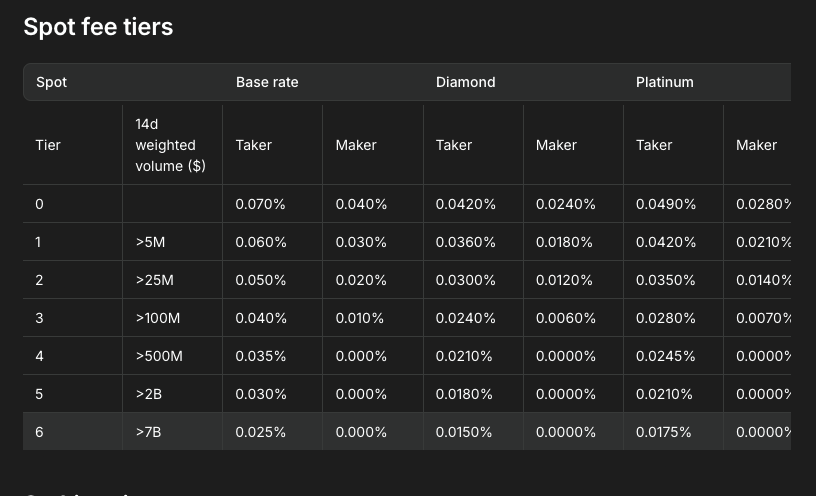
- Spot trading: Traders pay 0.04% maker fee and 0.07% taker fee
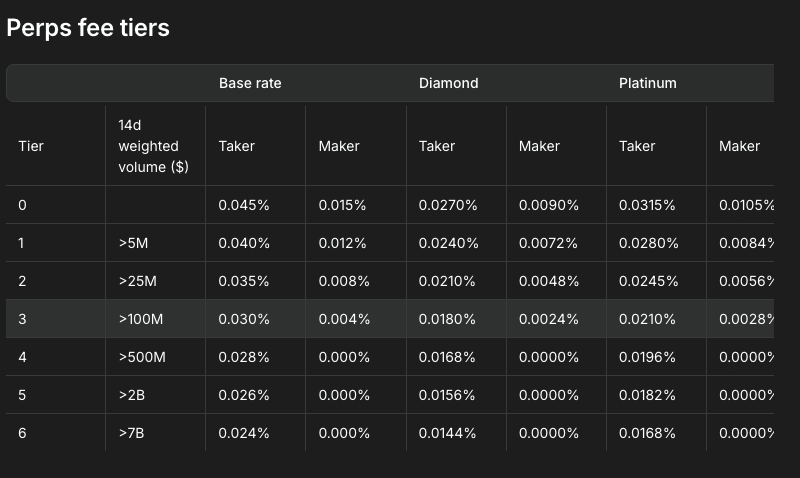
- Perpetual futures: Hyperliquid applies 0.015% maker fee and 0.045% taker fee.
How to Reduce Trading Fees on Hyperliquid
As a trader, one of the leading ways to enjoy lower trading fees on Hyperliquid is by qualifying for any of its staking tiers. With this, you can earn up to a 40% fee discount when you stake $HYPE tokens with any of the available validators on the platform.
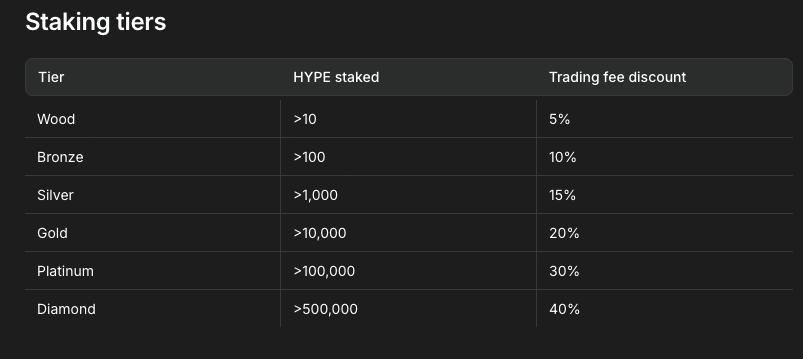
You can also enjoy a certain fee discount when you do any of these:
- Join Hyperliquid via our affiliate link for 4% fee discount.
- Complete a certain trading volume within 14 days to get 50% fee discount under this category. For a detailed guide on how this works, visit the Hyperliquid official fee structure page.
Hyperliquid Perps Fee Tiers (with Fee Discount)
Hyperliquid Spot Fee Tiers (with Fee Discount)
dYdX Fee Structure
dYdX focuses more on perpetual futures trading; therefore, it only has a clear fee structure for that. For instance, $SOL spot trading was launched in December 2025 at zero trading fees. This may change over time, so it is important to confirm fees when trading.
- Perpetual futures: 0.01% maker fee / 0.05% taker fee.
Note that users can complete BTC-USD perpetual trades at zero trading fee
How to Reduce Trading Fees on dYdX
dYdX also offers good fee discounts and rebates, effectively allowing users to pay lower trading fees.
- dYdX Surge: This gives you 50% trading fee rebates. Rewards are distributed at the end of the month.
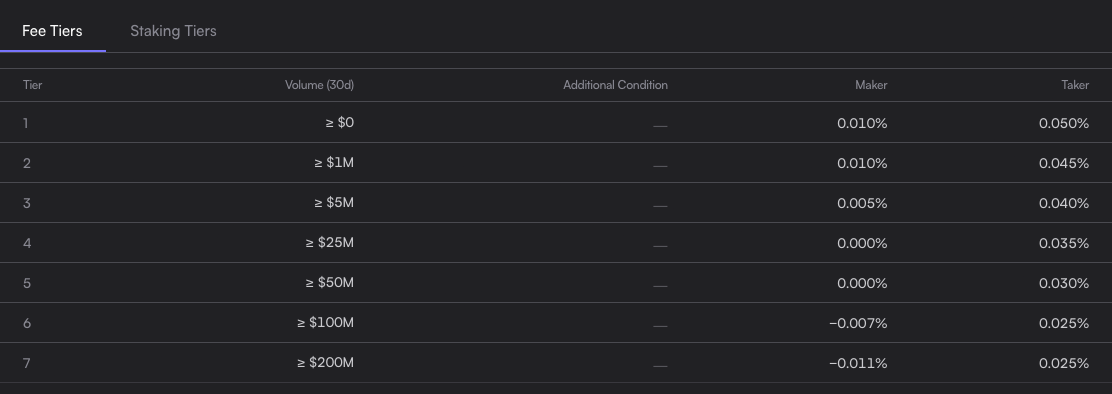
- Trading Tiers: You can get up to 100% fee discount when you meet the required futures trading threshold. For instance, Tier 4 users pay 0% maker fees and 0.035% taker fees for achieving at least 25 million futures trading volume within 30 days.
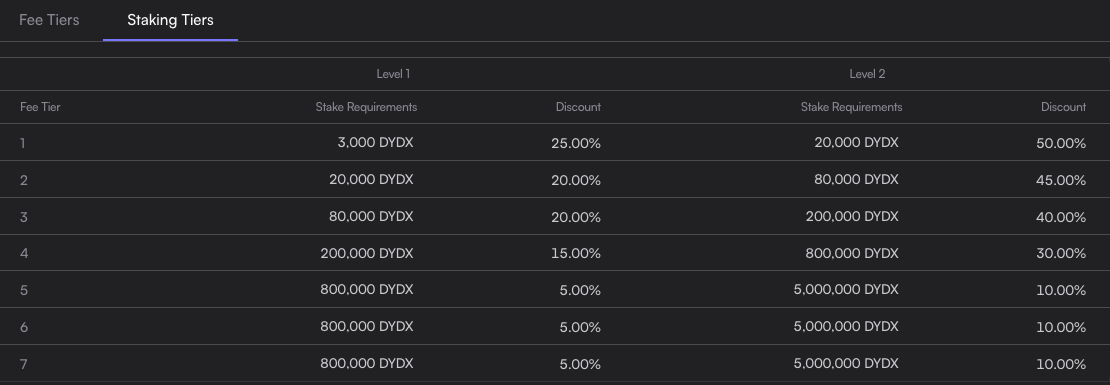
- Staking Tiers: Users can earn up to 25% fee discount. The higher you stake, the lower the discount percentage.
Quick Verdict: dYdX is a true winner here. Aside from lower maker fees, users can enjoy offers such as zero fees on spot trading and on BTC perpetual trades. It gets even better with the rebate and a fee discount of up to 100%.
Liquidity and Orderbook


Liquidity is essential for exchanges because it determines how easily crypto assets can be traded on the platform, particularly low-cap altcoins with few holders. Currently, Hyperliquid has an edge over dYdX here. With over $10 billion in 24-hour derivative trading volume, Hyperliquid is the number one exchange of choice for large-volume traders.
Additionally, the exchange draws liquidity from the protocol vaults - the Hyperliquid Provider and Liquidation Vault. These are community-owned vaults that provide the exchange with enough crypto assets to support market-making and liquidation events.
dYdX, on the other hand, has over $148 million in 24-hour derivative trading at the time of writing. This means large-volume orders may be delayed or subject to high slippage on the exchange.
Both Hyperliquid and dYdX use on-chain order books to process transactions. dYdX particularly relies on a modular architecture; thus, order matching is handled by separate modules. While this is expected to increase efficiency, we cannot confirm whether that makes dYdX work better or faster.
Features and Users' Experience
Hyperliquid and dydX have easy-to-use interfaces; however, Hyperliquid is more straightforward, which may contribute to a better user experience. For instance, while the exchange automatically prompts the deposit option after you connect a wallet for a new user, as an existing users, locating the deposit menu isn't simple because it isn't directly labeled; instead, you have to click the small '+' sign on the trading dashboard.
- Trading Pairs: Hyperliquid currently has over 243 trading pairs, while dydX has over 194.
- Trading Models: Hyperliquid offers a wider option here. You place spot or perpetual futures orders or try tradfi assets and the HIP-3 market. dYdX only focuses on spot and perpetual futures.
- Leverage: Traders can access up to 40x leverage on Hyperliquid. dYdX takes the notch up a little by offering up to 50x.
- Speed: With strong liquidity supply and a deep orderbook, trading on Hyperliquid is likely to be faster than trading on dYdX, especially for high-volume traders.
- Gas Cost: In-exchange activities can be completed at zero gas fee. However, users need to pay gas fees for deposits and withdrawals.
How to Earn Passive Income on Hyperliquid and dYdX
Hyperliquid and dYdX share two main passive income mechanisms in common: Staking and Crypto Vault.
Staking
dYdX and Hyperliquid rely on two different Layer -1 blockchains that use the Proof-of-Stake consensus mechanism to validate transaction correctness. Therefore, users on both exchanges can access a pool of validators and stake assets with them to earn a portion of their commission as staking rewards. You can stake $HYPE on Hyperliquid or stake $DYDX on the dYdX exchange.
Crypto Vault
dYdX and Hyperliquid also offer crypto vaults that users add funds to earn rewards, but they operate differently.
On Hyperliquid, you can add as little as $10 to either the protocol or the users' vault. The vault owner uses all the funds in the vault to execute several perpetual futures trades, and investors receive 90% of the total profit. Profit is shared based on the percentage contributed. Before joining, you must learn more about how Hyperliquid Vault works and the potential risks.
On dydX, users can access MegaVault. This is a community-selected market-making vault that provides liquidity on the dYdX orderbook to earn trading fees and rebates. Currently, the APY is around 16%.
Hyperliquid Crypto Vault vs dYdX MegaVault: Keep Differences
- Hyperliquid has both community-owned and individual vaults; dYdX has only a community-owned vault.
- Joining an individual vault on Hyperliquid exposes you to the owner's trading strategies, which may result in profit or loss. Contributing to the MegaVault on dYdX exposes you to only possible risk from the market-making activities.
- dYdX offers up to 16% APY, while the Hyperliquid protocol vault offers only.
Pros and Cons of Hyperliquid
Pros
- Deep liquidity and orderbook
- Optimal transparency for position and whale tracking
- Advanced security models
- High number of trading pairs
- Diverse trading models and passive income mechanisms
Cons
- High transparency increases the possibility of MEV attacks and high slippage.
Pros and Cons of dYdX
Pros
- Sufficient liquidity for popular assets
- Extremely low trading fee with fee discounts
- Occasionally, a zero fee on selected crypto pairs
- MegaVault may be less risky compared to individual vaults
- Battle-tested infrastructure with no history of attack
Cons
- Low liquidity for low-cap altcoins
- Higher leverage and no margin maintenance increase liquidation risk
Final Thought
dydX offers a really attractive trading fee structure that can make you wonder why it is not the top decentralized exchange at the moment. However, traders do not only prefer the exchange with the lowest trading fee; they also consider factors such as liquidity depth, trading speed, and overall platform efficiency when selecting an exchange to trade on.
Ready to start your decentralized journey? Start trading on Hyperliquid with our affiliate link to get 4% off your fees.
Frequently Asked Questions
What is the Difference Between Maker Fees and Taker Fees
Maker fees apply to limit orders, while taker fees apply to market orders. Limit orders are executed at the specified price, and they add liquidity to the order book because they are not completed immediately. Market orders are executed immediately at the current market price. It removes liquidity from the exchange's order book.
Can I Join a Crypto Vault on Any Exchange?
No, only a few exchanges offer a crypto vault for passive income. See our previous article for a complete understanding of how crypto vaults work and where you can join one.
Can I Trade with 100x Leverage on Hyperliquid?
You cannot use more than 100x leverage on Hyperliquid, as the exchange's maximum leverage is 40x.