Is Hyperliquid Safe in 2026? Risks, Security & Real Incidents
Is Hyperliquid safe? This is one of the most important questions for traders considering a decentralized exchange.
Cryptocurrency trading comes with significant risks, especially in a system where transactions are irreversible, and funds can be difficult to recover. Since blockchain technology prioritizes anonymity, unauthorized transfers or security breaches are often impossible to reverse.
When evaluating a platform like Hyperliquid, two key factors matter: the security model of the exchange and the practices traders use to protect their assets. Unlike centralized exchanges that may offer insurance mechanisms such as the Binance SAFU fund, Hyperliquid operates as a decentralized exchange, meaning users retain full custody of their funds, but also full responsibility.
In this article, we explore whether Hyperliquid is safe, the risks you need to be aware of, and how to protect your assets while trading.
If you’re completely new to the platform, it’s important to first understand how it works before evaluating the risks. This beginner-friendly Hyperliquid guide explains everything from setup to trading so you know exactly what you’re dealing with.
Is Hyperliquid Safe? (in short)
Hyperliquid is generally safe to use due to its decentralized design, on-chain transparency, and self-custody model. However, it is not risk-free. Users are fully responsible for their funds and are exposed to risks such as smart contract vulnerabilities, trading losses, and wallet security issues.
Familliar with Hyperliquid and want more info? Check out the best tools for Hyperliquid or learn how to track whales on Hyperliquid for a better trading experience.
What is Hyperliquid?
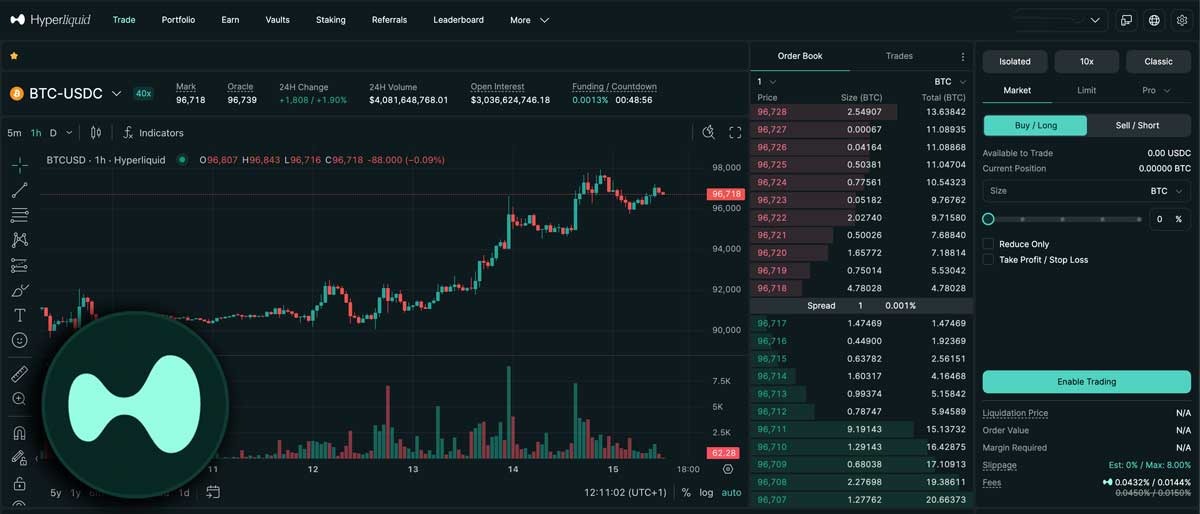
Hyperliquid is a decentralized exchange built in 2022 on a Layer-1 blockchain to provide seamless perpetual futures trading. The main aim of the exchange is to provide crypto traders with a CEX-like trading experience, without exposing users to unnecessary bottlenecks.
Founders: Hyperliquid was built by Jeff Yan and Iliensinc.
As a highly efficient DEX with no identity verification, location barriers, zero gas fee, and very low slippage, Hyperliquid has grown in user base and trading activity. According to CoinMarketCap, Hyperliquid has a current daily trading volume of over $5 billion.
Want to Start Trading on HyperLiquid? Start trading on Hyperliquid with a 4% fee discount
The question that naturally follows is whether Hyperliquid is completely safe or if it exposes traders to any risk despite its advanced and efficient infrastructure.
Quick Answer: Though Hyperliquid has a robust security model and uses margin maintenance to reduce the chance of complete liquidation, it is not completely risk-free. Hence, traders are still exposed to certain risks like smart contract risks, trading risk, and other notable risks discussed below.
How Does Hyperliquid Work
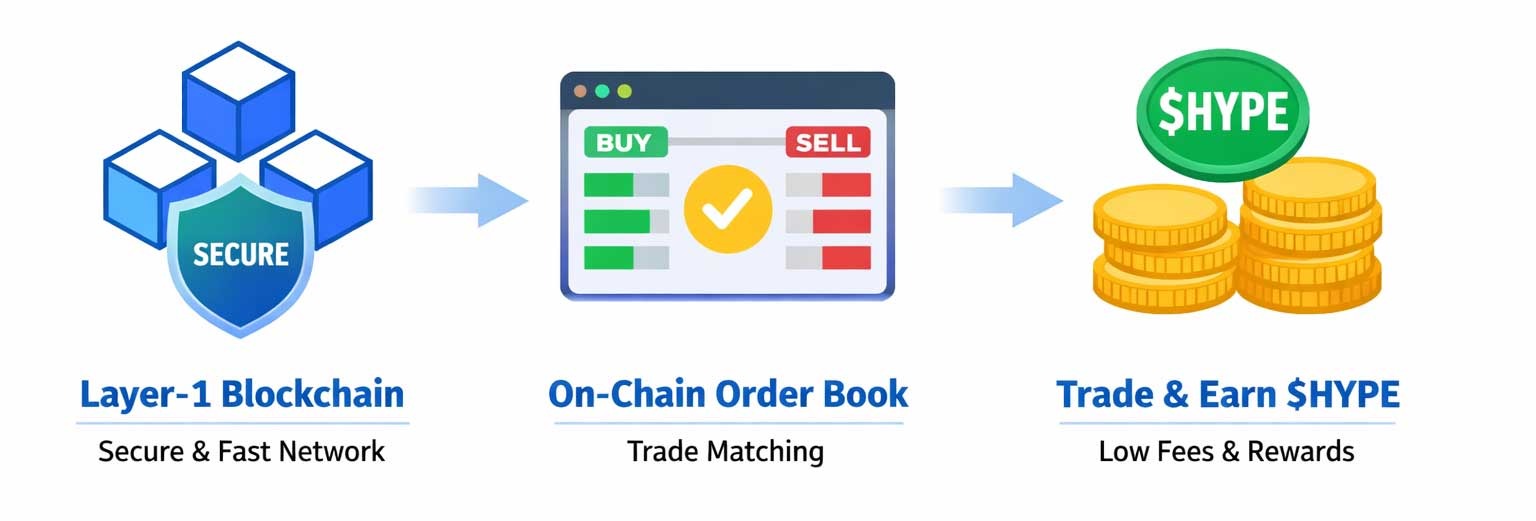
Hyperliquid is built on a fast Layer-1 blockchain, the Hyperliquid Blockchain. The exchange combines a public blockchain with an on-chain orderbook to increase speed and transparency. With this, orders are matched in a price-time priority, and transactions remain completely transparent and traceable for anyone to verify.
Furthermore, Hyperliquid relies on $HYPE. $HYPE is the ecosystem's native token used to increase network security through staking, pay for network costs, and provide fee discounts.
Since its TGE, $HYPE has benefitted from community support, unique structuring, and a balanced tokenomics. The coin has moved from its launch price of $3.90 to an all-time high above $49 and is trading at $40 at the time of writing.
As a project built and funded by Jeff Yan and his colleague, $HYPE does not feature Venture Capital (VC) allocation. Hence, many traders believe that this contributed largely to its positive price movement. Additionally, the ecosystem allocated $1B in annualized fees to programmatically buy back $HYPE.
Hyperliquid Self-Custody: Risks and Benefits Explained
Following the FTX crash in 2022, the mantra "not your keys; not your coin" became popular among crypto traders. What this essentially means is that storing assets on centralized exchanges, which are custodian exchanges, exposes users to two major types of risks: Fund mismanagement and a centralized breach.
The highlight of the risk is that it is beyond the user's control since centralized exchanges usually store assets in a vault or wallet they control. To protect your assets from these risks, you must move your assets to a decentralized exchange like Hyperliquid or store them on decentralized wallets like Trust Wallet.
Hyperliquid is one of the most popular DEXs because it eliminates these challenges while ensuring that users enjoy self-custody over assets. With this, crypto assets are stored directly on the blockchain, and users can manage access to their assets using the exchange or a wallet. However, self-custody comes with specific safety concerns.
Clicking Malicious Links: The most common risk when trading on a decentralized exchange is clicking phishing links, which directly connect your exchange or wallet to a malicious site or page and drain it. As reported by, over 1B crypto assets were lost to phishing links in 2026.
Wallet Keys and Seed Phrase Exposure: A decentralized wallet comes with a set of keys and seed phrases that grant access to your wallet. Public key is used to receive crypto assets from the public; hence, you can share it with anyone. The private key is for accessing and signing transactions; it must be protected because anyone with it can sign transactions and transfer your assets to another wallet, and such a transfer is often irreversible.
Finally, your wallet comes with 12 or 24 seed phrases uniquely arranged for your wallet. You must securely store these phrases because anyone with the phrases can access your wallet from other devices and see both your public and private keys.
Quick security tips to prevent self-custody risks
- Keep your seed phrases secured: Write down your wallet seed phrases in a book or paper and store them properly. Do not store seed phrases on your system or platform with an internet connection.
- Do not disclose private key: Do not mistakenly share your private key with anyone.
- Verify Website URLs: Use tools like CoinMarketCap to verify website links and exchange extensions, and apps before connecting your wallet.
- Use hardware wallets with DEXs: Separate trading funds from crypto capital. Keep trading funds on the exchange and transfer large amounts of capital to a hardware wallet to protect against any internet-related attacks.
Smart Contracts: Benefits and Risks Explained

Hyperliquid relies on the Arbitrum Bridge smart contract to automatically execute transactions when necessary conditions are met. With this, trading on Hyperliquid is permissionless and deterministic. This means that under normal conditions, trades are completed without intermediaries or unnecessary delays.
Though smart contracts improve efficiency, they expose users to two types of risk:
Smart contract breach: Smart contracts are prone to vulnerabilities and bugs. Therefore, when a smart contract is breached or manipulated, users and the entire market suffer significant level of losses and manipulations. These types of breaches can have different impacts on traders' assets and the entire market. For instance, oracle manipulation can affect how asset prices are displayed and computed by the platform, and this may lead to wrongful liquidation or incorrect balance.
An example is the coordinated Jelly Attack in March, 2025. A whale holding a lot of $JELLY token manipulated the token price by initiating deposits and withdrawals in a coordinated manner. This process pumped the token's price, causing the system to close several short/sell positions automatically. Traders and the Hyperliquid Provider Vault lost over $15 million in this attack.
MEV Attacks: MEV attacks happen when a malicious bot is used to detect a large order in the order book and place an order before it (frontrunning) or after it (backrunning) or before and after (sandwich) for the bot owner to artificially increase the asset price temporarily and benefit from it. Instead of the true market condition, the bot impacts the price and may force other traders to increase slippage or suffer liquidation.
To prevent this, Hyperliquid features a solid security model that is combined with regular smart contract auditing, update review, anti-MEV mechanisms, and bug bounties to discover risks or possible breaches and prevent them. To stabilize market conditions, Hyperliquid uses several funding mechanisms and a margin machine to ensure consistent throughput and accuracy.
Quick Security Tips: Actively engage the Hyperliquid communities and social channels to learn about new security threats and possible safety procedures.
Crypto Trading on Hyperliquid: Risks and Benefits Explained
Trading is inherently risk-based because every position ends in profit or loss. This means that without a smart contract breach, MEV attack, or wallet breach, traders can still suffer significant loss of assets just by trading. This is not to say that Hyperliquid directly exposes you to any type of trading risks, because risk exposure here depends completely on your trading strategies and risk appetite. The two types of risk here are:
Liquidity Risk: Liquidity is an essential part of any crypto trading platform because it determines how fast and easily you can trade a crypto asset on an exchange. While high liquidity means you can trade assets freely with low slippage and faster throughput, low liquidity means delayed trade execution, high slippage, or trade cancellation. In any of these instances, users lose money. When slippage is high, you are buying the asset at a significantly higher price than the market price.
Hyperliquid is a leading exchange with deep liquidity, which means traders are less likely to experience liquidity issues on the platform, particularly when trading major crypto assets. You can easily fill crypto orders at low trading fees and low slippage.
Leverage Risk: Hyperliquid offers up to 40x leverage on assets like $Bitcoin, which can be a good or bad thing depending on your trading experience and market conditions. For instance, trading with high leverage in a very volatile market increases liquidation risk, which means your margin (actual capital) can get completely wiped out. The higher the leverage, the riskier the trade becomes.
Hyperliquid Safety: Pros and Cons
Pros
- Full self-custody of funds
- Transparent on-chain orderbook
- No exchange custody risk (like FTX)
- Low fees and high liquidity
Cons
- No insurance or fund recovery
- Smart contract risks
- Requires strong wallet security knowledge
- High leverage increases liquidation risk
Is Hyperliquid Safer Than Other Exchanges?
Compared to other platforms like dYdX and Apex Omni, Hyperliquid offers a fully on-chain order book and no KYC requirements, which improves transparency and accessibility.
However, all decentralized exchanges share similar risks, including:
- Smart contract vulnerabilities
- Self-custody responsibility
- Lack of insurance or fund recovery
Overall, Hyperliquid is considered one of the more advanced DEXs, but it is not fundamentally safer than other leading platforms; it simply offers a different trade-off between control and risk. Want to get more in-depth about DEX comparisons? Read our Top Decentralized Exchanges article to compare the 5 best DEX’s.
How Does Leverage Work on Hyperliquid?
Leverage allows traders to increase trading value without increasing the actual capital. If you open a trade on Hyperliquid with $200 USDC and 10x leverage, your position value will be
$2,000 USDC ($200 x 10 = $2,000).
Your actual capital is used to maintain the position. This means that when the price moves against you, the exchange uses your capital to cover any loss incurred. For instance, if you open a $Bitcoin long position and the price begins to fall, your capital starts to reduce until it is completely wiped out.
Let's use the example above, $200 (capital) x 10x (leverage) = $2,000 (position value). Here, your capital is 10% of the total position; therefore, you will get completely wiped out when the price of the asset moves against you by 10%.
However, Hyperliquid offers a margin maintenance system to reduce complete liquidation, particularly if you trade with low leverage. To keep your trade open on Hyperliquid, you need at least 16.7% of your margin if you are using low leverage (3x), 1.25% if you are using high leverage. This means that once you lose part of your margin and you are left with any of these percentages, the system will forcefully close your position.
Best Security Tips for Hyperliquid Traders
- In a very volatile market, using low leverage is highly recommended to prevent fast liquidation.
- If you are a new trader, do not use above 5x leverage
- Use stop loss and take profit (SL/TP) to lock in profits and prevent complete liquidation.
Read our previous article to learn how to avoid liquidation in crypto futures and reduce trading risks.
Final Thoughts
Hyperliquid is one of the most advanced decentralized exchanges in 2026, but it is not completely risk-free. The main difference is that you are fully responsible for your own funds.
The good news is that most risks can be reduced with simple precautions. Always make sure you are connecting to the official Hyperliquid website, and avoid clicking random links. Never store your seed phrase online, and never share your private keys with anyone.
When trading, use lower leverage, set stop loss levels, and avoid risking too much on a single trade, especially on trading pairs with low liquidity. Most losses happen because of poor risk management, not because of the platform itself.
In the end, Hyperliquid can be used safely if you understand the risks and take the right steps to protect yourself.
Want to Start Trading on HyperLiquid? Start trading on Hyperliquid with a 4% fee discount
Frequently Asked Questions
Is Hyperliquid available in the US?
Yes, Hyperliquid is available in the United States and other countries as well. As a decentralized exchange, Hyperliquid eliminates the location barrier; therefore, all traders can use it.
What are the benefits of using Hyperliquid?
Trading on Hyperliquid comes with a lot of benefits. You get to execute perpetual futures trading, spot trading, and also access other passive earning mechanisms like staking and the Hyperliquid vault while retaining custody of your assets at all times.
Which wallet can I use with Hyperliquid?
You can use Hyperliquid with multi-chain decentralized wallets like Metamask, Trust Wallet, or blockchain-specific wallets like Rabby for Ethereum. You can also use a few Web3 wallets offered by centralized exchanges like the OKX wallet or the Coinbase Web3 wallet.
Is Hyperliquid the cheapest exchange in 2026?
Hyperliquid offers spot perpetual futures trading at a low fee. You can even reduce further when you start trading with our affiliate link or use $HYPE to pay for your trading fee. To compare trading fees on Hyperliquid and other exchanges, see our past article on the best decentralized exchanges in 2026.
Related Articles:
- How to Safely Follow Whales on Hyperliquid
- Best Hyperliquid Tools for Traders (2026 Guide)
- Hyperliquid Whale Tracker Explained (CoinGlass Guide)