Quantitative Crypto Trading: Strategies, Automation & Backtesting

Automating your trading strategy literally sounds like a money-printing machine. But how profitable and how passive is this actually? In this article, we’ll dive into the world of quantitative trading. We will be answering questions like, for who is quantitative trading? Is it really passive? What are the most important tests to fulfill in order to automate your trading strategy? And we’re going to look at some real examples of potential trading strategies.
What is Quantitative Trading?
Quantitative trading is all about translating trading ideas into clear rules that can be tested and automated. Instead of relying on gut feeling or emotions, decisions are made based on data, statistics, and predefined conditions. The goal is not to predict the market perfectly, but to build repeatable systems that can exploit small statistical edges over time.
Who can become a quantitative trader?
In today’s market, almost anyone with trading knowledge or a working trading strategy can automate it and become a quantitative trader. It has never been easier than it is now. Many tools that were once only available to institutional traders are now accessible to retail traders as well. The process of testing strategies is also far more efficient than it was 10 years ago.
However, even though the tools have improved, that doesn’t mean creating a profitable automated trading strategy is easy. You need a unique set of skills to make it work: courage, solid trading knowledge, creativity, and persistence.
In short: Anyone can automate their trading. But the real winners are those who combine courage, knowledge, creativity, and persistence.
Why these specific skillsets for Quant Trading?
First of all, you are entering a highly competitive field. If you do not dare to take risks and believe in your own ability to succeed, your chances will drop almost instantly to zero. You do need some basic knowledge of trading; however, interestingly enough, this might be the least important skill to develop.
Creativity plays a major role in the process, as you need to learn how to think “out of the box” and come up with unique strategies that are new and have real potential. Persistence is equally important to stay on the path you’ve chosen. You will encounter obstacles and challenges along the way, and overcoming them requires persistence.
These four qualities, courage, trading knowledge, creativity, and persistence, will significantly increase your chances of succeeding in the world of quantitative trading.
The advantages of Quantitative Trading
Quantitative trading is, in a way, quite similar to other business ideas with the simple aim of making a profit. However, the business structure is as well different. Let’s have a look at the advantages of quantitative trading
Scalability
Unlike most small businesses, where scaling often involves a lot of work, quantitative trading is very scalable. If you run a strategy with $10.000 and there is enough liquidity for your strategy, scaling just means changing some numbers in the program or increasing the leverage. So once you have a working trading strategy, you can quite easily scale it.
Time
Like with other small businesses, you most likely would need to invest a lot of time to make it work. While with quantitative trading, once you have a working strategy, you still need to invest time realistically, but it is not as much as with any other start-up or small business, and it’s on your own terms.
Marketing
You do not need to worry about marketing; the whole business idea is quite different. So you’re not trying t sell something to somebody. You’re trying to create a system that profits from the volatility of the markets.
Location
Depending on the strategy and structure of the company, you can theoretically create strategies from everywhere with an internet connection. You can easily work while travelling or hire staff overseas to outsource certain tasks. Quantitative trading, if done successfully, comes with a lot of freedom.
Trading Strategies
Let’s have a look at some potential trading strategies that can inspire you to automate.
Trend Following Strategy
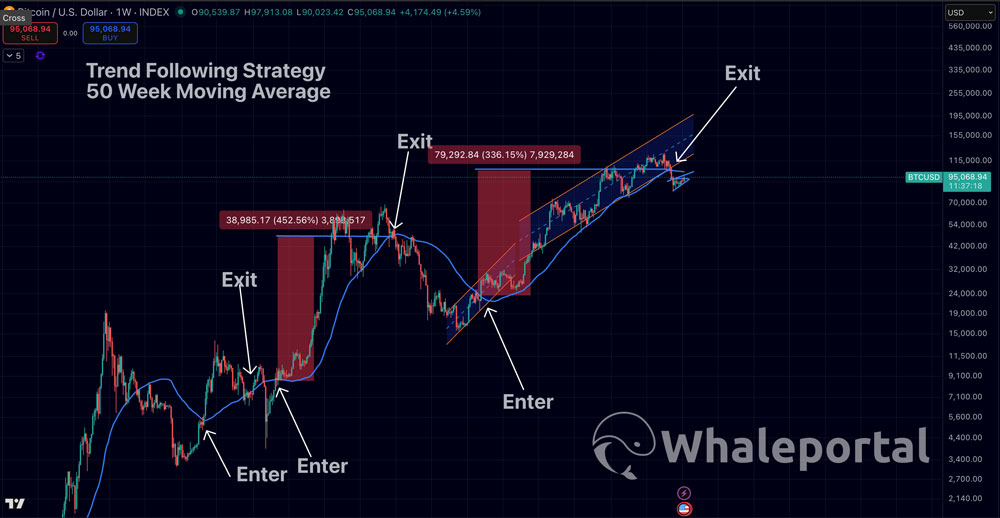
This might be the most famous and simplest strategy that you can apply and automate, and that is the simple moving average breakout strategy. If we look at Bitcoin, for example, then in previous markets it would have been very profitable to long whenever we break above the 50-week moving average and hold that position until it breaks back below the 50-week moving average.
You might get some fake signals here and then, but this strategy has been pretty accurate in following the macro trend on Bitcoin. This is a strategy that can be automated. Do take into account that every strategy always carries a risk, there is no potential reward without risk. Past performance is not a guarantee of future performance; however, you can definitely increase your chances and that’s what trading is all about.
Arbitrage Strategies
Another famous strategy is arbitrage trading. Arbitrage is when the price of a certain asset is different on various exchanges. So different that you can actually buy or sell on one exchange, and do the opposite on another exchange and make a profit. Let’s say Bitcoin trades at 100.000 USD on Coinbase, but on Bybit it trades for 100.400 USD. You can sell 1 Bitcoin on Bybit, and buy 1 Bitcoin on Coinbase simply said. This strategy can be automated, and this is what many institutions actually do. They scan all the exchanges and try to take advantage of price differences.
CME Futures Strategy
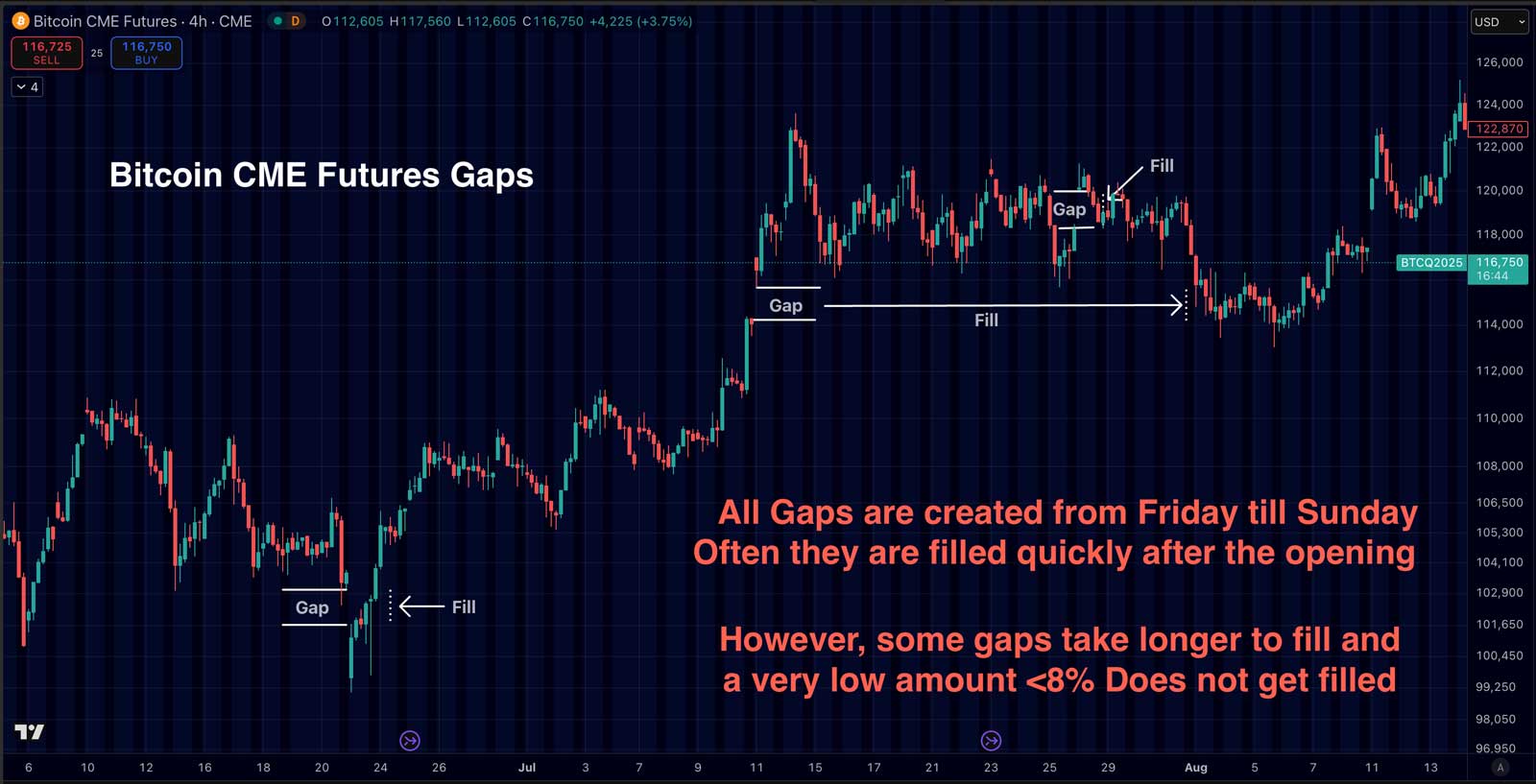
Another strategy is the Bitcoin CME Futures strategy. Bitcoin CME gaps form when CME futures close on Friday and reopen on Sunday at a different price, and historically, most of these gaps eventually get filled as liquidity returns and price reverts. Traders use this statistical edge by trading weekend divergences between CME and spot prices, timing entries around expected gap fills, or waiting for better risk-reward setups after low-liquidity weekend moves. Again, not risk-free, but just to give you some inspiration of what is possible.
Other Strategies
You can take it a step further by using tools like buying/selling pressure heatmaps, liquidation heatmaps, and a crypto sector performance index to spot where liquidity is concentrated and which categories your strategy should focus on. The key is to think creatively and combine multiple signals instead of relying on just one. Most importantly, backtest everything to confirm the edge before you put real money on the line.
Backtesting
Once you have determined a strategy, the next phase comes: Backtesting. This might be the most important and most difficult step of creating an automated trading strategy. There are many tools available where you can backtest your strategy like TradingView or QuantConnect, but even though you have these tools, you have to be mindful of errors and faults that often occur in backtests.
Correct Data and Delays
Getting the correct data is crucial for backtesting and using it in the correct way. For example, you’re trading the 1-minute timeframe, and your strategy depends on the 1-minute close of the candle. After the one-minute close, it should open a trade if the requirements are met. The 1-minute candle afterwards should normally fill that trade, because of the delay between calculating the entry and sending the order to the exchange, the order is not filled. In your backtest data it could be possible that it is calculated as filled. This can give an unreal estimate of profit/loss and is just a small example of things you need to think of when backtesting.
Data snooping bias
One of these errors is data snooping bias, which happens when a strategy is repeatedly tested on the same historical data until it appears profitable by chance. This creates an illusion of a reliable edge, while in reality the strategy is simply overfitted to past market conditions. As a result, performance often collapses when the strategy is applied to new, unseen data.
Fees
Sometimes a backtest can show significant profits, but when you include the amount of fees that need to be paid per trade, change in high losses. Especially in high-frequency trading, as many orders are executed and therefore often more fees are paid. This is less of a problem with a trend following system, as this often is an algorithm with fewer trades and holding them for a longer time. However, in any case, make sure you calculate the right fees in your backtest. Are the orders done through limit orders or market orders? Could there be slippage? It might be smart to calculate slightly higher fees just to make sure the strategy remains profitable and that there is some space for slippage or unforeseen costs.
Risk Management
It is said that risk management is one of the most important aspects of trading itself and that long-term successful traders differentiate from the unsuccessful ones through proper risk management. With quantitative trading, there are multiple risks factors you need to consider.
Capital Risk
The first one is capital risk, this would be there for every trader. You’re risking capital to gain more capital. With every strategy, you need to have a system for :
- How much capital is put at risk on any trade?
- How many trades can we lose in a row?
- What is the stop-loss?
- How much leverage is applied?
- What is the risk/reward ratio?
- Are there market conditions that the bot should be on hold?
If you have a clear answer to these questions, you’re on the right path. Most traders don’t take risk management too seriously and often enter a trade because a chart looks good, rather than having a clear entry and exit plan. This is also where most lack discipline and if this were applied, many traders could be more profitable in their trading.
Bot Risk
Any automated trading strategy has some form of model risk. What we often see is that a bot works perfectly until certain market conditions change, and the bot loses rapidly all piled up profits. The test of time is important, and I would suggest everyone to slowly build up the capital in the bot in moments after it has been proven to hold steady for some time. Slowly add capital, do not haste. This decreases the risk of the model and if problems occur early, you’re able to update or improve the model and continue to slowly add capital.
Exchange Risk
This might be the risk most traders don’t even think of but is a legitimate one, especially in crypto. With quantitative trading in crypto you need to connect your trading system through an API with an exchange. However, in the past years, many things have happened with crypto exchanges. FTX, one of the biggest exchanges in 2021, even went insolvent.
Next to an exchange becoming insolvent, which is low-risk, you still have to account for liquidation events that occur now and then. This is something you might calculate within your strategy or have the right risk management tools that make sure that the strategy is out of positions or benefits from the extreme moments. Do good research and take time to pick the right exchange for your trading.
When choosing between centralised and decentralised exchanges, it’s important to understand the trade-off between custody risk and execution risk. On centralised exchanges, the exchange holds your funds, which introduces counterparty risk but usually offers better liquidity and faster execution. On decentralised exchanges, you stay in full control of your funds, greatly reducing custody risk, but execution can be affected by factors such as smart contract risk, network congestion, and slippage. The right choice depends on the strategy: some traders prioritise capital safety, while others need optimal execution and deep liquidity.
I would personally suggest Bybit as the most institutional-friendly and most stable exchange. You can also create an account as a business entity on Bybit. They have shown Time and time again to be reliable, even during difficult times where other exchanges paused withdrawals (For example, on October 10, 2025).
In recent years, decentralised exchanges (DEXs) have become significantly more popular and far more advanced than they were a few years ago. In many cases, they can even reduce risk compared to centralised exchanges, since there is no single central entity holding your funds. On most DEXs, you remain in full custody of your crypto at all times.
Using a DEX is usually straightforward: you simply connect your wallet, link the API to your trading system, and start trading. Some platforms even offer additional security features, such as double-signature withdrawals, which further reduce overall risk.
In my view, some of the best decentralised exchanges right now are Apex Omni, a DEX backed by Bybit, HyperLiquid, and AsterDEX.
Conclusion
Quantitative trading is not a shortcut to easy money, but a structured and disciplined approach to trading that focuses on data, testing, and risk management rather than emotions. While modern tools have made automation more accessible than ever, long-term success still depends on having a real edge, robust backtesting, and strict control of risk. Understanding factors such as execution quality, fees, and exchange risk is just as important as the strategy itself.
For anyone who wants to go deeper into quantitative trading and build a stronger foundation, I highly recommend the books by Ernest P. Chan, which provide practical, realistic insights into developing, testing, and managing quantitative trading strategies.
FAQ
What is quantitative crypto trading?
Quantitative crypto trading is a data-driven approach where trading strategies are based on predefined rules, statistics, and backtested models rather than emotions. These strategies are often automated using trading bots and APIs connected to crypto exchanges.
Is quantitative crypto trading profitable?
Quantitative crypto trading can be profitable, but only when strategies are properly tested, risk-managed, and adapted to changing market conditions. There is no guaranteed profit, and results depend on execution quality, fees, liquidity, and the robustness of the strategy.
Do I need coding skills for quantitative crypto trading?
Coding skills are not strictly required to start, as many platforms offer low-code or no-code solutions. However, learning basic programming significantly improves your ability to build, customize, and maintain profitable quantitative crypto trading strategies.
What are the biggest risks in quantitative crypto trading?
The main risks include overfitting during backtesting, exchange or API failures, execution issues such as slippage, and sudden changes in market volatility. Poor risk management is one of the leading causes of failure in automated crypto trading.
Can I use quantitative trading strategies on decentralised crypto exchanges?
Yes, quantitative trading can be applied to decentralised exchanges, where traders remain in full custody of their funds. However, execution risk, smart contract risk, and network congestion should be carefully considered when running automated crypto trading systems on DEXs.
Related Articles:
- Decentralized Exchanges Explained: Which DEX Is the Best?
- Crypto Sector Indexes Explained
- Apex Omni Order Types Explained