How to Trade S&P 500, Gold & Oil with Crypto (No KYC, 24/7 Access)
What if you could trade US stocks without a US brokerage account, or trade oil and gold directly with your MetaMask wallet?
A few decentralized exchanges now make that possible by offering platforms where trading traditional assets like the S&P 500, oil, and gold works just like trading Bitcoin or any other crypto assets. These exchanges execute transactions in seconds without KYC verification or location barriers. To get started, all you need to do is add USDT or USDC to your crypto wallet and connect it to your preferred exchange.
Trading TradFi assets on decentralized exchanges increases accessibility by replacing the trading structure that closes at 4 pm Eastern time with 24/7 trading platforms. One thing, though: decentralized exchanges only offer perpetual trading at the moment, which means you can not buy and hold these assets; you open a trade that runs perpetually. Your position does not expire; it closes when the price is triggered.
In short, this article explains the benefits and risks of trading TradFi assets on decentralized exchanges, how to place a trade on DEXs, the best exchanges to use, and the differences between trading on traditional platforms and DEXs.
Before you start trading, keep in mind that we have included affiliate links in this article to provide you with significant trading fee discounts on the exchanges.
Quick Point: What does it mean to trade TradFi assets on Decentralized Exchanges?
Trading traditional finance assets like stocks and commodities on decentralized exchanges gives you access to real-world assets (RWA) on a blockchain-based infrastructure. You are not trading the asset directly; instead, you are trading an instrument that represents the asset and mirrors its price movement. To achieve this, exchanges use various mechanisms, such as synthetic tokens or tokenized assets.
In essence, trading AMZN stock on Hyperliquid does not mean owning the stock; it means being exposed to its price movement in real time. If you open a buy/long position, you record a profit if the price increases or get liquidated if it falls significantly against you.
On which Exchange can I trade TradFi assets?
TradFi assets became popular on leading CEXs like Binance, Bybit, and Bitget; however, if you reside in countries where these exchanges are restricted from operating, you cannot access them. To increase access and meet demand, decentralized exchanges like Hyperliquid, AsterDEX, and Apex Omni are becoming popular alternatives to no-KYC crypto exchanges, offering easy access to traditional assets without regional restrictions.
Best Decentralized Exchange for TradFi Assets: Hyperliquid vs AsterDEX vs Apex Omni
|
Features |
Hyperliquid |
AsterDEX |
Apex Omni |
|
Founders |
Jeff Yan and Iliensinc |
ex-Binance team |
Backed by Bybit |
|
KYC Verification |
Not required |
Not required |
Not required |
|
Asset Coverage |
Stocks, Indices, commodities, forex, pre-IPO |
Stocks & commodities |
Stocks, Indices, & commodities |
|
Order types |
Market, Limit, Pro |
Market, Limit, Stop Limit |
Market, Limit, Conditional |
|
Leverage |
Up to 50x |
Up to 75x |
Up to 50x |
|
Trading fees |
0.015% - Maker Fee 0.045% - Taker Fee |
0.000% - Maker Fee 0.040% - Taker Fee |
0.020% - Maker Fee 0.050% - Taker Fee |
|
Fee discount |
Yes / Up to 40% |
Yes / Up to 50% |
Yes / Up to 50% |
|
Discount requirement |
Trading volume $HYPE staking |
Trading Staking |
Trading volume $APEX staking |
|
Trading pairs |
100+ |
25+ |
24+ |
|
Margin |
USDC & USDT |
USDT |
USDT |
|
Liquidity / Trading volume |
High / Over $7 billion |
Moderate / Over $1 billion |
Moderate / Over $1 billion |
|
Price feeds |
Oracle |
Oracle |
Oracle |
|
Transparency |
Extremely high |
Very low |
Low |
|
Best for: |
Whales & low-high volume traders interested in diverse options |
Low-high volume traders interested in lower fees and high leverage |
Low-high volume traders interested in limited exposure |
Ready to explore US stocks, commodities, and S&P indices?
Choose your platform and start trading with discounted fees:
- Hyperliquid – 4% Fee discount
- AsterDEX – 2% Fee discount
- Apex Omni – 5% Fee discount
Connect your wallet and start trading in minutes.
Trading TradFi Assets on Traditional Exchanges vs Crypto Exchanges
For experienced traders, moving from trading commodities and indices on traditional platforms like NYMEX and NYSE to a decentralized exchange is not just about changing platforms; it is about improving experience and expanding access. If you are still wondering why you need to switch to a DEX for your TradFi trading, here are four reasons:
Low Trading Margin: Buying stocks and commodities on traditional platforms or centralized exchanges comes with size limitations, that is, the least amount of gold you can buy. Decentralized exchanges provide access only to price action; therefore, there is no size limit, so you can trade with as little as $10. This alone makes TradFi assets more accessible to all traders.
No KYC or Identity Verification: Decentralized exchanges are self-custodial in nature and rely on blockchain infrastructure for trust, speed, and security. To use, you do not need to verify your identity; instead, you can connect a decentralized wallet to the exchange, execute trades, and also withdraw assets to the wallet.
Zero Location Barrier: The US stock market is largely inaccessible to non-US residents because it requires opening a US brokerage account and verification. Decentralized exchanges replace this process with smart contracts, a crypto wallet, and stablecoins. Which means you can now execute trades directly from anywhere using USDT, USDC, or other acceptable stablecoin
No Hidden Fees: The process of buying stocks, S&P 500 Indices, or even commodities on traditional platforms is layered with hidden fees because typical transactions move between 4 to 5 entities (Retail trader or broker app, central exchange, clearing house, and custodian bank), with users paying fees at each point. Since the process is internal, investors pay high fees (many of which are undisclosed). DEXs replace this with a simple trading fee structure: maker and taker fees.
Faster Settlement: A longer trading process and more entities can also reduce settlement time. Decentralized exchanges replace the layered institutional structure of the traditional system with automated code and a crypto wallet, eliminating delays and enabling transactions in seconds.
No Physical/Real Ownership: Holding TradFi assets is not possible on decentralized exchanges, but you can access perpetual contracts that mirror the price of traditional assets like gold in real-time. No physical asset backs the contract, and you do not really own it; you only get to trade it.
Now, let’s discuss the top decentralized exchanges where you can trade stocks, indices, commodities, and forex.
Trading TradFi Assets on Hyperliquid
Hyperliquid is a decentralized exchange built on a Layer-1 blockchain to facilitate quick perpetual and spot trading. Hyperliquid not only increases on-chain transparency but also allows users to experience a CEX-like trading style on a decentralized infrastructure, as it relies on an orderbook to quickly match orders and execute trades on a price-time priority basis.
While the platform originally focused on crypto trading, it has now expanded its reach by giving traders access to 100+ TradFi assets, including stocks, commodities, indices, forex, and pre-IPO. With this, you can open perpetual trades for oil, gold, AMZN, Biotech, Copper, and more on an interface that is completely similar in use and features to a crypto trading interface. This means that you can easily open a perpetual position for any stock or commodity the same way you open for crypto assets. Additionally, you can use up to 50x leverage, select a margin type, and even enjoy trading fee discounts
Ranked as the number one decentralized exchange by CoinMarketCap, Hyperliquid has the highest derivative trading volume and a deep orderbook, making it a very good platform for whales looking to execute large-volume trades.
We find trading traditional assets on Hyperliquid very easy, which is good for all traders, especially for beginners. It features an easy-to-use interface and has over 100 trading pairs under its TradFi category. This makes it a good platform for experienced traders. To learn how to deposit USDC into your perpetual account, execute trades, track positions, and even reduce trading fees using fee discounts, check out our Hyperliquid Tutorial.
Note: Only a few assets are paired with USDT for trading, which means most TradFi assets are paired with USDC on Hyperliquid. To be on the safe side, you should confirm the asset pair before converting your fiat into any stablecoin or depositing it on the platform.
Quick Summary
- Hyperliquid is built on a layer-1 blockchain, which is considered fast and secure.
- You can access over 100 TradFi assets with up to 50x leverage on Hyperliquid.
- The standard trading fee structure applies (0.015% maker and 0.04% taker). Review the Hyperliquid fee structure to see how you can reduce fees using an affiliate link, trading more volume, or staking $HYPE.
- You can only open perp positions for TradFi assets. Not spot trading
Ready to start trading? Join Hyperliquid to enjoy 4% discount on your trading fees
How To Open A TradFi Perpetual Trade on Hyperliquid
Step 1: Visit the official Hyperliquid website to connect your wallet or create an account
Step 2: Click on ‘Connect Wallet’ and select the preferred wallet to use
- Note: Connecting a wallet or creating an account is free. No gas fee
Step 3: Now, click on ‘deposit ' on the interface and input the amount of USDC or USDT you wish to add to the exchange. Minimum deposit is 5 USDC.
Step 4: Click on ‘Trade’, then click on the token pair for more options
Step 5: Select “TradFi” in the trading category
Step 6: Select whether you want to trade stocks, commodities, forex, or Indices
Step 7: Now, select the asset you want to trade among the options
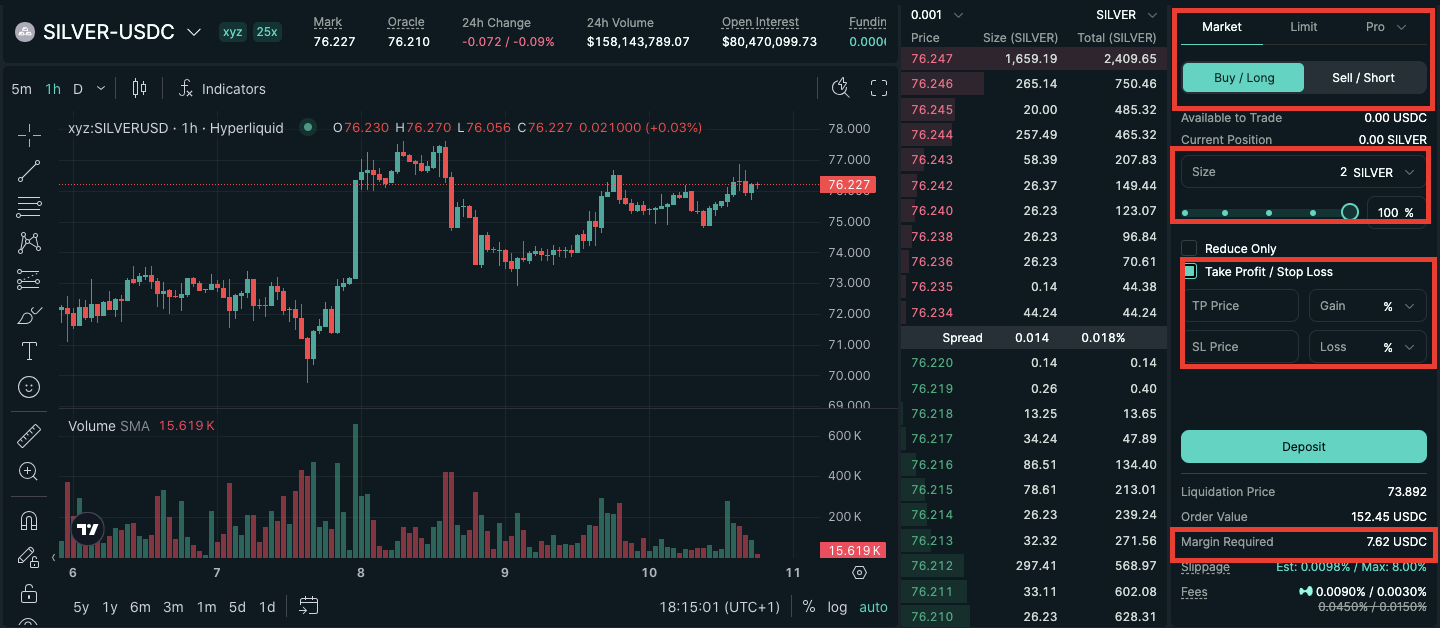
This takes you to the trading interface, where you can set up your perpetual trade
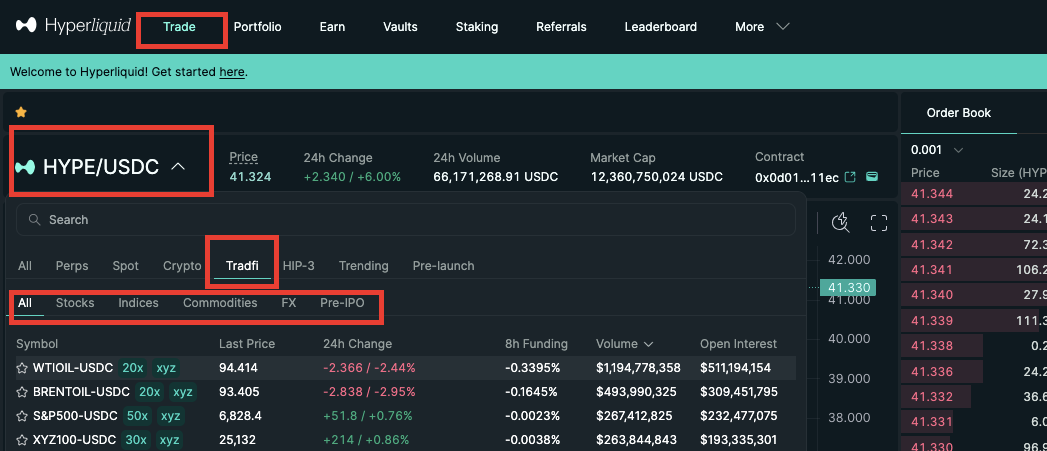
Step 8: Enter the size you want to trade, e.g., 1 silver. Set leverage, select the margin, and choose the order types.
Step 9: Then set the stop-loss and take-profit targets. The exchange calculates the minimum margin (capital) required to open the trade size. Ensure that you have enough USDC to cover it
Step 10: Click on ‘Buy/Long or Sell/Short’ to open a trading position.
Trading TradFi Assets on AsterDEX
AsterDEX is another popular decentralized exchange backed by ex-Binance team members. Like Hyperliquid, AsterDEX offers perpetual trading for crypto and traditional finance assets, which is usually referred to as Aster Perpetuals.
Compared to other DEXs, AsterDEX stands out for two main features.
First, AsterDEX offers extremely high leverage, up to 1001x, for crypto trading, making it an ideal platform for traders who love high risk and are not afraid of liquidation. We can say this feature is retained for TradFi trading too, as it offers 75x leverage, the highest so far. For beginners, using below 5x leverage remains the best way to preserve capital and reduce liquidation risk.
Additionally, AsterDEX offers advanced privacy settings for traders. As a user, if you don’t want other traders to monitor your trading, track your wallet, or copy your trade, all you have to do is turn on the Account Privacy setting. Large-volume traders can combine the feature with its hidden-order features to prevent on-chain tracking and thereby reduce the risk of MEV attacks.
We explain how AsterDEX achieves this level of privacy in our Apex Omni vs AsterDEX article
Currently, AsterDEX offers limited TradFi exposure because you can only trade stocks and commodities. However, it serves a good purpose if you are only looking to trade US stocks as a non-US resident.
Quick Tip: Unlike Hyperliquid, it offers 75x leverage on some TradFi assets, making it a good option if you are looking to increase profit margins without trading more capital. Of course, that comes with a high risk of liquidation. If you are new to using high leverage or perp trading on a DEX, check out our AsterDEX tutorial to get started.
Quick Summary:
- Currently, AsterDEX allows users to trade TradFi assets at zero maker fee
- AsterDEX offers higher leverage than Hyperliquid, up to 75x.
- The leverage level determines the maximum position you can open
- TradFi trading on the exchange is limited to stocks and commodities
To open your first crude oil or gold perpetual positions, sign up on AsterDEX for 2% trading fee discount.
How to Trade TradFi Assets on AsterDEX
Step 1: Visit the official AsterDEX website and click on “connect wallet”
Step 2: Select any of the available wallets
Step 3: Once the wallet is connected, click on ‘Deposit’ and input the amount of USDT you want to trade with
Step 4: Now, on the main interface, click on the trading pairs, e.g., ‘ASTERUSDT’
Step 5: Select one of the TradFi asset categories, ‘Stocks or Commodities’
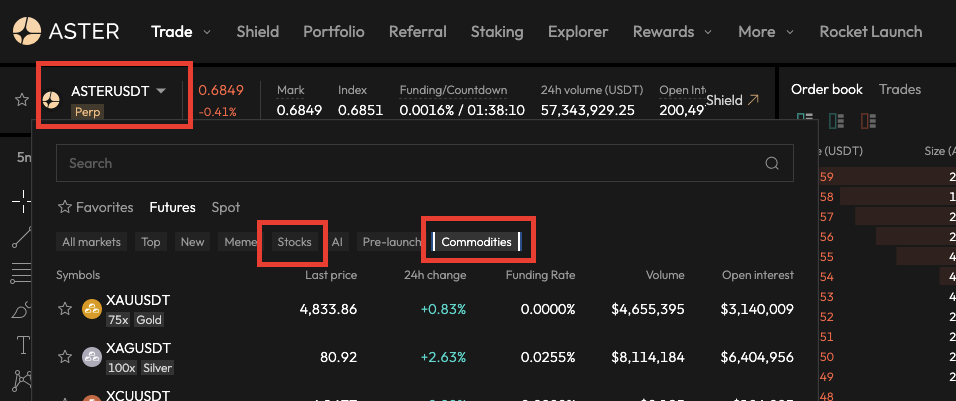
Step 6: On the trading interface, enter the size you want to trade, e.g., 1 XAU. Set leverage, select the margin type, and choose the order types.
Step 7: Then set the stop-loss and take-profit targets. The exchange calculates the minimum margin (capital) required to open the trade size. Ensure that you have enough USDT to cover it
Step 8: Click on ‘Buy/Long or Sell/Short’ to open a trading position.
RWA Trading on Apex Omni
Apex Omni is the third decentralized exchange on our list where you can easily trade traditional finance assets like gold, stocks, oil, silver, and more. Currently, the exchange offers only 24 assets under this category.
Apex Omni is a leading platform for perpetual and spot crypto trading. Built on the Apex Pro infrastructure and supported by Bybit, Apex Omni is gradually becoming a top choice among crypto traders, and if you are looking to include stocks or commodities in your portfolio, you may want to check it.
Unlike AsterDEX, which only gives users access to stocks and commodities, Apex Omni also provides access to indices, which gives traders a wider ecosystem to explore. However, given that it currently has fewer trading pairs than AsterDEX, the number of assets per category is likely very small. For instance, you have only 3 commodities on Apex Omni: Gold, Silver, and the United States Oil Fund.
One important thing to note is that Apex Omni provides these assets under its RWA trading category. Therefore, you will not see a section on TradFi, but you can find the assets under RWA. Also, you do not trade these assets directly; you need to create a distinct RWA account on Apex Omni, then transfer funds from your funding or perpetual account to your RWA account before you can start trading.
However, it is important to note that trading on this exchange operates similarly to Hyperliquid and AsterDEX. It is perpetual and provides up to 50x leverage.
Apex Omni currently applies its regular perpetual trading fees: a 0.05% taker fee and a 0.02% maker fee. Traders can reduce the fee by qualifying for the VIP Tier benefit, either by achieving the required trading volume within 14 days or by staking $APEX (the ecosystem's native token). For instance, you can get up to 20% fee discount when you stake at least 100,000 $APEX.
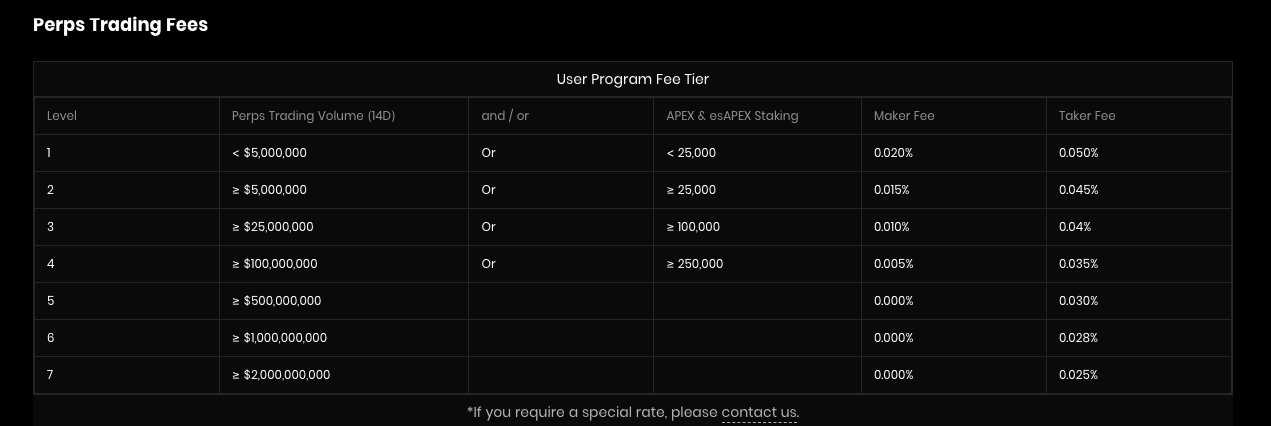
Quick Tip: You can also complete RWA trading on Apex Omni at zero maker fee when your trading volume reaches at least $500 million within 14 days.
Quick Summary:
- Apex Omni is backed by Bybit, a centralized exchange with a solid security mechanism
- TradFi assets are located under RWA
- To trade TradFi assets, you need to create an RWA account and fund it.
- You get to use up 50x leverage on Apex Omni, which is considerably high for perp trading
Ready to explore Apex Omni for crypto and TradFi trading? See our complete guide on how to trade on Apex Omni or connect your wallet to get started
How To Trade TradFi Assets on Apex Omni
Step 1: Visit the official Apex Omni website
Step 2: Connect a decentralized wallet like Metamask
Step 3: Now, click on deposit to add funds to the exchange
Step 4: Back to the interface, click on ‘Perps’
Step 5: Now, click on ‘RWA’
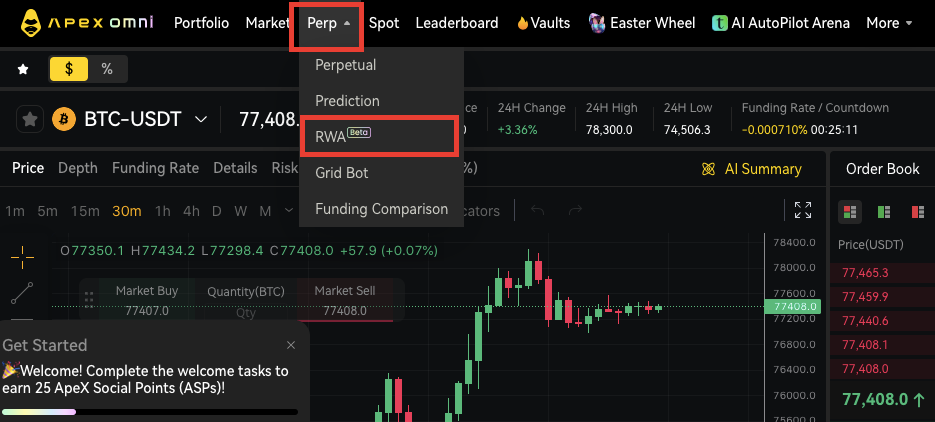
Step 6: On the next page, select one of the available trading pairs
Step 7: Now, click on ‘Create RWA Account’
Step 8: Now that the account is created, click on ‘Portfolio’ and then click on ‘Transfer’ to send USDT from your funding account to your RWA account

Step 9: Go back to the trading interface, enter the Qty and trigger price.
Step 10: Then set the preferred leverage, select the margin type, and choose the order types.
Step 11: Then set the stop-loss and take-profit targets. The exchange calculates the minimum margin (capital) required to open the trade size. Ensure that you have enough USDT to cover it
Step 12: Click on ‘Buy/Long or Sell/Short’ to open a trading position.
Quick Comparison
|
Features |
Hyperliquid |
AsterDEX |
Apex Omni |
|
KYC Verification |
Not required |
Not required |
Not required |
|
Ease of trading |
Easy |
Easy |
Added steps like creating RWA account applies |
|
Asset Coverage |
Stocks, Indices, commodities, forex, pre-IPO |
Stocks & commodities |
Stocks, Indices, & commodities |
|
Leverage |
Up to 50x |
Up to 75x |
Up to 50x |
|
Trading fees |
0.015% - Maker Fee 0.045% - Taker Fee |
0.000% - Maker Fee 0.040% - Taker Fee |
0.020% - Maker Fee 0.050% - Taker Fee |
|
Fee discount |
Available |
Available |
Available |
|
Trading pairs |
100+ |
25+ |
24+ |
|
Margin |
USDC & USDT |
USDT |
USDT |
|
Liquidity / Trading volume |
High / Over $7 billion |
Moderate / Over $1 billion |
Moderate / Over $1 billion |
Conclusion
Trading traditional finance assets is becoming the norm on decentralized exchanges, but Hyperliquid still leads other DEXs in terms of trading pairs, liquidity, volume, and ease of trading. For instance, it currently offers pre-IPO trading, which is not available on AsterDEX or Apex Omni. However, note that while decentralized exchanges eliminate barriers like KYC verification and cross-border access, it comes with smart contract risks and require a good understanding of wallet security to maintain.
Finally, note that perpetual trading comes with a significant risk of liquidation. Therefore, we recommend trading with low leverage as a beginner to protect your capital and reduce risk.
Frequently Asked Questions
What is RWA?
RWA (Real World Assets) are physical or traditional financial assets brought onto blockchains as tokens
What is the difference between the maker and taker fees?
A maker fee is charged when you place a limit order. This order is not filled immediately; it adds liquidity to the exchange. The taker fee is charged on market orders, which are orders placed at the current price of an asset and are filled immediately.