AFX vs Hyperliquid: Which DEX Is Better for Futures Trading?
AFX Trade vs Hyperliquid: Which Decentralized Exchange is the Best for Futures Traders?
Decentralized exchanges now offer perpetual futures and spot trading using a closely similar structure. For instance, Hyperliquid and AFX Trade rely on distinct layer-1 blockchains built specifically for fast and secure on-chain trading. But when we compare exchange fees, advanced features, margin types, and assets, they offer different benefits.
To find out which exchange is better for traders, we tested Hyperliquid and AFX Trade firsthand. We executed spot and futures trades, reviewed trading fees and VIP discounts, explored the passive income mechanism, and examined other key features that normally impact daily trading activities.
Depending on your experience and preferred features, you may discover that even though Hyperliquid is very popular, a new platform like AFX Trade is a better fit for you.
Want to start trading on a relatively new DEX? Check out AFX Trade and receive 5% discount on fees
Hyperliquid vs AFX Trade
|
Features |
Hyperliquid |
AFX Trade |
|
Blockchain |
Hyperliquid (Layer-1) |
AFX (Layer-1) |
|
Trading types |
Spot and perps |
Perps |
|
Order types |
Market, Limit, TWAP, Stop Market/Limit |
Market, Limit, TWAP, Conditional Market/Limit, and Reduce only |
|
Trading pairs |
243+ |
34+ |
|
Max Leverage |
40x |
100x |
|
Trading fee |
Maker fee: 0.015% Taker fee: 0.045% |
Maker fee: 0.01% Taker fee: 0.06% |
|
Fee discount |
Up to 40% with VIP discount |
Up to 45% with VIP discount |
|
Margin Mode |
Cross / Isolated Margin |
Cross / Isolated Margin |
|
Margin Type |
Stablecoin or paired asset |
Stablecoin |
|
Gas fee |
Free on all in-exchange TXs |
Free on all in-exchange TXs |
|
Crypto bonus |
None |
Ongoing trading reward |
|
Funding rate |
Calculated every 4 hours |
Calculated every 4 hours |
Best DEX for experienced and high-volume traders: For traders seeking an advanced trading model, multi-asset collateral support, and fast trade execution, Hyperliquid is a solid option.
Best DEX for beginners and low-volume traders: AFX Trade is suitable for traders seeking lower fees and VIP benefits, or for beginners interested in fast trading, crypto bonuses, and ongoing rewards.
Not sure if any of these exchanges are for you? Check out our article on the best decentralized exchanges for crypto trading for more options.
What is Hyperliquid?
Hyperliquid remains one of the best decentralized exchanges because it combines high daily trading volume with protocol-managed liquidity pools, providing high-volume traders with fast trade execution and low slippage.
Unlike other DEXs, Hyperliquid has both spot and perpetual futures trading, making it one of the few exchanges where you can hold assets and trade futures. But it has a few crypto assets in the spot section.
We executed trades on Hyperliquid using different crypto assets as margin (capital) because it supports multi-collateral mode. For a pair like HYPE-USDC, you use either $HYPE or USDC.
Note: You must deposit the asset onto the support chain. You can only deposit $BTC via the Bitcoin blockchain. And each asset has a minimum deposit amount. For USDC, the minimum we could deposit is 5 USDC.
In-exchange activities are completely free, so you can adjust orders without incurring additional gas fees. Gas fees apply to deposits or withdrawals.
Beyond regular blockchain tracing, you can easily follow wallet addresses, review profit and loss history, and gain useful insights into public positions.
Want to start trading on one of the most famous DEXs? Start trading on Hyperliquid and receive 4% discount on your fees
Pros and Cons of Hyperliquid
Pros
- Features decentralized copytrading
- Offers wide RWA options
- Lower taker fee and up to 100% discount on maker fee
- Traders can use full on-chain transparency for wallet tracking
Cons
- Not suitable for users interested in privacy
- Position visibility can increase MEV attacks like frontrunning
What is AFX Trade?
The first limitation we noticed on AFX Trade is that it currently allows only USDC deposits only on the Arbitrum blockchain. To trade, we had to first swap Ethereum for USDC in our MetaMask wallet.
That adds an extra gas fee to our trading cost, and it is the first step if you don’t have USDC on Arbitrum. You can bridge assets from any blockchain to Arbitrum in MetaMask. Just click on ‘Swap’ in your wallet and select Arbitrum and USDC as your preferred blockchain and asset.
AFX Trade is a newly launched decentralized exchange designed strictly for perpetual futures trading with CEX-like features. It is a solid option for beginners looking to explore crypto trading on a simple interface. For example, you can easily switch between features and execute a long or short trade with 4 clicks. Input trading size, set stop-loss/take-profit, adjust margin mode, and click buy/long or sell/short.
The exchange does not offer spot trading, so you cannot hold assets on it. All assets are held directly on the blockchain, giving users full self-custody and easy access.
AFX Trade supports over 500 wallets at the time of writing, so you can easily connect any Web3 wallet. Our preferred option is the MetaMask wallet because it supports multiple blockchains.
Connect your wallet to AFX Trade to start trading
Pros and Cons of AFX Trade
Pros
- Up to 100x leverage on BTC and ETH
- Lower maker fee and up to 90% discount
- VIP discount percentage is slightly higher
- Ongoing crypto bonus for new and active traders
Cons
- Does not have spot trading
- Users’ vaults are not active for copytrading
- Only support USDC deposit via the Arbitrum chain at the time of writing
Blockchain Infrastructure
Hyperliquid and AFX Trade are built on distinct layer-1 blockchains. For traders, that is enhanced security and fast trade execution.
The Hyperliquid blockchain is divided into HyperCore and HyperEVM with a capacity for up to 200,000 transactions per second. HyperEVM supports the exchange with a dedicated and fully transparent trading environment. Hence, traders can trace every transaction and open positions right on the exchange.
Because Hypeliquid and AFX Trade rely on Layer-1 blockchains, they do not inherit the security risks or concerns associated with external infrastructure.
The AFX is a high-performance layer-1 blockchain designed to support the AFX Trade exchange with 24-hour crypto trading and fast execution similar to what traders experience on popular centralized exchanges like Bybit or Binance.
Unlike CEXs that combine on-chain trading with off-chain settlement, on AFX, order matching and settlement are done on-chain to increase speed and ensure that transaction details are fully traceable.
Though AFX Trade does not support in-exchange transparency like Hyperliquid, users can use its explorer feature to view order details on its blockchain.
Aside from speed, the blockchain is designed to resist price manipulation by ensuring that the market price of the asset is derived from combining different oracle feeds. This allows the exchange to prevent manipulation and therefore protect users from wrongful liquidation.
Wallet Connection
On both AFX Trade and Hyperliquid, we tested MetaMask, Trust Wallet, and Rabby. Both exchanges support over 500 wallets, which makes it easy for users to connect their wallets, deposit assets, and start trading.
Quick Tip: If you prefer to trade on a single blockchain, such as Ethereum, you can use blockchain-specific wallets like Rabby. For flexibility, we recommend using multi-chain wallets like MetaMask or Trust Wallet.
Both blockchains feature solid security models, but they do not protect your assets from wallet theft or phishing links. To prevent unauthorized access or the transfer of funds, you should write down wallet seed phrases and private keys in a book or journal and store them securely.
We recommend using at least two wallets. Use one wallet for active crypto trading. This is the wallet you connect to exchanges to execute. Then use the other wallet to store assets for the long term.
How to Connect Wallet to AFX Trade
- Step 1: Visit the official AFX Trade website
- Step 2: Click on ‘Connect’ on the exchange homepage
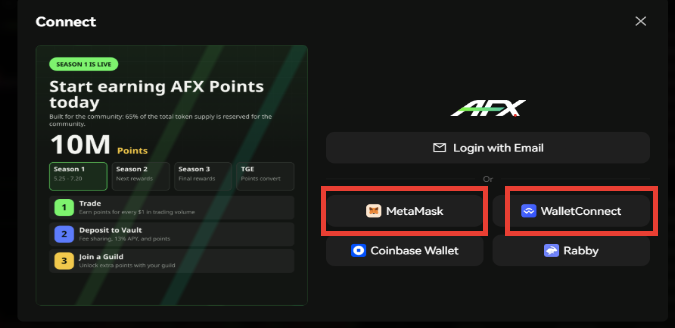
- Step 3: Select your preferred wallet.
- Step 4: If your preferred wallet is not among the few options, click on ‘Wallet Connect’ for more options
- Step 5: Now, click on ‘All Wallet’ to select the preferred option. This will open your wallet app or PC extension

- Step 6: Accept the connection in your wallet
- Step 7: Confirm that the wallet is fully connected by checking the top right corner for your wallet address.
Security and Privacy Features
AFX Trade and Hyperliquid support no-KYC trading while providing regular blockchain anonymity. Traders interact with the exchange using wallet addresses rather than verifiable information such as identity cards or phone numbers. As a result, trading activities are not directly linked to users. However, Hyperliquid offers very limited privacy because traders are publicly visible for others to track.
To minimize volatility and protect users' assets, exchanges combine smart-contract audits, bug bounties, and MEV protections. With that, the exchange can reduce liquidation risk, prevent attacks, and also reduce the chance of anyone frontrunning your orders.
AFX Trade offers enhanced security and a four-phase liquidation process to improve risk management and prevent sudden liquidation of large-volume assets from negatively impacting price.
AFX Trade and Hyperliquid Trading Fee Compared
Hyperliquid Trading Fee Structure
- Spot Trading: Maker fee: 0.04% / Taker fee: 0.07%
- Futures Trading: Maker fee: 0.015% / Taker fee: 0.045%
Hyperliquid offers one of the cheapest taker fees in the crypto space. On several exchanges, including AFX Trade, the taker fee is significantly higher than the maker fee because taker orders are market orders. They completed immediately, thereby reducing exchange liquidity.
Maker orders, on the other hand, are limit orders. They are executed when the price of the assets reaches the buyer’s predicted price. Before execution, the orders are added to the exchange's order book, where they add liquidity to the exchange.
How to reduce trading fees on Hyperliquid
Though decentralized exchanges don’t offer crypto bonuses to cover fees, they offer lower fees to active traders. On Hyperliquid, you can get up to a 40% taker fee discount and up to a 100% maker fee discount when you meet the required trading threshold.
Meeting the highest threshold will require consistent trading, but the good thing is that you can start enjoying lower fees once your futures trades exceed $5 million in volume in 14 days.
Hyperliquid Perp Trading Fees
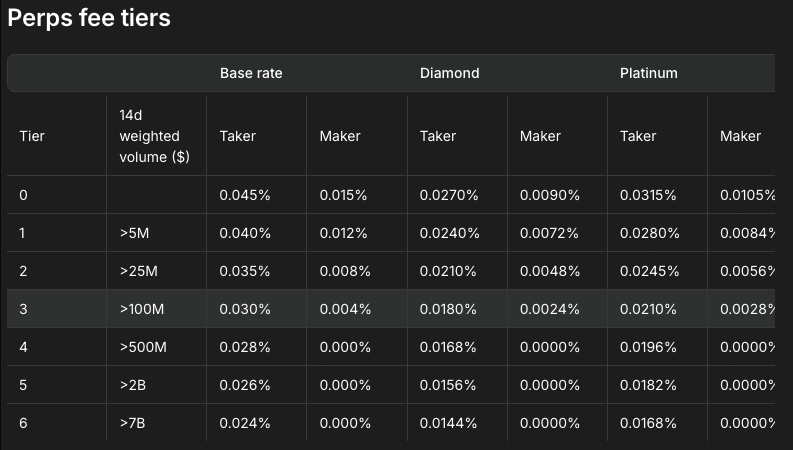
Hyperliquid automatically applies a 4% discount to your trading fee when you visit the exchange using our referral link.
Want to know how Hyperliquid works? Check out the Hyperliquid Tutorial.
AFX Trade Trading Fee Structure
- Futures trading: Maker fee: 0.01% / Taker fee: 0.06%
AFX Trade does not support spot trading, so it does not have a fee structure for that. But it offers the lowest maker fee among popular exchanges, such as Hyperliquid and Apex Omni. Basically, the trading fee is lower when you execute limit orders
The trick here is to always execute limit orders by adjusting the asset price. Though that sounds like a good approach, it can work against you because if the asset price does not reach your predicted price, your order will not be executed. And that can lead to missing out on good opportunities while trying to lower trading costs.
How to reduce trading fees on AFX Trade
You can enjoy a VIP discount of up to 45% of taker fees and up to 90% of maker fees. While the discount is not significantly higher than what you get on Hyperliquid, the catch is that it is easy to qualify for and maintain your VIP level as a trader on AFX Trade.
AFX Trade uses a 30-day cumulative volume, giving you more time to reach the VIP threshold. In contrast, Hyperliquid uses a 14-day volume, so if you don't qualify within 14 days, your earlier trading volume no longer counts, making it harder for lower-volume traders to achieve VIP status.
AFX Trade VIP Tier and Fee
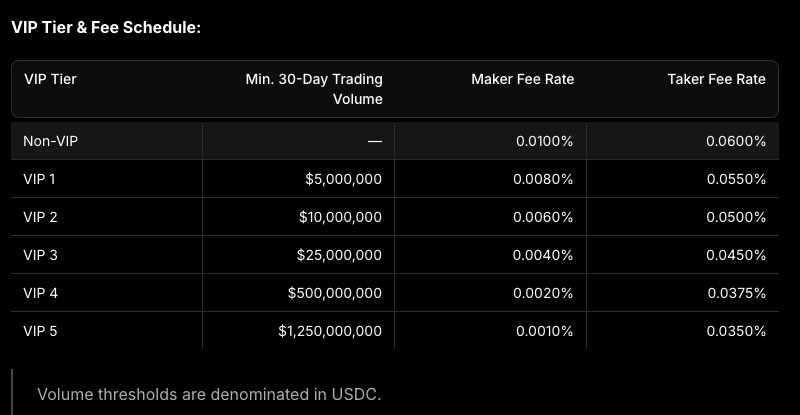
Another way to reduce fees on AFX Trade is to use a referral link. You can get a 5% fee discount on AFX Trade with our link.
For a full guide on how to trade on AFX Trade, see our AFX Trade Tutorial.
Trading Features and Users Experience
Liquidity and orderbook
Hyperliquid is popular among large-volume traders and crypto whales, which significantly increases its daily trading volume. The exchange relies on liquidity pools, where users can add funds to earn passive rewards. Currently, the Hyperliquidity vault has over $200 million in total value locked.
AFX Trade, on the other hand, is a recently launched crypto exchange with a growing number of trading pairs and a daily trading volume lower than Hyperliquid's, but this does not mean executing trades or navigating within the exchange is slow.
On AFX Trade, we completed a 0.4 LTC-USDC trade instantly with minimal slippage and opened long positions in ETH-USDC and SOL-USDC in seconds during different trading sessions. Though interacting with popular assets is fast, we expect slower trading speeds for low-cap altcoins.
What surprises us is that there isn’t any difference in execution speed between the two exchanges when trading BTC, but Hyperliquid offered noticeably deeper liquidity on larger orders
Also, AFX Trade relies on a liquidity pool to complete liquidation events without causing massive price volatility.
Ready to execute your first futures trade? Start trading on AFX Trade.
User interface
Hyperliquid and AFX Trade feature a similar interface. You can easily select a trading pair, set margin type, leverage, stop-loss, and take-profit.
Once an order is executed, you can monitor it in the open position section under the chart, where you also have your trade history and funding history.
Although the AFX Trade interface may occasionally require you to reload your browser to view it, it has an additional feature we find very useful. This is the ‘info’ option available next to the chart.
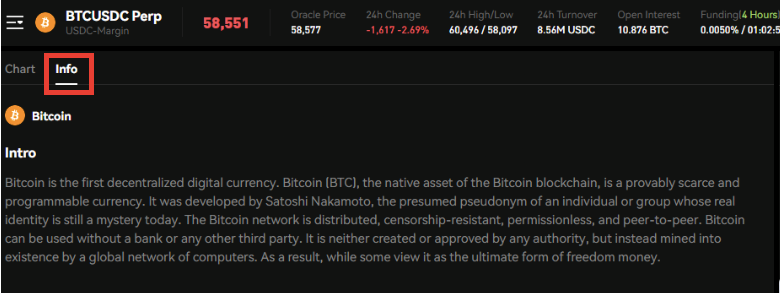
With the feature, new traders can learn about a crypto asset without leaving the exchange. Just click on ‘info’ to get basic information about the selected asset.
Hyperliquid features a transparent leaderboard where users can access large-volume traders, monitor their trades, and track their profit and loss. In the past, traders used it to discover unknown crypto whales, such as the Trump Insider.
Hyperliquid Tracking Tools
Aside from the Hyperliquid leaderboard, you can use tools like WhaleStreet to track wallet addresses. WhaleStreet provides simplified data that makes it easy for traders with limited experience to review whale trading strategies.
With its daily notifications, you can analyze active positions, track wallet profit and loss history, and follow whales closely rather than random trades.
Following other traders can improve your trading experience, but it also comes with some risk. Before you copy any strategy, it is important that you learn how to follow Hyperliquid whales safely for better results.
How to earn passive income on Hyperliquid or AFX Trade
Passive income seekers can join the Hyperliquid or users' vaults. The exchange vaults are liquidity pools used to cover liquidation events and other market-making activities.
Users' vault is similar to regular copy trading on a centralized exchange like Bybit, but it does not replicate or open trades directly in your account. Instead, you add your USDC to a vault created by a lead trader to earn part of the profit made from trades executed by the vault owner.
Like Hyperliquid, AFX Trade offers liquidity pools and users' vaults, but users’ vaults are currently unavailable. For now, you earn passive income by adding funds to the exchange pool to provide liquidity.
In addition, users can earn rewards as VIP traders or enjoy crypto bonuses as new users. These are not passive rewards because active trading is required.
Learn about crypto vaults on DEX and how they work.
Final Thought: Which DEX is Better?
AFX Trade and Hyperliquid provide seamless perpetual futures trading, but experienced traders tend to favor Hyperliquid for its liquidity depth and high adoption. Futures copy traders can use the Hyperliquid leaderboard and whale tracking tools like WhaleStreet to gain better insight into whales' strategies, improve their trading positions, or predict leading sentiment.
AFX Trade is a new platform that can be rewarding for traders, particularly if your trading volume is moderate to low. The platform offers crypto bonuses, lower maker fees, and additional rewards for VIP users.
New users can enjoy crypto rewards for trading and referrals, while active traders benefit from more than just a fee discount. However, while chasing a reward, keep in mind that AFX Trade is a new platform that is yet to be fully tested for security and stability.
Frequently Asked Questions
What is the Difference between Hyperliquid and other DEXs like AFX Trade?
Hyperliquid and other decentralized exchanges are similar in many ways, but they also differ in notable ways. For instance, while Hyperliquid provides full on-chain visibility, AFX Trade only offers blockchain traceability. Anyone can trace wallet activity, but you cannot compare multiple positions on a single dashboard, as on the Hyperliquid leaderboard.
Is Hyperliquid the cheapest exchange for futures trading?
Hyperliquid offers a very competitive fee structure, but it is not the cheapest among exchanges. Currently, AFX Trade offers much lower maker fees on crypto trading.
What is AFX Trade
AFX Trade is a decentralized crypto exchange launched in 2026 for perpetual futures trading. The exchange features a very simple trading interface, making it a good option for beginners. It also offers ongoing bonuses and crypto rewards for new users.