Best No-KYC Exchanges for Beginners in 2026 (Reviewed & Tested)
Best No-KYC Exchanges for Beginners in 2026
The first problem most beginners run into on centralized exchanges is verification before they can access trading or withdraw funds. While it is true that CEXs like Binance and Bybit offer easy spot and futures trading with access to over 1000 crypto pairs, they are heavily regulated and restricted.
No-KYC exchanges are the best alternatives here because they have a wide global reach and require no verification. Before using a no-KYC exchange, you should confirm that you can trade and withdraw assets without mandatory KYC. This is where most exchanges fail.
How We Ranked These No-KYC Exchanges: We tested each exchange from a beginner’s point of view and combined that with our own experience, user reviews (including Trustpilot), trading volume, number of available trading pairs, and overall reputation in the crypto space. We also looked at how easy each platform is to use, especially for new traders.
In this article, we break down the best no-KYC exchanges for beginners. You can also see our full ranked overview of the best no-KYC crypto exchanges in 2026 in our main guide.
Quick Answer: Which exchange is the best No-KYC exchange for beginners?
BTCC offers more than five easy sign-up options, high withdrawal limit, and is one of the few long-running crypto exchanges with a clean security record. But it is a centralized exchange, which means assets are stored in the exchange’s wallet. For decentralized alternatives, try dYdX for easy spot trading and low fees or Apex Omni for beginner-friendly futures trading with multi-chain support.
|
Situation |
Best platform |
|
Beginners interested in spot and futures trading with no-KYC |
|
|
Beginners interested in spot trading, no-KYC, and self-custody |
|
|
Beginners interested in futures trading, no-KYC, and self-custody |
|
|
Beginners interested in no-KYC trading with no withdrawal limit |
Note: This guide lists centralized and decentralized crypto exchanges for beginners looking to trade spot and futures without identity verification. We included affiliate links to each exchange. Using the links, we earn referral commission while you enjoy trading fee discounts on DEXs and get to join ongoing crypto bonuses on CEXs.
For centralized exchanges, KYC demand may change over time. Always confirm the current position on the exchange before use.
BTCC vs dYdX vs Apex Omni vs AsterDEX vs BloFin: Which is Better for Beginners
We tested these exchanges for beginners using hands-on experience, user reviews, trading data, and overall reputation in the crypto market.
|
Features |
BTCC |
dYdX |
Apex Omni |
AsterDEX |
BloFin |
|
Asset security |
Custodian |
Self-custody |
Self-custody |
Self-custody |
Custodian |
|
Trading pairs for spot |
297+ |
194+ |
100+ |
200+ |
400+ |
|
Trading fees Maker/ Taker |
Spot: 0.2%/ 0.3% Futures: 0.025% / Taker: 0.045% |
Spot: 0% on BTC & SOL Futures: 0.02% / 0.05% |
Spot: 0.0425% Futures: 0.02% / 0.05% |
Spot: 0.005% Futures: 0.015% / 0.045% |
Spot: 0.1%/ 0.1% Futures: 0.02% / 0.06% |
|
Multi-chain support |
Yes |
Yes |
Yes |
Yes |
Yes |
|
Wallet connection |
Not required |
Required |
Required |
Required |
Not required |
|
Crypto tutorial |
In-exchange guide and demo account |
None |
None |
None |
Demo account |
|
Copy trading |
Available |
Not available |
Available |
Available |
Available |
|
Verification |
Required, but works without it |
Not required at all |
Not required at all |
Not required at all |
Required, but works without it |
|
Liquidity |
Sufficient for trading |
Deep with low slippage |
Deep with low slippage |
Deep with low slippage |
Sufficient for trading |
|
Withdrawal |
$10,000 daily limit |
No daily limit |
No daily limit |
No daily limit |
$20,000 daily limit |
|
Trading fee discounts |
VIP discount - up to 50% |
Fee rebate - up to 50% Vip discount - up to 100% Affiliate discount |
Vip discount - up to 40% Affiliate discount - 5% |
$Aster discount - 5% VIP discount - up to 50% Affiliate discount - 4% |
VIP discount - up to 50% |
|
Crypto bonus |
Up to $30,000 |
None |
None |
None |
Up to $10,000 |
Note: The spot trading fee may be slightly higher or lower on DEXs based on the network fee at the time of trading.
Best No-KYC Exchanges for Crypto Trading: Beginners' Guide
1. BTCC
BTCC is a centralized crypto exchange that allows traders to interact with over 297 crypto pairs without identity verification. It supports USDT and COIN-M margins, which means you can trade assets paired with other cryptocurrencies without converting to a stablecoin.
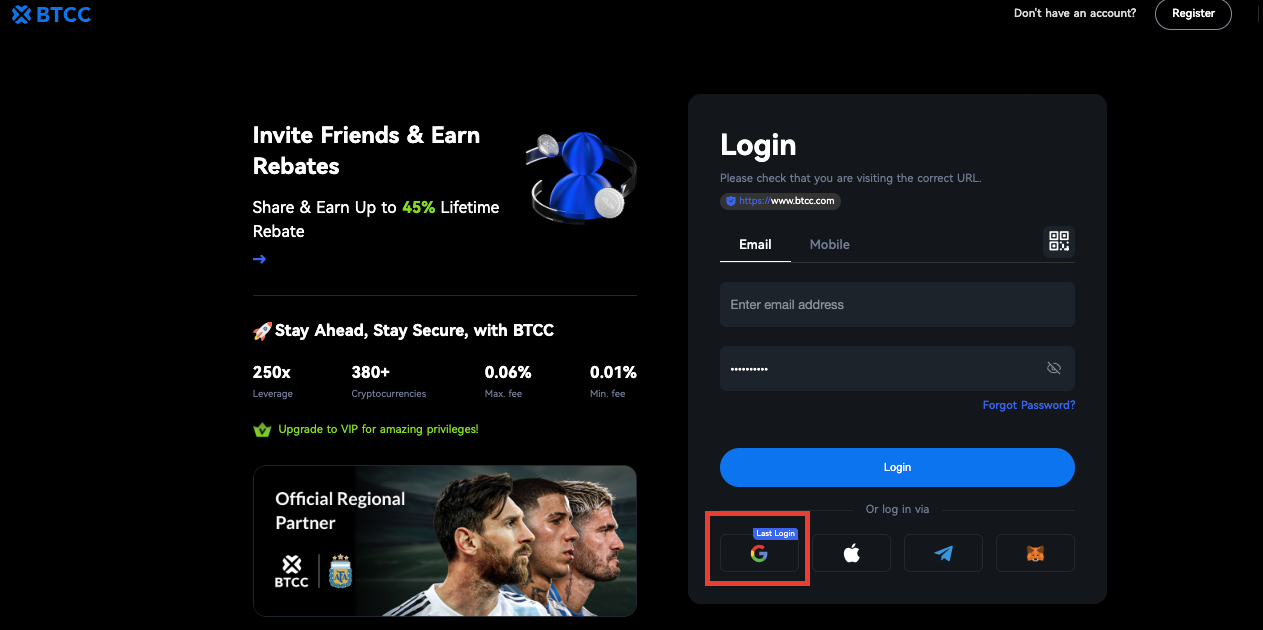
When setting up an account, the Gmail option was the fastest. After clicking on the Google logo on the login dashboard, the exchange automatically validates my Gmail address. With that, I started trading in less than 2 minutes.
BTCC was launched in 2011, but unlike old platforms like Binance and Bybit, it has limited blockchain support. For instance, you can deposit SOL only on the Solana blockchain; sending from other chains, such as Ethereum, will result in asset loss. Even popular assets like USDT support just 8 blockchains
If you are just getting started, stick to sending USDT on the BNB chain or Tron while you carefully confirm which networks are available for other crypto assets to avoid sending coins from unsupported chains.
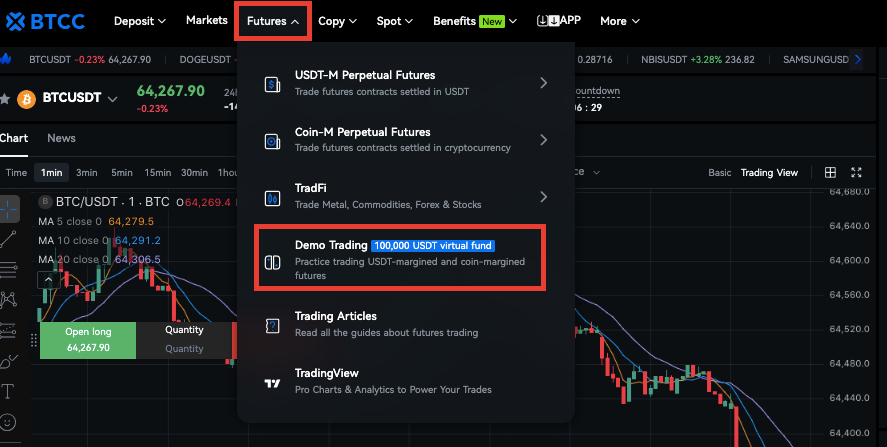
BTCC offers demo trading and in-depth guides for every step. These are features I find helpful before trading with real money. You can use the virtual fund to learn more about liquidation in crypto trading. To use it, click on ‘futures’ on the main interface and select ‘demo trading.'
|
Pros: High withdrawal limit: $10,000 daily. Free Crypto Bonus: BTCC also offers a generous $30,000 crypto bonus. Zero breach history: Since its launch, BTCC has not been breached. Easy usage: You can switch between live and demo trading with a single click. |
Cons: No fiat access: Unverified users cannot use the fiat deposit and withdrawal options. Local restriction: BTCC is not available in some countries. High spot trading fee: BTCC has one of the highest spot trading fees in the space |
|
Leverage: 100x (without KYC) |
Trading fee (Maker/Taker): BTCC Spot trading fees: 0.2% / 0.3%
|
Check out our BTCC crypto bonus guide or Start trading on BTCC to get up to $30,000 crypto bonus.
2. Apex Omni
Apex Omni is where you begin real futures trading after using demo accounts on CEXs for a few months. The exchange focuses mainly on perpetual futures trading, with few assets available for spot trading.
Apex Omni ranks among the top 5 exchanges by daily trading volume on CoinMarketCap and maintains a liquidity vault. All of these contribute to its liquidity depth, which supports faster trade execution. This means orders get filled without delay, but large-volume traders may still experience slippage. To prevent this, place limit orders by setting the price you want to buy or trade an asset at.
Check our Apex Omni tutorial for a complete guide on order types and how to trade on Apex Omni.
Apex Omni is built on the Arbitrum chain for privacy, but it also offers multi-chain support, making it easy for traders to deposit assets from other blockchains.
New traders interested in passive income can also add USDC to exchange-managed vaults to provide liquidity, or deposit into other traders' vaults to access decentralized copytrading.
Note that on Apex Omni, regular withdrawal often takes hours. You can opt for the fast withdrawal option for an extra fee. This ensures that withdrawals are completed immediately, but the exchange applies a fee of around $2, depending on the blockchain and network conditions.
Apex Omni is a good fit for new crypto traders looking to explore advanced futures trading and broader options, such as RWA assets and pre-IPO trading.
|
Pros: Large RWA market: You can open perpetual trades for several shares, indices and other real-world assets. Advanced privacy: Apex Omni relies on a zero-knowledge chain to increase trading privacy |
Cons: Additional withdrawal fee: Apex Omni is the only exchange on the list that applies an additional withdrawal fee. Limited spot trading: Beginners will likely struggle to navigate the spot section. |
|
Leverage: 100x |
Trading fees (Maker/Taker): Apex Omni spot trading fee: 0.0425% Apex Omni futures trading fee: 0.02% / 0.05% |
To start trading, visit Apex Omni and connect your wallet.
3. AsterDEX
AsterDEX is a Binance-backed decentralized exchange known for its deep liquidity, fast trade execution, and high leverage. Though it is more suitable for experienced traders with good knowledge of crypto liquidation, beginners can benefit from its low trading fees, fee discounts, and simple interface.
The trick is to use very low leverage. We recommend a maximum of 3x leverage.
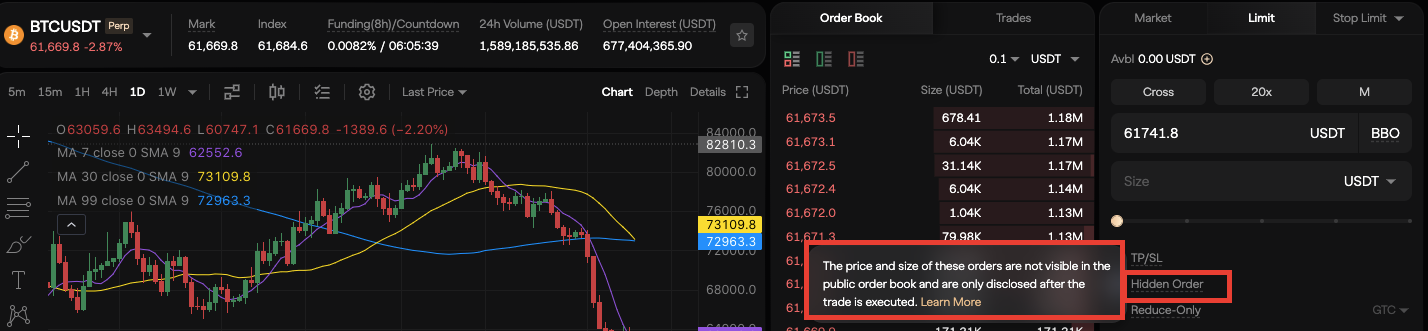
We find AsterDEX’s interface very easy to navigate. For instance, you can easily select between spot and futures trading by simply clicking on trade. For your futures orders, you can enable the hidden order option on the trading interface to hide orders from the public orderbook.
AsterDEX's trading fee structure is the best part of the exchange. When you pay trading fees with its native token ($ASTER), you enjoy a 5% discount. Also, AsterDEX has the lowest trading fees for both spot and futures trading.
Though AsterDEX has limited trading pairs under spot, you can trade over 200 crypto assets under the futures section. The exchange supports cross-margin and multi-asset modes, enabling users to hold trading positions across all assets in their accounts.
Best for: Beginners looking to easily complete perpetual futures trades with low fees and a zero withdrawal limit. AsterDEX is one of the best alternatives to Binance if you live in countries where Binance or other CEXs are restricted.
|
Pros: Lower fees: AsterDEX offers the lowest trading fees among all listed exchanges. Fee discount: In addition to its VIP-level discount, you also get a 5% discount when you hold $ASTER for trading fees. High-level privacy: You can enable the hidden-order feature to hide all trading details from the public orderbook. |
Cons: High leverage: This is not suitable for new traders. Limit spot trading: The spot trading interface is complicated and offers few trading pairs, mostly memecoins. |
|
Leverage: 1001x |
Trading fees (Maker/Taker): AsterDEX spot trading fee: 0.005% AsterDEX futures trading fee: 0.015% / 0.045% |
Join AsterDEX now to enjoy a 4% discount on all trading fees.
4. BloFin
BloFin was launched in 2023, but it is gradually becoming a good option for traders looking for no-KYC exchanges with higher daily withdrawal limits, flexible margin requirements, and a modern trading interface.
New and existing traders interested in passive income can access real-world assets such as tokenized treasuries on BloFin by subscribing to RWUSD with at least 10 USDT.
To access this, click on ‘Earn’ on the main page and select ‘RWUSD.’ This exchange converts your USDT to RWUSD on a 1:1 basis and pays you daily interest. This feature differs from flexible staking on other CEXs in that you cannot withdraw or redeem your USDT instantly. Instead, the exchange offers two redemption options.
Standard redemption attracts a 0.05% fee and takes 3 days, while instant redemption attracts a 0.1% fee. Also, BloFin can adjust the Annual Percentage Rate (APR).
Choosing between BloFin and BTCC can be tricky because, though they are both centralized exchanges with no-KYC trading support, they have different strengths.
5. dYdX
dYdX offers the easiest spot trading interface that slightly outperforms other decentralized exchanges that we’ve tested. dYdX makes it easy to track your holdings and open positions. Holdings are the crypto you have in your account, while open positions are your spot orders that are yet to be filled.
As a leading DEX, dYdX has sufficient liquidity to support popular assets and offers no withdrawal restrictions. Spot and futures trades are filled instantly, but limit orders are only filled when the asset price reaches the specified price. With this, you can execute high-volume orders faster and avoid hidden fees.
Note that all decentralized exchanges require a wallet connection for usage. Also, DEXs rely on smart contracts to automate transactions. Smart contracts may be breached, occasionally leading to wrongful liquidations.
Before you start trading on dYdX, check out this dYdX tutorial for a detailed overview of how the exchange works, how to deposit funds, execute trades, and withdraw funds easily.
|
Pros: Zero gas fee: In-exchange activities are completely free. Zero spot trading fees: Users enjoy 0% trading fees on selected assets. Fee rebates: Earn up to 50% rebate on fees. |
Cons: Low liquidity for low-cap altcoins Unstructured spot trading fees |
|
Leverage: 50x |
Trading fee (Maker & Taker): dYdX spot trading fee: Vary based on asset and liquidity. dYdX futures trading fee: 0.02% / 0.05% |
Join dYdX using our affiliate link and start trading on a decentralized exchange.
BTCC vs BloFin: Which no-KYC Centralized Exchange is Better?
BloFin offers higher trading pairs. You can access over 400 crypto pairs, which is good if you intend to trade low-cap altcoins instead of popular crypto assets.
The leverage level and withdrawal limit are also higher. While BTCC offers 100x max leverage without KYC, you can use up to 150x on BloFin. The withdrawal limit on BTCC is $10,000, but BloFin offers a daily limit of up to $20,000.
BloFin clearly has some edge over BTCC, but BTCC is a long-established CEX with wide global reach, no-KYC support, and no publicly documented system breach. BloFin, on the other hand, was launched in 2023; hence, it does not yet offer BTCC’s level of security or trust.
|
Pros: Higher withdrawal limit: On BloFin, you can withdraw up to $20,000 High leverage: BloFin offers up to 150x leverage. Robust security tools: BloFin combines routine audits, an insurance fund, and ADL to protect funds and manage liquidation events. |
Cons:
Limited RWA Access: on BloFin, you can trade real-world assets directly; you can only deposit stablecoins into its RWA treasury for daily rewards. New Platform: BloFin is a new trading platform launched in 2023, it does not have the reputation of a long-established exchange yet. |
|
Leverage: 150x (without KYC) |
Trading fees (Maker/Taker): BloFin spot trading fees: 0.1% / 0.1% BloFin futures trading fees: 0.02% / 0.06% |
Start trading on BloFin today and get up to $5,000 in deposit bonuses. For more information about the bonus program, visit our Blofin Deposit Bonus page.
Final Thought
After testing several Centralized and decentralized no-KYC exchanges, we found two main differences: trading experience and withdrawal limits.
Centralized no-KYC exchanges have withdrawal limits, but offer more trading pairs, exchange-managed accounts for asset storage, a user-friendly interface, and a demo account.
Decentralized no-KYC exchanges offer limited access to spot trading but a robust futures trading interface, with no withdrawal limit. The exchanges do not hold or manage your assets, which protects you from custodian risks like fund mismanagement, but also requires you to connect and store your assets in a Web3 wallet.
Another difference between centralized and decentralized no-KYC exchanges is the risk of sudden KYC. Centralized exchanges may demand sudden verification if the exchange faces pressure from regulators, but a decentralized exchange cannot spring a verification surprise on you.
Quick Summary: Centralized No-KYC Exchanges vs Decentralized No-KYC Exchanges
|
Centralized No-KYC Exchanges |
Decentralized No-KYC Exchanges |
|
Has withdrawal limit |
No withdrawal limit |
|
Limited leverage use |
High leverage use |
|
KYC-risk is high |
No KYC risk |
|
Custodian asset storage |
Self custody |
|
Higher trading fees |
Lower trading fees |
|
No trading fee discount |
Offers trading fee discount |
|
Offers crypto bonus, but may require verification to claim |
No crypto bonus |
|
No wallet connection required |
Requires connection to web3 wallet but also offer in-exchange account |
Final Verdict: If you are interested in safe, no-KYC trading without the risk of a sudden verification request, a decentralized exchange is a solid option. However, if you want broad spot trading, centralized exchanges offer a better experience.
Frequently Asked Questions
Which no-KYC Exchanges have the lowest trading fees?
AsterDEX has the lowest trading fee structure, but it is not suitable for spot trading. You can only use it for perpetual futures trading. dYdX is a good alternative for spot traders.
Where can I get a crypto bonus as a beginner?
You can get a crypto bonus on centralized exchanges when you participate in their deposit or trading challenge. We review the best crypto bonuses and provide a step-by-step guide on how to participate in each.
What is the best no-KYC Exchange for beginners?
Choosing the best no-KYC exchange depends on your trading preference and experience. Exchanges like BTCC offer the best spot and futures trading experience, while DEXs like dYdX and Apex Omni also offer high asset security.
What are the risks of using no-KYC crypto exchanges?
Trading on no-KYC exchanges comes with significant risks. For no-KYC centralized exchanges, the risk of sudden verification demands and withdrawals being paused remains the biggest concern. No-KYC decentralized exchanges offer limited customer support, making it difficult to resolve any issues that may arise during use.
Is trading on a no-KYC exchange legal?
Using a no-KYC exchange is not necessarily illegal, depending on your country. Keep in mind that most countries are interested in regulating crypto exchanges, making it difficult to access no-KYC exchanges.