Best No-KYC Futures Trading Exchanges in 2026 (Ranked & Compared)
Best No-KYC Crypto Exchanges for Futures Trading (2026)
No-KYC exchanges operate differently. Some exchanges break the no-KYC promise after you deposit funds, while some introduce withdrawal limits or restrict daily trading volume. These restrictions must be considered in futures trading, where positions often require frequent collateral transfers and larger withdrawals.
Also, KYC databases are increasingly targeted by crypto attackers, and submitting your details makes this easier. The Binance data exposure in 2023 is a good example. For high-volume futures traders, this poses somewhat of a risk, as attackers can easily link your trading activity to your real identity. But then no-KYC exchanges have their own risks and limitations as well, such as withdrawal limits.
In this guide, we review 5 no-KYC exchanges for futures trading based on risk of KYC request, withdrawal limits, trading fees, leverage, and liquidity.
For a general review of no-KYC exchanges, see our article on the Best no-KYC crypto trading platforms.
Quick Summary: Which Exchange is The Best For You
|
Situation |
Best platform |
Why |
|
Low-volume traders with limited futures trading experience |
BTCC, BloFin |
Access in-exchange tutorials and demo trading accounts. |
|
Experienced or high-volume traders |
Apex Omni, Hyperliquid, or AsterDEX |
High liquidity for fast trade execution and advanced liquidation tools. |
|
Aggressive leverage traders |
AsterDEX |
Offers the Highest leverage for futures trading |
|
Beginners interested in passive income |
Apex Omni, Hyperliquid, or AsterDEX |
Offers decentralized crypto vaults. |
|
Traders with high withdrawal demand |
Apex Omni, Hyperliquid, or AsterDEX |
No daily withdrawal limit |
|
Traders with moderate daily withdrawal ($10,000 - $20,000) |
BTCC, BloFin |
Daily withdrawal limit applies |
|
Active traders interested in RWA perpetual positions |
BTCC, Apex Omni, Hyperliquid |
Offers a wide RWA market |
Key Takeaways:
- You can access both CEXs and DEXs for no-KYC futures trading.
- If you want no-KYC, no withdrawal limits, and no verification, DEXs are the best options.
- CEX is considered more beginner-friendly but comes with limited order types
- Before trading on any no-KYC exchanges, check your local laws, the exchanges’ terms of use, and available features such as liquidity, trading pairs, and trading fees.
- Futures trading on no-KYC exchanges does not eliminate your tax obligations.
Best No-KYC Exchanges For Futures Trading Compared
|
Features |
Apex Omni |
BTCC |
Hyperliquid |
AsterDEX |
BloFin |
|
Exchange type |
DEX/ Self-custody |
CEX/ Custodian |
DEX/ Self-custody |
DEX/ Self-custody |
CEX/ Custodian |
|
Withdrawal limit |
No limit |
$10,000 |
No limit |
No limit |
$20,000 |
|
Trading fees Maker / Taker |
0.02% / 0.05% |
0.03% / 0.048% |
0.015% / 0.045% |
0.01% / 0.035% |
0.02% / 0.06% |
|
KYC Risk |
None |
Low |
None |
None |
Moderate |
|
Max leverage |
100x |
100x |
40x |
1001x |
150x |
|
Daily volume |
$1B+ |
$23B+ |
$8B+ |
$1B+ |
$1B+ |
|
Copy trading |
Available |
Available |
Available |
Available |
Available |
Before you start trading, you should read our other post to confirm if no-KYC crypto trading is legal in your country.
4 Things to Keep in Mind Before Using No-KYC Exchanges
Locations: Some no-KYC exchanges may be restricted in your country, particularly centralized exchanges.
Crypto-to-Fiat: Most no-KYC exchanges do not offer crypto-to-fiat conversion. Using Hyperliquid, we often convert crypto assets like BTC to stablecoins (USDC) and send the USDC to Coinbase for conversion to USD.
Tax Reporting: If you reside in the United States, India, or other countries where cryptocurrency ownership and trading are taxed, you must report all profits and crypto assets to the tax authority.
Trading Experience: Your trading experience matters when using no-KYC exchanges. Beginners should practice with a demo account before investing real money, use low leverage, and learn about liquidation risk in crypto futures.
Best Decentralized No-KYC Exchanges for Futures Trading
Apex Omni
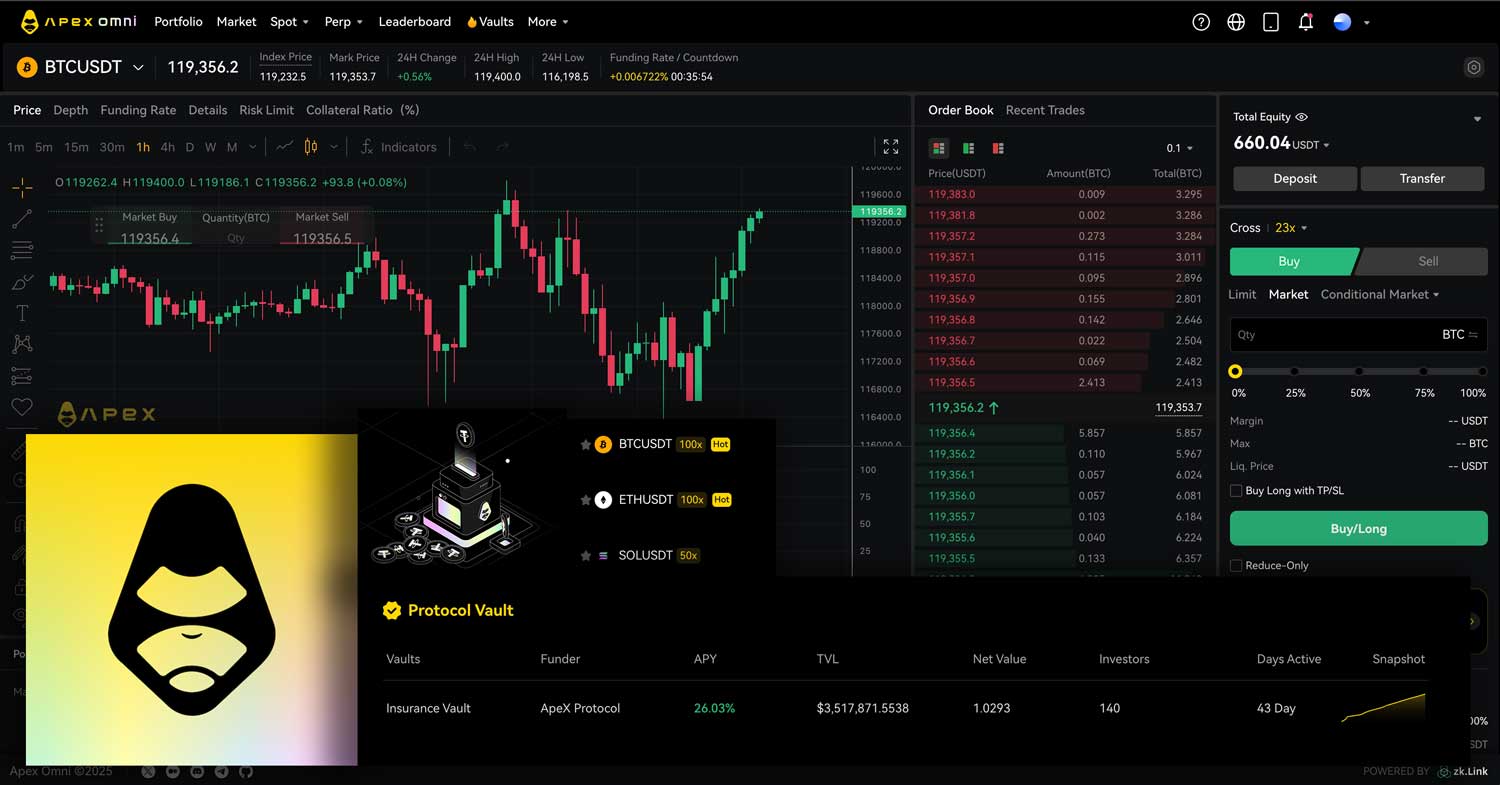
If you are unable to use centralized exchanges like Bybit due to KYC hassles and location restrictions, Apex Omni offers the same experience and is also backed by Bybit.
With its simplified interface and deep liquidity, Apex Omni combines fast trade execution with advanced trading options, making it suitable for both new and experienced traders. As a beginner, you can easily execute limit or market orders in isolated or cross-margin mode with up to 100x leverage. Experienced traders can use advanced order types such as conditional market or limit orders, post-only or immediate-or-cancel orders, to better control liquidity.
For instance, using IOC in futures trading allows you to capture available liquidity before the price level changes. Using this feature, Apex Omni will fill as much of your order as possible at your specified price and automatically cancel any unfilled portion.
Another useful feature of Apex Omni is the funding rate comparison dashboard. We repeatedly use the dashboard to compare rates across major exchanges like Binance, Bybit, and Hyperliquid. Futures traders can use funding rates to spot arbitrage opportunities and predict price reversals before opening a futures position.
Get a step-by-step guide on how to use Apex Omni in our Apex Omni Tutorial.
Apex Omni Trading Fee, Trading Pair, and Leverage
|
Fees: 0.02% / 0.05% |
Trading pairs: 134+ |
Max Leverage: 100x |
Pros
- It combines a simple interface with fast execution for high-volume orders.
- As a no-KYC exchange, Apex Omni offers self-custody and no withdrawal limit.
- Access to advanced trading indicators like trading pairs tracking on TradingView, and a funding rate section to compare funding fees on multiple exchanges.
- Passive income seekers can use Apex Omni vault for decentralized copy trading.
- VIP and affiliate discount: offers up to 50% fee discount to VIP traders.
Cons
- On Apex Omni, regular withdrawals can take hours to process, and the exchange charges an additional fee for instant withdrawals.
- The trading fee is slightly higher than on other exchanges, but you can reduce it with a VIP or affiliate discount.
Get a 5% discount when you start trading on Apex Omni.
Hyperliquid
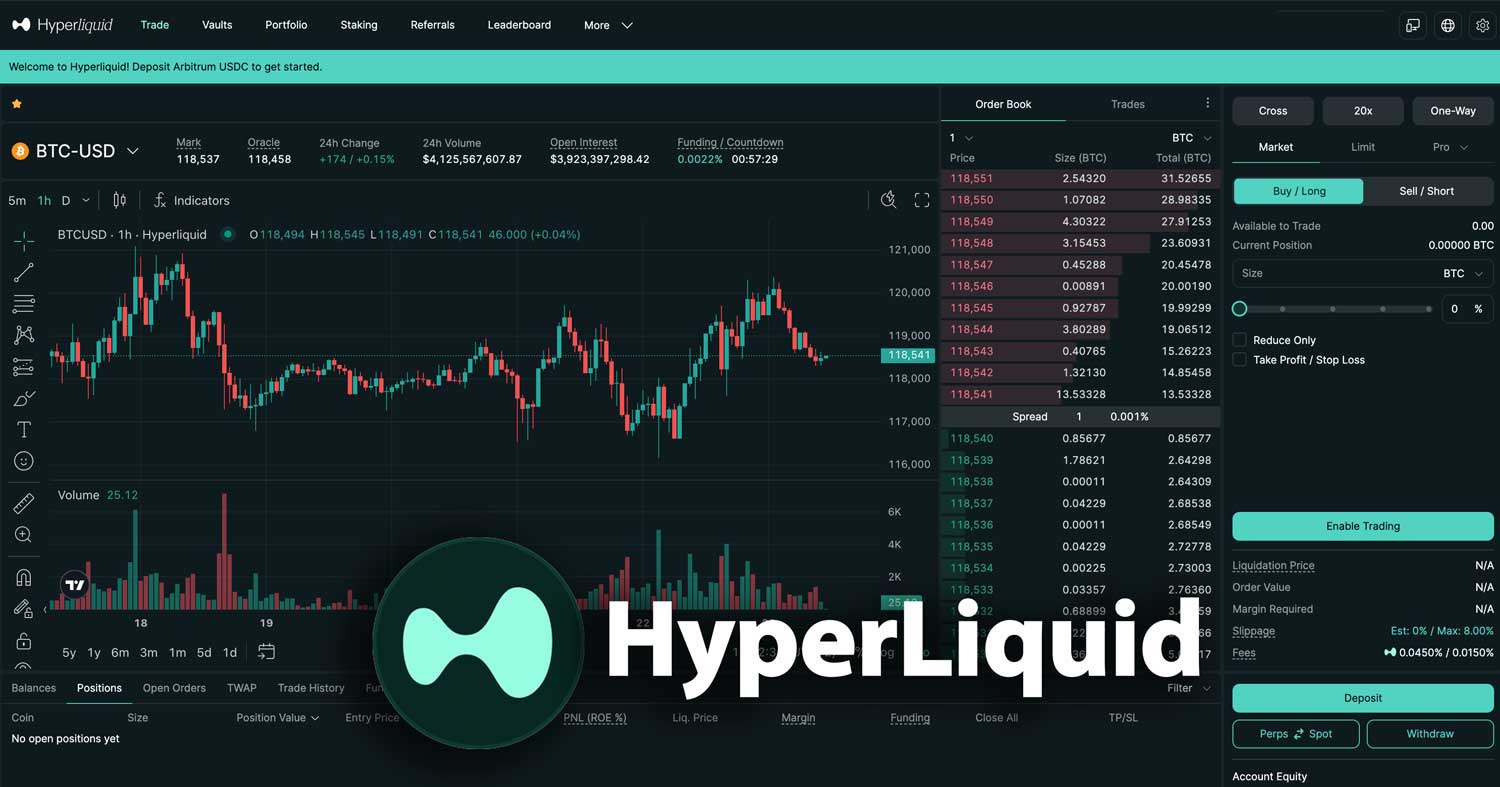
As a futures trading platform, Hyperliquid offers deep liquidity across multiple blockchains. The exchange is better suited to experienced traders with a solid understanding of futures trading.
Hyperliquid has several features that manage liquidation events. One that benefits traders is Hyperliquid margin maintenance. This feature ensures that your account is not completely wiped out when prices move against you. Instead, the exchange closes your order when your capital has reached the minimum margin required to back your order.
Hyperliquid also uses the Hyperliquidity Provider (HLP) vault as its primary liquidity vault to absorb liquidated positions. The exchange combines that with auto-deleveraging (ADL) to ensure that trading remains smooth and fast, while reducing the risk of forced liquidation in extreme market conditions.
The only trade-off for high-volume traders is the on-chain transparency. New and low-volume traders can use this feature to track whale activities on the exchange, but traders looking for privacy won’t enjoy it.
Also, we do not recommend blindly following whales; instead, you can use tools like WhaleStreet to gain detailed insights into how whales trade.
Ready to trade on Hyperliquid? Check out our Hyperliquid tutorial to get started.
Hyperliquid Trading Fee, Trading Pair, and Leverage
|
Fees: 0.015% / 0.045% |
Trading pairs: 340+ |
Max leverage: 40x |
Pros
- Advanced on-chain transparency allows traders to identify whale wallets and copy their trading strategies, or even positions.
- Hyperliquid offers a CEX-like futures trading experience, but no KYC.
- Its deep liquidity reduces slippage in larger orders
- Offers self-custody for users seeking to maintain full access to and control over their funds.
- In-exchange activities are completely gas-free.
- Withdrawal is fast, at no extra cost, with no daily limit.
Cons:
- Hyperliquid prioritizes on-chain transparency over traders' privacy. This means all your trades are constantly traceable.
Trade on Hyperliquid to enjoy a 4% fee discount.
AsterDEX
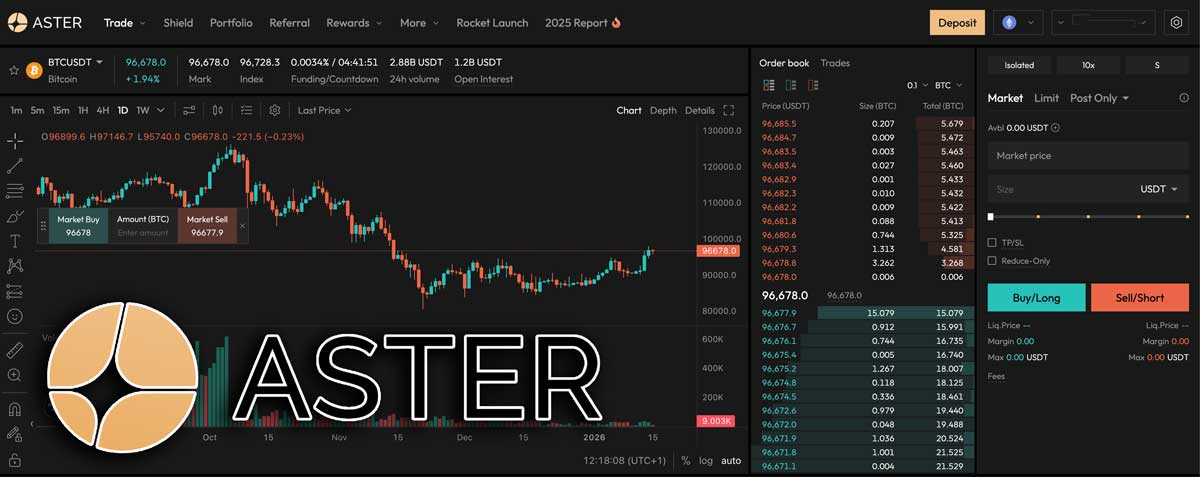
If you want to trade like you are on Binance, but without submitting your ID for verification, AsterDEX is a good alternative. Backed by Binance, the exchange features a CEX-like trading interface and moderately deep liquidity.
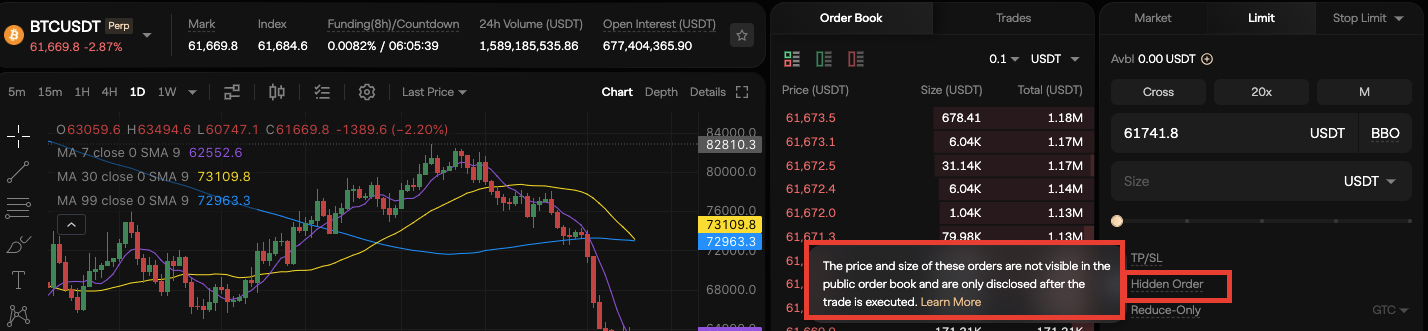
AsterDEX stands out as a decentralized exchange for two reasons: first, the hidden order feature. Unlike Hyperliquid, AsterDEX offers extra privacy features. Beyond the regular blockchain anonymity, you can use this feature to hide your order from the exchange’s order book until it is filled. This ensures that high-volume orders have minimal impact on price and protects traders from possible MEV attacks.
Want to learn how to use AsterDEX step by step? Check out our complete AsterDEX Tutorial, where we explain wallet setup, futures trading, hidden orders, leverage settings, and risk management for beginners.
How to use the Hidden Order features on AsterDEX
Step 1: Connect your wallet to the official AsterDEX website.
Step 2: Select your trading pairs and set your preferred margin mode and leverage.
Step 3: Now, input the order amount and set your take profit/stop loss
Step 4: After the TP/SL, check the ‘Hidden Order’ box
Step 5: Click on trade to open a position.
Another feature is its extremely high leverage. On the exchange, you can use up to 1001x leverage on selected assets. This may be used in an experiment or short-term trades; it is not recommended for everyday trading.
Beginners should note that using high leverage increases liquidation risk. Depending on your margin, using 1001x leverage means even a 0.1% move against your trade may completely liquidate your positions.
AsterDEX Trading Fee, Trading Pair, and Leverage
|
Fees: 0.01% / 0.035% |
Trading pairs: 400+ |
Max Leverage: 1001x |
Pros:
- Low trading fee: AsterDEX offers no-KYC futures trading with one of the cheapest trading fees in the space. You can even reduce trading fees when you qualify for any of its VIP tiers.
- Advanced Privacy: The hidden order feature stands out for those who want to keep their trade private.
- No withdrawal limit: You can withdraw all your funds without delay or limitation.
- High trading pairs: AsterDEX has a growing list of crypto assets. Currently, you can trade over 400 assets.
Cons
- Extremely high leverage: Using the max leverage is not recommended because a single second of volatility may just be enough to liquidate a position.
Connect your wallet to AsterDEX to start trading.
Best Centralised No-KYC Exchanges for Futures Trading
BTCC
Established in 2011, BTCC is one of the most stable centralized exchanges for futures trading. For US residents looking for an alternative to Binance.us or Coinbase, which are heavily restricted, BTCC allow traders to execute limit or market orders with up to 100x leverage.
The exchange supports very limited blockchains depending on the coin. You can only deposit $SOL via solana blockchain. Sending USDT is possible from only 9 blockchains.
You can easily withdraw trading profits or unused funds, as the exchange also supports daily withdrawals of up to $10,000 without verification. To withdraw or buy crypto with USD, you need to verify your identity.
Also, note that though BTCC has a good reputation as a no-KYC futures trading platform, centralized exchanges are generally subject to local laws, so regulatory changes can affect their availability.
BTCC Trading Fee, Trading Pair, and Leverage
|
Fees: 0.025% / 0.045% |
Trading pairs: 297+ |
Max Leverage: 100x |
New users can even participate in the ongoing $30,000 crypto bonus on BTCC.
Pros
- In-exchange trading tutorial. As a new user, BTCC provides internal guides that pop up when you want to trade, deposit, convert or withdraw.
- You can withdraw up to $10,000 daily. If you forgot your password and had to reset it, the exchange pauses withdrawals for 24 hours.
- BTCC is available worldwide, with a few countries exempted. See the BTCC restricted countries list for a full overview.
- CEXs are generally good for beginners because they offer simple asset custody, and you can use demo accounts to learn before using real money.
Cons
- Order types are limited to only limit or market orders. No advanced options like you have on DEXs.
- Sudden verification requests may be triggered by high-volume trading or fiat deposits.
BloFin
BloFin is one of the fastest-growing no-KYC futures exchanges, especially among traders seeking high leverage, flexible margin requirements, and a modern trading interface. The exchange supports no-KYC futures trading and allows crypto withdrawals of up to $20,000 per day.
Compared to many smaller no-KYC exchanges, BloFin stands out for its strong liquidity, copy trading features, and beginner-friendly platform. It also offers select stock-based trading contracts, although its traditional market offerings are more limited.
BloFin uses two mechanisms to protect traders in major liquidation events. Its insurance fund was designed to absorb losses from liquidated positions, while ADL can be triggered if the insurance fund is insufficient during extreme market conditions.
BloFin Trading Fee, Trading Pair, and Leverage
Fees: Maker: 0.02% / Taker: 0.06%
Trading pairs: 400+
Max leverage: 150x
Pros
- On BloFin, you can withdraw up to $20,000
- BloFin offers up to 150x leverage, which is higher than what you get on BTCC.
Cons
- BloFin is not available in several countries, including those on the BloFin restricted countries list.
New Platform: BloFin launched futures trading in 2023. Therefore, its regulatory standing and reputation are not yet established.
To access the ongoing crypto bonus on BloFin, sign up now.
Which is Safer? DEXs vs CEXs for No-KYC Futures Trading
With on-chain anonymity and no withdrawal limit, Decentralised no-KYC exchanges like Apex Omni offer stronger security. Also, users retain self-custody. This means that your crypto asset is not sitting in an exchange cold wallet; instead, it is stored on the blockchain only you can access.
Note that DEXs rely on smart contracts to automate trades. Smart contracts are prone to vulnerabilities and bugs, which may lead to wrongful liquidation or price manipulations.
Centralized exchanges, on the other hand, are custodian platforms. The exchange stores your assets in its wallet or vault and can pause withdrawals, freeze your assets, or require verification.
For example, BitMEX introduced a sudden KYC verification in 2020 following the US authorities' regulatory actions. This happened even though BitMEX supported no-KYC trading for years.
If regulators shut down a centralized no-KYC exchange, recovering your assets or withdrawing funds becomes very complicated or requires a long legal process.
Quick Note: When using a decentralized exchange, it is recommended to understand liquidation risks and also learn how to protect your seed phrases and private keys before you start trading.
Conclusion
Using any of these exchanges for spot trading or long-term crypto holding is not recommended. They deliver solid results for beginners and active traders looking to complete futures trades without constant KYC restrictions. For instance, Apex Omni is a solid choice for fast trade execution, while Hyperliquid offers deep liquidity and full on-chain transparency for whale tracking.
While executing trades on these exchanges offers full anonymity and significant on-chain privacy, secure your assets by moving unused cryptocurrencies into a Web3 or cold wallet for the long term.
Note that futures trading comes with significant risks due to market volatility. For beginners, we recommend using a stable platform like BTCC to access demo trading with virtual funds. This ensures that you learn about futures trading types (long or short), liquidation risk, and regulated leverage usage before you start trading with real money.
Frequently Asked Questions
Which no-KYC exchange has the highest withdrawal limit for crypto trading?
Most centralized no-KYC exchanges have around $1,000–$2,000 in daily withdrawals without verification. BTCC offers up to $10,000 in crypto withdrawals per day. For high-volume traders, the safest no-KYC option with no withdrawal limit is a DEX.
Can a no-KYC exchange suddenly request identity verification after I've already deposited funds?
Yes, most exchanges advertised no-KYC to attract traders, then demand ID verification after you’ve deposited funds. Also, a centralized exchange may suddenly request identity verification if it faces regulatory concerns.
What happens to my asset if I refuse to complete identity verification?
Centralized exchanges may pause withdrawals or freeze your crypto asset until you provide the required documents and complete verification, but decentralized exchanges cannot freeze your funds.
Is no-KYC futures trading legal in the US?
While some exchanges may geoblock US IP addresses, options like BTCC are still available. See our article on is no-KYC trading legal for a detailed answer.
How do I report no-KYC futures trades for tax?
Many countries mandate self-reporting. To simplify this process, you can use Koinly or CoinTracker to import your wallet and exchange transaction history for your reports.