GMX Tutorial for Beginners (2026): How to Trade Futures Without KYC
GMX Tutorial
In 2026, decentralized exchanges are becoming practical alternatives to centralized exchanges by combining self-custody with user-friendly features. However, while some are easy to use, traders need a quality guide for others.
As one of the best decentralized exchanges, GMX has interesting trading features, but the interface may seem complex to new users. We execute multiple orders on GMX, review the fee structure and liquidity depth, and explore its core unique features.
The biggest difference between GMX and other exchanges like Hyperliquid or Apex Omni is that GMX allows you to trade directly from your wallet, but the trading fees are relatively high.
In this article, we provide a clear guide to executing trades, withdrawing assets, and accessing passive income mechanisms on GMX.
Get started on GMX if you are already familiar with advanced trading platforms.
What is GMX?
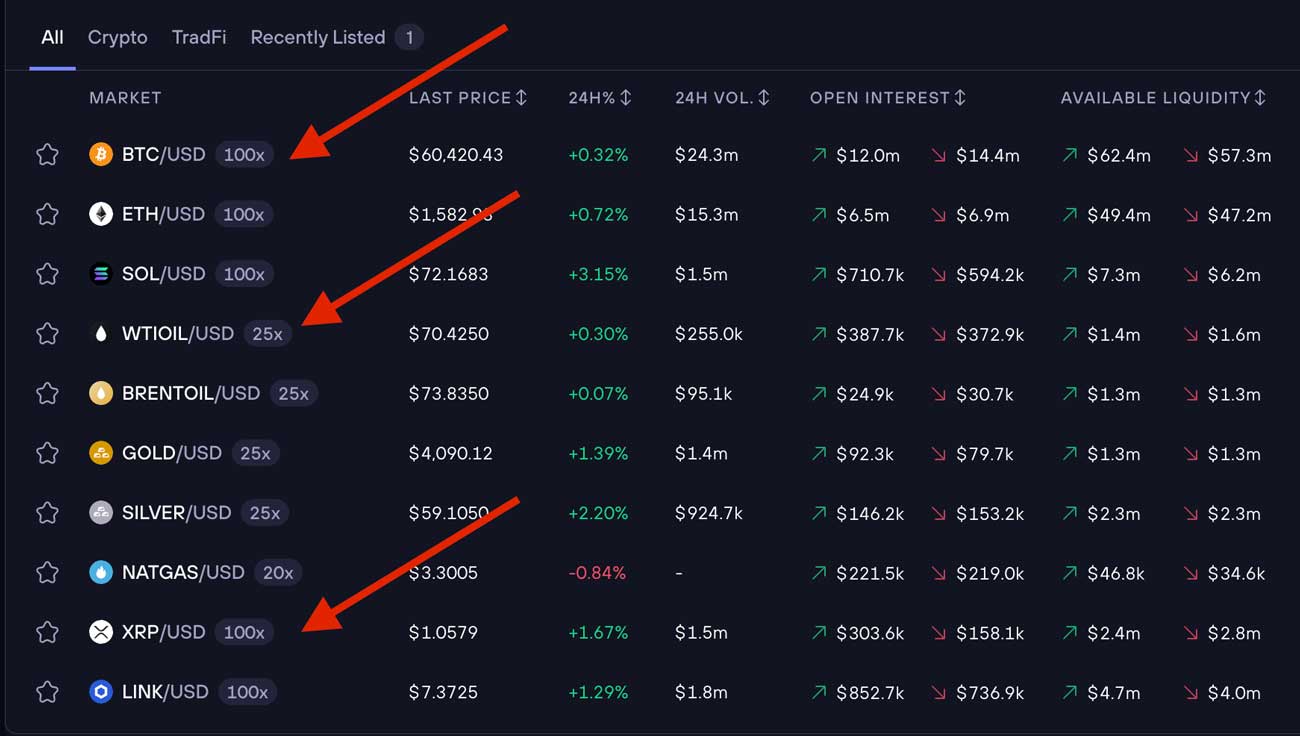
GMX is a decentralized exchange launched in 2021 on the Arbitrum and Avalanche blockchains. It supports both spot and perpetual futures trading. GMX offers up to 100x leverage on major markets such as BTC, ETH, and SOL. Leverage limits vary by asset, with precious metals like Gold and Silver supporting up to 25x leverage, while other cryptocurrencies typically range between 25x and 100x leverage depending on the market.
For beginners, understanding the trading interface might take a while. From the moment we connected our MetaMask wallet, we could see that the exchange is built for active traders. Even though it has some solid features, using GMX is easy to use when you understand terms like slippage, wrapped assets, price impacts, and other technical features you’ll have to deal with before you can execute a single trade.
Unlike popular exchanges like Hyperliquid, where you can only trade after depositing funds, on GMX we completed a $20 AVAX/USD trade directly in our wallet without moving assets around or depositing it into the exchange. Note that aside from the trading fee, a $0.21 network fee was also applied.
Wallet trading reduces the smart-contract risk that traders face on other exchanges. But it requires practical knowledge of wallet management, which is another challenge new traders may encounter on the exchange. GMX supports over 570 decentralized wallets, so you can easily find compatible options aside from MetaMask.
Need a simple alternative to GMX? Try futures trading on Apex Omni.
Why You Should Choose GMX
If you have good crypto trading experience, here are some of the reasons you may want to use this exchange:
No-KYC Crypto Trading: GMX is one of the best no-KYC crypto exchanges with no KYC verification or withdrawal limit.
Direct wallet trading: Instead of depositing funds into the exchange, GMX allows traders to open futures trading positions directly in their wallet. This removes the need to bridge assets or any hidden fees, but trading fees and network fees still apply.
Multi-Asset Collateral: When interacting with a trading pair, BTC-USDC, you can decide to use any of the two assets as collateral.
Multi-Chain Support: GMX supports 8 blockchains: Arbitrum, Avalanche, Ethereum, Base, BNB, Solana, MegaETH, and Botanix. Note that blockchain availability depends on your trading mode. For instance, if you deposit assets into the exchange after connecting your wallet, you can only execute trades on Arbitrum, Base, BNB, and Ethereum.
TradFi Asset Exposure: GMX also provides access to a limited set of Real-World Assets. These include stocks and commodities. Currently, you can trade only 7 TradFi assets.
Passive Income: The exchange is also a good fit for passive income seekers because it maintains liquidity pools per asset. This means users can provide liquidity by adding assets into various liquidity pools to earn yield.
Governance rights: Staking $GMX, the exchange’s native token, gives you governance rights, which allow you to support or vote against any proposal on how to manage or improve the exchange.
Start trading on GMX for a 5% fee discount on all trades.
Comparing GMX to Centralized Exchanges
|
Features |
GMX |
CEXs (Bybit, Binance and MEXC) |
|
Custody |
Self-custody |
Exchanges maintain custody |
|
KYC Verification |
Not required |
Required |
|
Trade Execution |
Liquidity pools |
Orderbook |
|
Trading fees |
Higher than most CEXs |
Higher than most DEXs |
|
Trading pairs |
100+ |
1000+ |
|
Slippage rate |
Medium (Transparwantly shown) |
Low slippage (Depending on your order size) |
|
Demo trading |
Not available |
Available |
|
Copy trading |
Not available |
Available |
|
Passive income |
Staking and liquidity pools |
Staking, launchpool, airdrops, in-exchange bonuses |
|
Bot trading |
Available |
Available |
Note: Slippage is not unique to GMX. It can occur on any exchange, especially during low liquidity or when placing large orders. The size of your order relative to market liquidity is the biggest factor affecting slippage.
Who Should Use GMX?
GMX is ideal for
- Experienced futures traders
- Traders who prefer no-KYC crypto trading and self-custody
- Users with a good understanding of gas fees
- Liquidity providers looking for passive income
GMX may not be ideal for:
- Complete beginners
- High-frequency traders
- Traders seeking lower fees or copytrading
GMX Step-by-Step Guide for Beginners
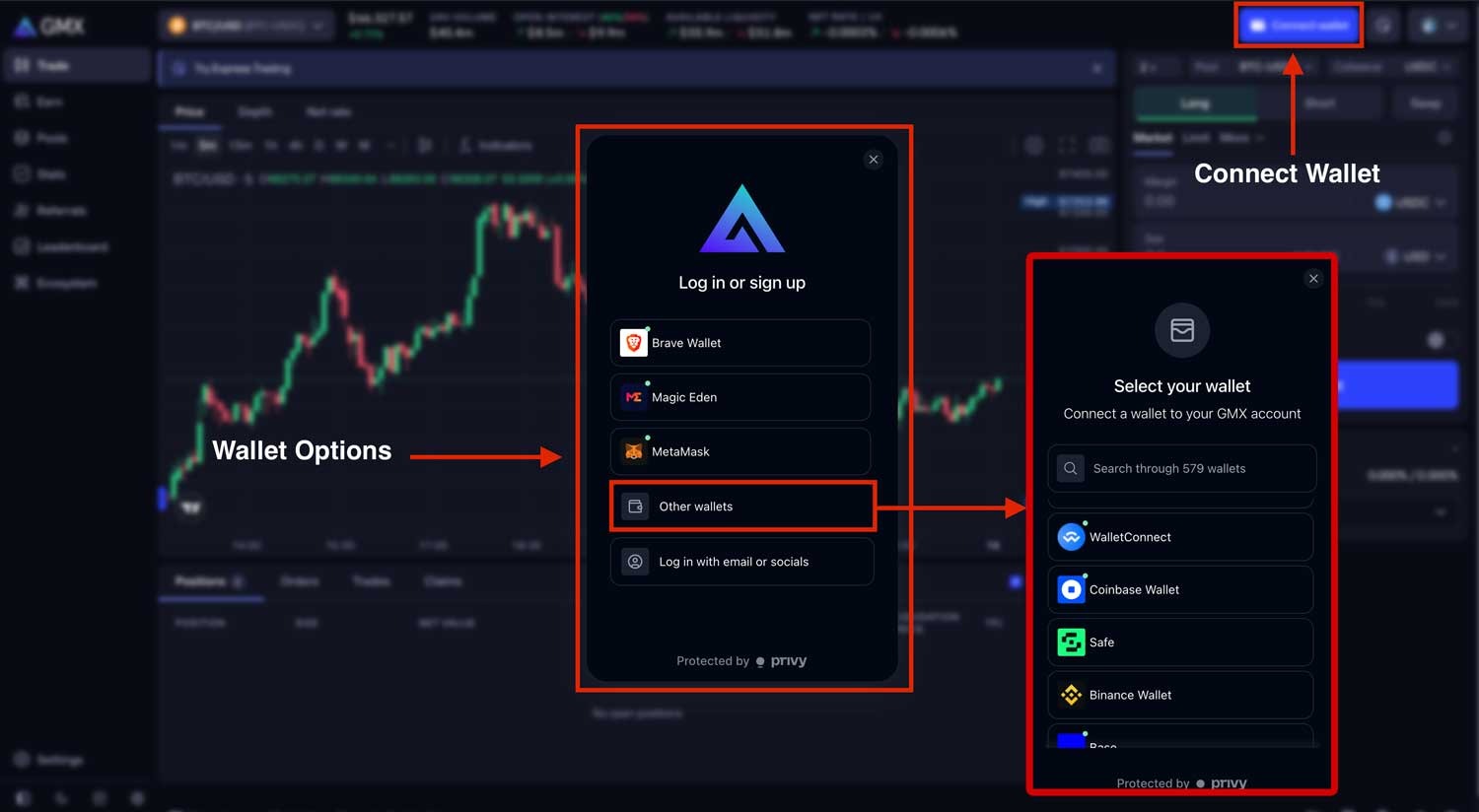
How To Connect Wallet To GMX Exchange
Step 1: Visit the official GMX website
Step 2: On the main interface, click on ‘Connect’
Step 3: In the pop-up option, select ‘MetaMask’ or any web3 wallet of your choice
Step 4: This will automatically open your wallet app where you can authorize the connection.
Step 5: Now that your wallet is connected, you should see your wallet address in the top right corner of the interface.
Note: To keep your wallet safe, always confirm that you are connecting to the right website.
How To Deposit Funds on GMX Exchange
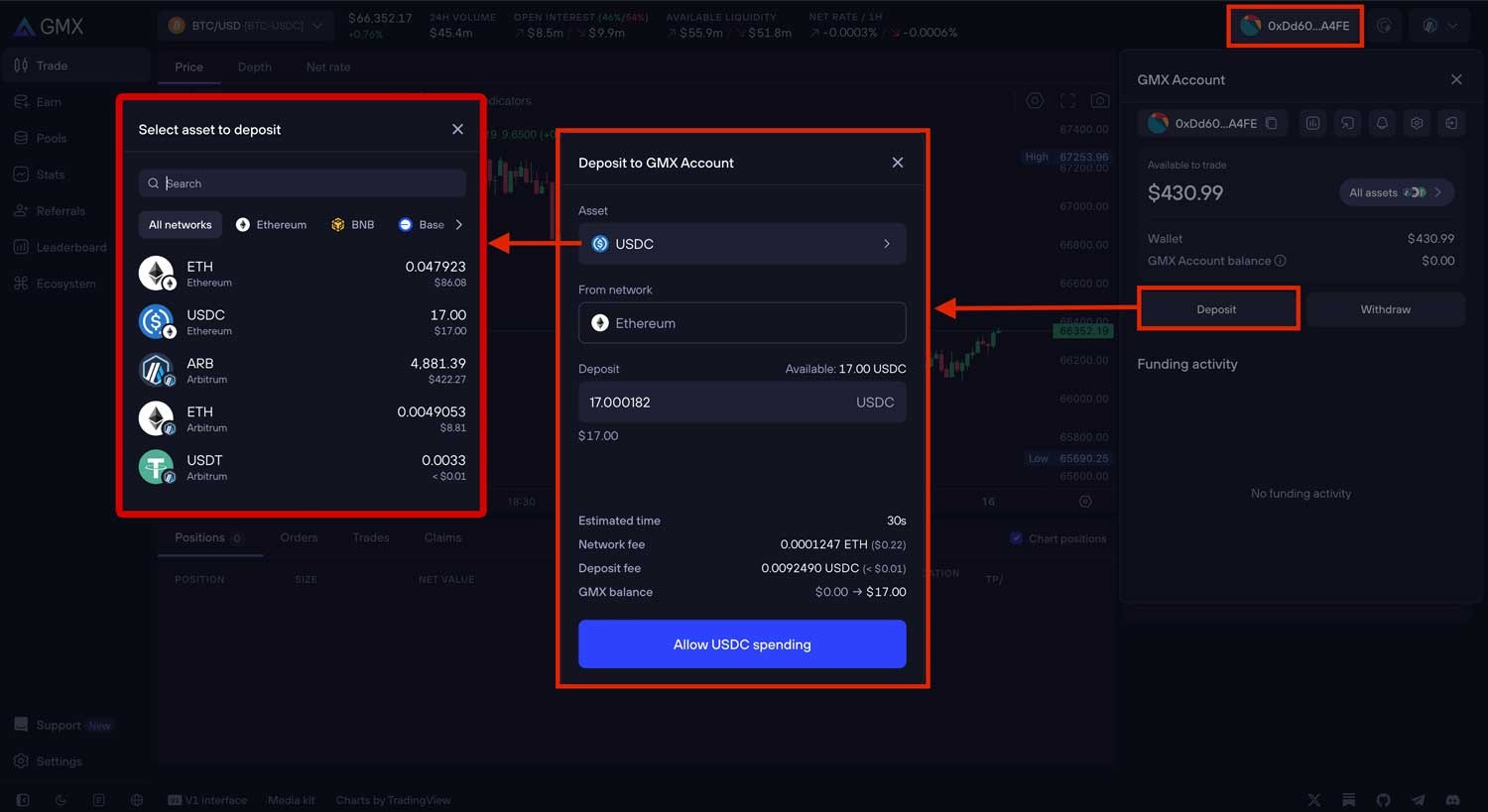
To deposit assets, always ensure that you have the network native token to cover the gas fee. To send USDC on the Ethereum blockchain, keep enough ETH in your wallet.
Step 1: Click on your wallet address in the top right corner
Step 2: In the drop-down, click on ‘Deposit’
Step 3: Select any of the supported assets to deposit and the network
Step 4: Insert the amount you want to deposit, eg, 100 USDC
Step 5: Now click on ‘Allow USDC Spending’ to complete
Note: GMX applies a network and deposit fee.
How to Trade Futures on GMX Exchange
Execute your first futures trades on GMX following these steps:
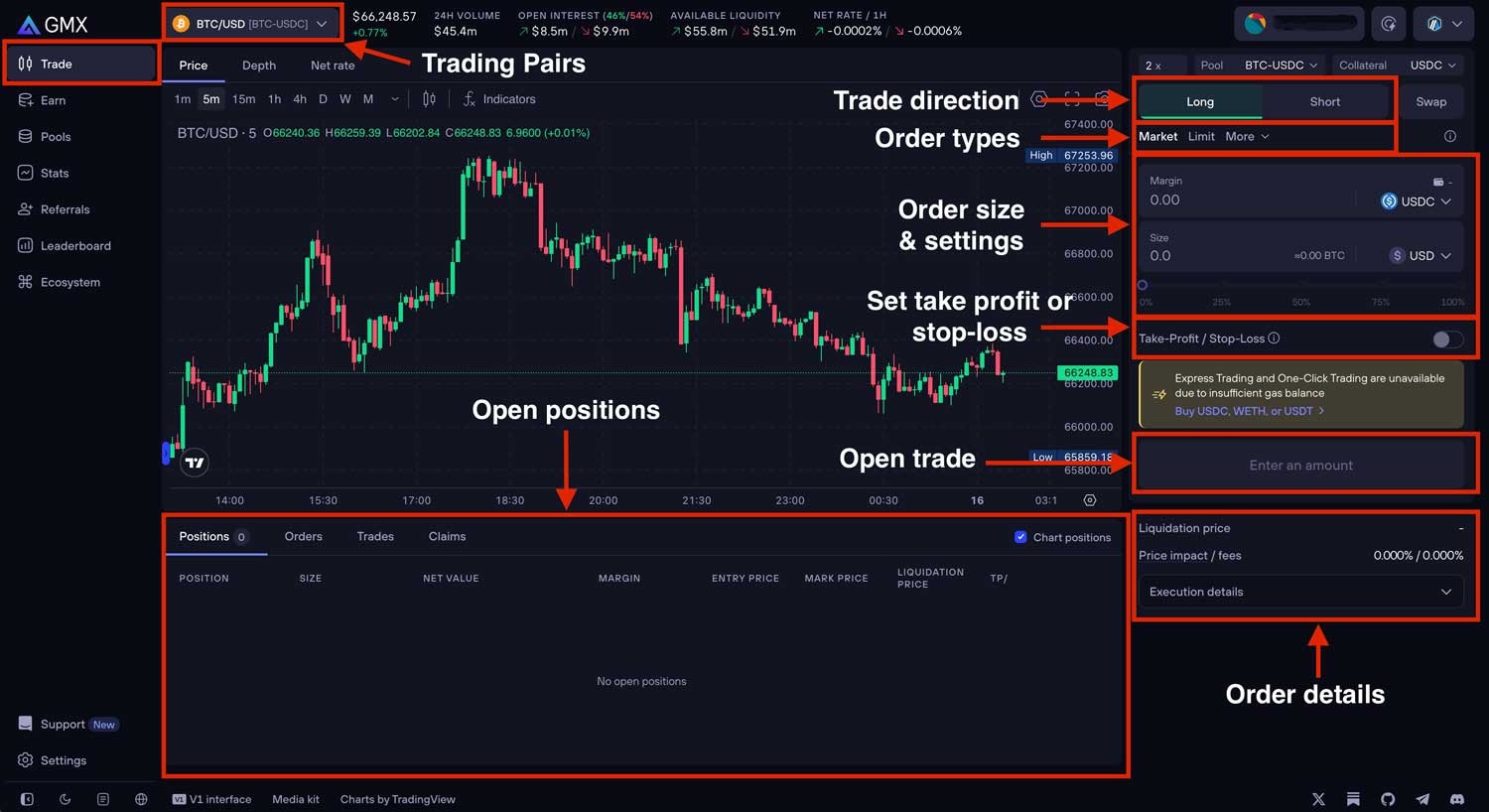
Step 1: On the main interface, click on ‘Trade ’ to go to the perp trading dashboard.
Step 2: On the trading dashboard, select your preferred trading pair. Eg, BTC/USDC
Step 3: Select either ‘Long or Short’
Step 4: Select an order type (Limit or Market order) and set the leverage level
Step 5: Enter the amount you want to trade with as Margin. The exchange calculates your position size based on the leverage level you selected. Using $100 USDC margin and 10x leverage gives you a $1000 position size (100 x10 = 1000)
Step 5: Set your take profit and stop loss
Step 6: Review details and execute the trade
Your trading position will be displayed right under the chart in the ‘Open Position’ section, where you can increase or decrease your margin.
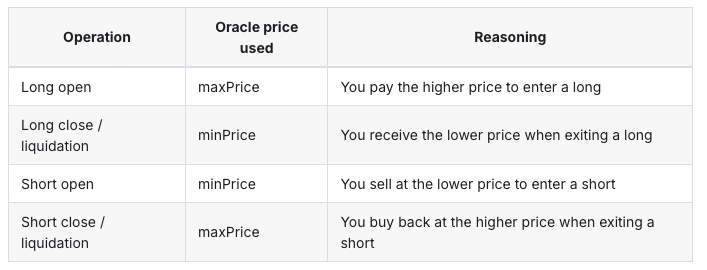
Note: GMX executes orders using the min price or max price, not the actual market price at the time of trading
How to Withdraw Assets on GMX
Step 1: Make sure that your wallet is connected, then click on your ‘wallet address’ displayed in the top right corner
Step 2: Select the token to withdraw
Step 3: Select the network you want to receive the asset
Step 4: Enter the withdrawal amount to complete
Step 5: Click ‘Withdraw’
GMX Trading Fee Explained
- Trading fees: 0.04% / 0.06%
GMX does not apply the usual maker and taker fee structure because the exchange does not maintain an orderbook. Therefore, the trading fee is calculated based on how your order contributes to the exchange's open interest.
The exchange applies:
- 0.04% - when your trade reduces the difference between long and short open interest
- 0.06% - When your trade increases the difference between long and short open interest
While the base trading fee is between 0.04% / 0.06%, additional execution costs can significantly increase the final amount paid. During our testing, we found that trading costs on GMX can increase quickly once slippage, trading fees, network fees, and price impact are factored in. For a $100 USDC trade, the total cost was close to $2 (about 2% of the position) with a 1% slippage rate.
GMX Swap Fees: You can complete single token swaps for free. However, when swapping regular cryptocurrencies and stablecoins on GMX, a swapping fee applies.
|
Swap Type |
Fee |
Impact on liquidity pool |
|
Standard |
0.05% |
Swap decreases the imbalance between the long and short token pools |
|
Standard |
0.07% |
Swap increases the imbalance between the long and short token pools |
|
Stablecoin (Arbitrum) |
0.005% |
Swap decreases the imbalance between the long and short token pools |
|
Stablecoin (Arbitrum) |
0.02% |
Swap increases the imbalance between the long and short token pools |
|
Stablecoin (Avalanche) |
0.01% |
For all swaps |
On futures trades, GMX applies funding fees. This fee is paid to traders to maintain their trading positions and ensure that the price of futures contracts is close to the spot market price. See how funding fees are calculated on other centralized and decentralized exchanges.
Check out the GMX Fees doc to read more on GMX trading fees.
How To Reduce Trading Fees on GMX
There is no particular way to reduce trading fees on GMX because it only applies the lower trading fee when your order improves the imbalance between short and long open interest. This does not benefit traders in most cases, because you may want to take long positions based on your analysis of crypto trading indicators, even when long open interest exceeds short open interest.
However, you get a 5% discount on all trading fees when you start trading on GMX without our link.
Is GMX Safe? Security Measures for DEXs
GMX combines smart contract review, independent audit, and bug bounty programs to reduce system attacks. By using reputable security firms, GMX conducts routine smart contract checks and even publishes the report publicly, making it easier for users and traders to review the GMX system audit reports and understand the ecosystem's strength.
Keep in mind that these measures increase system security and mitigate risks, but they do not eliminate the risk of attack. As a decentralized exchange, GMX still relies on smart contracts to automate transactions. Smart contracts are vulnerable to bugs, which can lead to attacks on the system.
Trading on GMX also requires good knowledge of wallet security. As a trader, you must learn this to keep your funds safe.
Protect your wallet against phishing attacks: Common tactics include connecting your wallet to the wrong website, chasing unverified airdrops, signing unverified transactions, or interacting with the wrong interface.
Solution: Always verify the exchange link and transaction details. To increase security, use two different wallets for trading and asset storage. For instance, you can use a hot wallet like MetaMask for trading and store most of your assets in a cold wallet like Trezor.
Protect wallet security details: A decentralized wallet includes three security details: seed phrases, private key, and public key. The public key can be shared with others, but seed phrases and your private key grant access to your funds. Sharing that with anyone allows them to transfer your funds without your permission.
Solution: After creating a wallet, do not store seed phrases and private keys electronically on your phone, PC, or email draft. Instead, write it out in a book or journal and store it securely.
Add an extra layer of security with 2FA tips, like locking your wallet with a password, to ensure that not everyone who can access your phone or PC can access your wallet app or browser extension.
How to earn Passive income on GMX
You can earn passive income on GMX by staking or joining a liquidity pool.
Staking $GMX token: $GMX is the exchange’s native token, and staking it gives you access to staking power (staking duration + staking amount) and governance power. Access to staking rewards is currently on hold.
The reward will be distributed when the $GMX price reaches $90. For now, your reward accumulates continuously based on your staking power.
One thing to note is that unstaking more than 20% of your staked assets will reset your staking power to zero. This means you do not qualify to receive rewards for your past staking history.
To learn more about staking conditions and rewards, review the $GMX tokenomics.
Joining Liquidity Pool: GMX has several liquidity pools because it relies on them to facilitate trading. By adding your assets to a liquidity pool, you qualify to earn fees from leveraged trading, swaps, spreads, and other market-making activities on the exchange.
The liquidity pools are broadly divided into two: GLV (GMX Liquidity Vault) and GM. With GLV, you are providing liquidity into multiple pools with the same asset, while GM allows you to contribute to a single pool.
How to Join Liquidity Pools on GMX
Joining a pool requires you to buy the pool token. Follow the steps below to buy GLV or GM.
Step 1: Click on ‘Earn’ on the dashboard.
Step 2: On the page, click on ‘Buy GLV or Buy GM’. This takes you to the liquidity pool page.
Step 3: Click on any of the pools. Ensure you hold the required token. For instance, the AVAX/USD pool requires the $AVAX token to join.
Step 4: On the interface, insert the amount you want to use to buy the token.
Step 5: The exchange calculates the amount of the pool token you receive.
Step 6: Verify the details before executing the transaction.
GMX Promotion and Referral Link
GMX allows traders to create referral links via its affiliate program. With that, you can earn up to 15% commission on trading fees. Commissions are claimable rewards that can be swapped to different assets after being claimed. The rewards are in different tiers.
As a trader, using an affiliate link to interact with GMX for the first time gives you a 5% discount on trading fees on all orders.
Comparing GMX To Other DEXs
|
Features |
GMX |
Apex Omni |
Hyperliquid |
|
Multi-chain support |
Yes |
Yes |
Yes |
|
KYC Verification |
Not required |
Not required |
Not required |
|
Trading pair |
100+ |
130+ |
247+ |
|
Trading fees |
0.04 - 0.06 (trading) 0.005 - 0.05 (swapping) |
0.02% - maker fee 0.05% - taker fee |
0.015% - maker fee 0.045% - taker fee |
|
Trading fee discount |
Affiliate link - 5% |
Affiliate link - 5% VIP tier - up to 50% |
Affiliate link - 5% VIP tier - up to 50% |
|
Liquidity depth |
Low - Moderate |
High |
High |
|
Leverage |
85x |
100x |
40x |
|
Copy trading |
Not available |
Available |
Available |
|
Settlement type |
Liquidity pools |
Orderbook |
Orderbook |
|
Gas fee |
|
|
|
|
Margin / Collateral |
Multi-asset |
USDC |
USDC & USDT |
|
On-chain privacy |
Low |
Low |
High |
Want to know which of these DEXs is suitable for your trading? Check out our article on the best decentralized exchanges in 2026.
Pros and Cons of GMX
Pros
Advanced features: With direct wallet trading, exchange account trading, and detailed transaction details, GMX works well for experienced traders.
On-chain transparency: Traders' trading positions, sizes, and profit-and-loss histories are publicly available on the leaderboard, where anyone can review or replicate them.
Suitable for passive income seekers: GMX still offers passive income mechanisms like staking and liquidity provision for traders seeking passive income rather than active trading.
Flexible Access to Funds: Users can unstake or withdraw all staked assets and liquidity provided without delay. The exchange does not lock your token or restrict access to them.
Automated trading options: For in-wallet trading, you can enable one-click trading to automate up to 10 trades without a wallet signing popup for each trade
Cons
Higher fees: GMX trading fees and swapping fees are higher than the base maker fee of 0.02% you have on other exchanges.
High price impact: Slippage is high, and the exchange applies network fees and deposit fees, which can significantly increase the final execution price for assets.
Complex Interface: The trading interface and mechanics require good technical knowledge to handle.
No access to staking rewards: Currently, staking rewards are withheld until $GMX reaches $90, and it is possible to lose out on the reward if you unstake assets at any point. For context, $GMX is currently at $5.55. Reaching $90 will require traders to hold their staking positions for an extended period.
Conclusion
A key limitation of GMX is the high trading cost. For high-volume traders, slippage, trading fees, and network costs can take a big chunk of your profits or trading capital, especially during volatile periods. Also, GMX relies on liquidity pools for trade execution, so you want to constantly check the liquidity depth under ‘Pools’ per asset to determine execution speed.
While DEXs are shifting towards lower fees and faster execution, GMX is focused on providing traders with useful trading tools and a robust passive income structure that serves both active traders and passive income seekers.
Frequently Asked Questions
What is GMX?
GMX is one of the popular no-KYC decentralized exchanges for futures trading. GMX allows traders to execute trades with leverage from their wallets or by depositing assets into the exchange
How does leverage work on GMX?
Leverage lets you open larger positions with less capital. On GMX, you can use up to 85x leverage. Note that higher leverage increases the risk of liquidation.
How can you earn on GMX without trading?
You can provide liquidity through GMX’s liquidity pools and earn a share of trading fees and market activity. Also, you can stake $GMX tokens on the exchange to qualify for staking rewards during distribution.