Trade Stocks, Gold & Oil with Crypto
Cryptocurrency markets have become the modern-day evolution of traditional stock trading. Penny stocks are quite similar to the nowadays Alt-coins. While crypto offers exciting opportunities, many traders still seek exposure to more established markets like stocks, commodities, and gold, which typically come with lower volatility.
According to a report by CoinGecko, TradFi perpetual volume hit $1.45 trillion in the first half of 2026, with exchanges like Binance, Bitget, and Hyperliquid providing access to traditional asset trading with crypto.
The good news? You can also trade these traditional assets using crypto like USDT, without the hassle of converting to fiat or dealing with banks.
In this article, we’ll show you exactly where you can trade stocks and commodities using crypto, and break down which platforms require KYC and which ones don’t, so you can choose the best option based on your location and privacy preferences.
This article covers centralized exchanges that support TradFi assets. If I’m completely new to trading, these are the exchanges I’ll opt for because they are simple to use and usually have little to no compliance issues.
For those who prefer trading on some of the best decentralized exchanges, check out our article on trading TradFi assets on DEXs without KYC.
Bitget TradFi
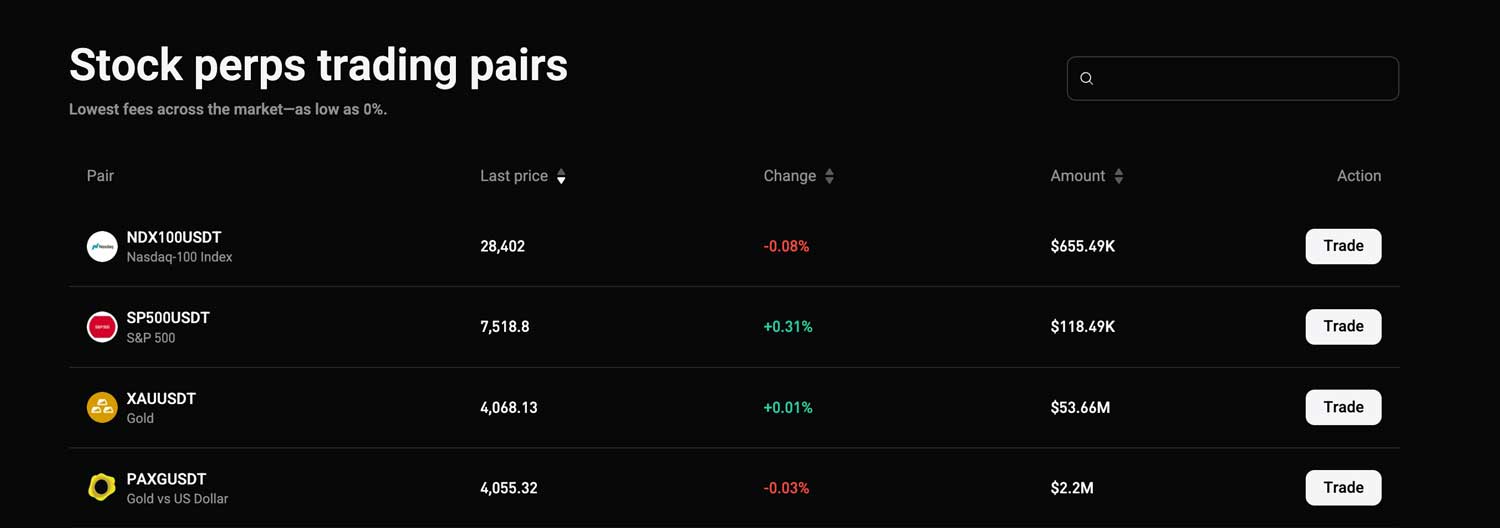
Bitget is another well-known exchange that supports on-chain trading of TradFi assets through its Universal Exchange (UEX) and rTokens. The purpose of the UEX is to provide traders with an all-in-one trading experience. With one account, you can trade Stocks, ETFs, Commodities, pre-IPO, Indices, and Forex.
Bitget has a wide TradFi market, and trades are settled in USDT or USDC.
The Bitget app provides a more seamless experience, but you may find trading a little confusing on your PC at first because the exchange opens separate tabs for each trade, rather than allowing users to switch between features on a single interface.
To get started, you need to click on on-chain under ‘Trade’ on the main Bitget interface. This opens a new tab for on-chain trading where you have the different options.
On Bitget, you can access TradFi assets through spot, futures, and Contract for Difference (CFD) trading. This is very similar to how you trade crypto, as it does not restrict users to perpetual futures only. The CFDs allow users to open long or short positions with up to 500x leverage. This option lets you speculate on the price movement of the underlying asset without owning it.
Stock spot trading means that you can actually hold the assets. But do not mistake that for holding the real assets. Stocks and ETFs on Bitget represent the underlying assets. For example, rTSLA has TSLA (Tesla) stock as its underlying asset.
Also, Bitget TradFi is connected to Nasdaq and NYSE liquidity. So, high-volume orders tend to have low slippage, and traders receive dividends on stock positions in USDT. Note that withholding tax applies depending on your location.
Traders can use tokenized assets as part of their trading balance. For instance, if you are holding rTSLA on the exchange, you can pledge the position on Bitget as collateral to open other positions.
You don’t need to convert or sell your stocks, but liquidation affects the value of your asset when the trade closes.
Bitget is suitable for:
- Traders with limited capital. Your stock position counts toward account liquidity.
- High-volume traders seeking deep liquidity and low slippage.
- Traders interested in a wide TradFi market. Bitget has over 500 TradFi assets.
- Futures traders seeking high leverage. Bitget offers up to 500x leverage.
Binance TradFi
Unlike other crypto exchanges, Binance offers a straightforward trading experience by blending TradFi assets with crypto assets. Bybit gives a separate TradFi account, and Bitget offers a different interface for each TradFi category.
You don’t need any of these to interact with TradFi assets on Binance. You can find them under ‘Futures’ or interact with stocks and ETFs once you get to the ‘Trade’ section.
The exchange supports stocks, gold, crude oil, pre-IPO, commodities, and ETFs
Traders receive dividends on their stock positions, making this similar to holding stocks on a regular brokerage platform. This is possible because Binance stocks are supported by a real brokerage. Stocks offer 1:1 backing against the underlying stock but do not provide additional shareholding rights.
There is no additional processing fee for dividends, but withholding tax applies. This varies by location. For US residents, withholding tax is charged at 30%
Another feature worth noting is that Binance TradFi's fee structure is transparent and clear. On the page, you can find full details on platform, regulatory, and other applicable fees.
Trades are settled in USD, but the exchange supports multiple margins.
You can buy stocks with USDC, USDT, BNB, or USD1 without manually converting the asset. These assets are charged directly from your account and automatically converted to USD at zero fee.
Also, you do not need to constantly move assets around, as the exchange can charge directly from any of your accounts, including your spot, funding, or earn account.
Consider Binance for TradFi if you are in this category:
- Traders seeking fractionalized ownership of stocks. You can buy assets with low capital
- Beginners looking for simplified access to TradFi assets. Binance offers a simple experience.
- High-volume traders looking for lower fees and dividends on stocks. Binance is a leading exchange with high trading volume, a large user base, and 0% maker fee on TradFi perps
- Traders looking to automate stock buying as part of a DCA strategy. Binance currently supports automated stock trading.
Binance requires verification, and it is not available in some countries. Always check the Binance restricted countries list before trading. For US traders, read our article on how to use Binance in the US.
Bybit: Global Stock Trading with USDT
Bybit, one of the largest crypto exchanges, now also lets you trade stocks like Apple and Tesla, popular commodities like gold and oil, and even forex pairs. This marks a major shift, opening the door to a whole new audience of traders who want exposure to traditional markets without leaving the crypto ecosystem. It combines the crypto space and traditional finance (TradFi) on a single platform.
Bybit now gives you access to a wide range of traditional markets, including:
- Stocks (Apple (AAPL), Tesla (TSLA), Amazon (AMZN), Nvidia (NVDA), Meta (META), and more)
- Commodities like Gold, Oil, and Silver
- Forex pairs like EUR/USD
- Indices like the S&P 500 and NASDAQ
All of this is available via CFD trading (Contracts for Difference), which means you're speculating on price movements, not owning the actual asset. It works similarly to USDT perpetual contracts, so if you're already familiar with crypto trading, the experience will feel very familiar. The contracts are settled in USDT.
Bybit offers mainly perpetual trading for TradFi assets. Traders can use up to 100x leverage on metals and other assets, but leverage is limited to 5x on stocks.
Trading volume for TradFi assets is gradually increasing, and Bybit has an ongoing prediction and trade challenge where users predict the top-gaining stocks to earn part of the $1M prize
Verification
While you don’t need to make a bank transfer to start trading, Bybit does require all users to complete a KYC (Know Your Customer) verification process.
This means the platform may not be available in your country if you live in a restricted region. Luckily, there are some alternatives if you’re living in a restricted country.
We recommend Bybit for:
- Traders interested in a broad commodity market. You can trade oil, coffee, cocoa, and other commodities on Bybit.
- New traders looking for low to moderate leverage. Bybit offers up to 5x leverage on stocks.
- Traders in countries where Binance or Bitget are restricted. These include the Netherlands, Germany, France, and more
BTCC Exchange
BTCC Exchange is one of the few centralized exchanges where ID verification is not compulsory. You can still trade in traditional markets using crypto without submitting any documents.
It's growing in popularity and can be a great option for investors looking to diversify, spreading their positions across both crypto and traditional finance (TradFi) markets, all without needing identity verification.
BTCC Exchange offers tokenized futures on traditional assets, allowing users to trade contracts linked to commodities like gold and silver, as well as stocks of major companies such as Apple, Google, Tesla, Meta, and Nvidia.
It works similarly to Bybit: the contracts are settled in USDT. If you're an experienced crypto trader familiar with perpetual contracts, it's essentially the same concept.
Besides centralized exchanges, some DEXs also allow you to trade traditional markets like the S&P 500, gold, and oil using crypto.
Best for:
- Traders looking for no-KYC TradFi trading. Users can trade on BTCC without ID verification.
- Traders seeking low taker fees and a moderately high leverage for a TradFi experience.
- Traders interested in popular TradFi assets. BTCC has a limited number of trading pairs, but it currently allows users to trade oil, gold, 3 forex pairs, and a few stocks.
Start trading gold, oil, and other TradFi assets on BTCC
Crypto exchanges with MT5
MetaTrader 5 (MT5) is a professional trading platform used by many experienced traders. It offers more control, faster execution, and extra tools for analyzing the market. With MT5, you can trade crypto, stocks, gold, and forex from one platform.
Bitget, Bybit, and BTCC support MT5. Binance doesn’t, but it can be connected via a third-party bridge.
Is TradFi perps the same as Crypto Perps?
TradFi perpetual futures trading is similar to crypto perps, but they are not exactly the same. Crypto perps currently have deeper liquidity and higher trading volume. That aside, TradFi perps means you are interacting with the price movement of traditional assets like gold, while crypto perps means you are trading regular crypto assets.
Futures trading in both assets involves opening long and short positions, so it is recommended that you learn how to predict price movements using trading indicators.
Quick Features of TradFi Trading on Binance, Bitget, Bybit, and BTCC
|
Exchange |
Binance |
Bitget |
Bybit |
BTCC |
|
KYC |
Yes |
Yes |
Yes |
no-KYC |
|
Leverage |
100x |
500x |
100x |
50x |
|
Liquidity |
High liquidity |
High liquidity |
High liquidity |
Low liquidity |
|
Fiat deposit |
Yes |
Yes |
Yes |
Yes (But need KYC verification) |
|
Fees (Perps) (Maker/Taker) |
0% / 0.04% |
0.02% / 0.06% |
0.01%/0.06% |
0.025%/0.045% |
|
Trading pairs |
150+ |
500+ |
300+ |
30+ |
|
Margin |
USDT, USDC, BNB, U, USD1 |
USDT, USDC |
USDT |
USDT |
Conclusion
If you live in a supported country and can verify your identity, Bitget offers a wide tradfi market with obvious benefits like dividends and deep liquidity. Bybit comes next for traders in countries that are not supported by these two exchanges.
Bybit holds a MiCA license, so it is available in several countries where Binance is not. You can trade over 300 TradFi assets, including stocks, gold, and forex, with a low maker fee.
But if you can’t pass KYC or live in a restricted country, BTCC is a great alternative. It lets you trade many of the same markets without needing to upload any documents. Decentralized exchanges offer a secure, seamless platform for trading TradFi assets without KYC.
Budget, Bybit, and BTCC support MT5 and provide access to similar traditional finance markets. So whether you prefer a top-tier exchange or a no-KYC option, you now have solid platforms for trading traditional assets with crypto.
Start trading traditional markets with crypto today. Sign up on Bybit to claim up to $30’000 in deposit bonuses, or try BTCC for no-KYC access and a 10% Deposit Bonus. To earn more rewards, it is worth exploring the best crypto exchanges with deposit bonuses.
FAQ
Can I trade Nvidia stock with crypto?
Yes, you can trade Nvidia (NVDA) using crypto on platforms like Bitget. Bitget offers stock trading through its Gold & FX suite, where you can use USDT to trade major tech stocks including Nvidia, Apple, Tesla, and more.
Where can I trade stocks like Apple and Tesla with Bitcoin or USDT?
You can trade stocks like Apple (AAPL) and Tesla (TSLA) using Bitcoin or USDT on crypto exchanges such as Bybit and BTCC. These platforms offer crypto-settled contracts for popular stocks, making it easy to access traditional markets with your crypto balance.
Can I trade gold or oil without KYC using crypto?
Yes, BTCC allows you to trade gold and oil using USDT or BTC without requiring KYC. It's a no-verification platform that supports commodities and indices through crypto-based contracts.
Which crypto exchange lets you trade stocks without a bank account?
Both Bybit and BTCC let you trade stocks without needing a bank account. You can fund your account with crypto like USDT and start trading directly, with Bybit requiring KYC and BTCC allowing no-KYC access.
Where can I DCA stocks for a long-term investment?
Aside from traditional platforms like Robinhood, crypto exchanges like Bitget and Binance also allow you to buy and hold stocks (spot trading), similar to crypto spot trading. You can use Binance bStock automated trading to regularly buy a specific amount of stock. You qualify for rewards when your volume surpasses 300 USDT.
Are stocks on crypto exchanges real?
Stocks on crypto exchanges like Binance are not the same as stocks on brokerage platforms. Some exchanges claimed that the stocks are backed by real assets, especially the spot version, so users get dividends, but they do not hold voting power or the right to attend meetings. If you are trading stocks via futures, you do not own the underlying stock; you are only predicting changes in its price.